
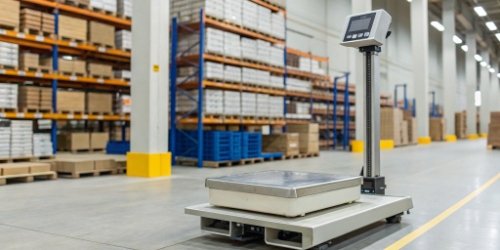
Struggling with inaccurate raw material tracking? These errors create inventory chaos and production mistakes. A label printing scale integrates weighing and labeling, solving this from the start.
Yes, a label printing scale is a powerful tool for this. It combines precise weighing, data capture, and label printing into one seamless step. This ensures every raw material is accurately recorded and clearly identified from the moment it enters your facility, improving inventory management.

I've seen many businesses face challenges at their receiving docks. A small mistake in recording the weight of incoming materials can cause big problems later on. It’s a common pain point that affects everything from production planning1 to final product quality. The good news is that there’s a straightforward solution. By integrating the right technology at this first step, you can build a foundation of accurate data that serves your entire operation. This is where a simple but effective tool comes into play. Let's look at how this technology works and how it can help you.
How Do Label Printing Scales Assist in Tracking Raw Material Intake?
Manually recording the weight of incoming goods is slow and full of errors. These mistakes can throw off your entire inventory system and disrupt your production plans. Our scales automate this process.
They work by weighing incoming materials and immediately printing a label. This label includes the exact weight, supplier information, date, and a unique barcode. The data is sent directly to your ERP or inventory system, removing manual entry and ensuring accurate tracking from the beginning.

When a shipment of raw materials arrives, the first step is to verify what you received. A label printing scale2 makes this step simple and accurate. An operator places a container on the scale. The scale captures the exact weight. Then, it instantly prints a label with all the key information. This process is crucial because it creates a digital record right at the source. The data from our scales can be sent directly to your company's ERP system3. This means no one has to write down numbers and type them into a computer later. This connection eliminates human error and gives managers real-time visibility4 into what has just arrived.
Here’s a breakdown of the key data capture5d:
| Data Point | Purpose |
|---|---|
| Exact Weight | For accurate inventory and production costing. |
| Date/Time Stamp | For tracking shelf life and FIFO/LIFO systems6. |
| Supplier Info | For quality control7 and supplier management. |
| Unique Barcode/ID | For easy scanning and tracking throughout production. |
This automated data capture8 is the first step toward a more controlled and efficient warehouse.
Can Label Printing Scales Improve the Efficiency of Material Labeling Processes?
Is your team wasting time weighing items, then walking somewhere else to print and apply labels? This multi-step process is slow and creates many delays. Our scales combine these tasks into one efficient action.
Of course. They merge two separate tasks—weighing and labeling—into a single, quick operation. An operator places the material on the scale, and a professional label with weight and other data is printed on the spot. This greatly reduces handling time and boosts workflow efficiency.

I often see facilities where labeling is a clear bottleneck. An employee weighs a box, jots the weight on a piece of paper, walks to an office, types the info into a PC, prints a label, and walks back to stick it on the box. This is a lot of wasted motion and time. A label printing scale changes this entire workflow. The scale, printer, and terminal are all in one place. The process becomes simple: place, weigh, and label. This happens in seconds, right at the receiving station. This consolidation of tasks not only speeds things up but also frees up your employees to work on more valuable activities. As a software vendor, integrating with hardware that provides such clear efficiency gains is a strong selling point for your own customers.
| Traditional Process | Integrated Process with Label Scale |
|---|---|
| 1. Place item on scale. | 1. Place item on scale. |
| 2. Write down the weight. | 2. A label prints automatically. |
| 3. Walk to a computer. | 3. Apply the label. |
| 4. Enter data to print a label. | |
| 5. Walk back to the item. | |
| 6. Apply the label. |
This simple change can save a surprising amount of time and money.
How Are Label Printing Scales Utilized in Managing Inventory and Raw Materials?
Do you lack a real-time view of your raw material stock levels? This often leads to unexpected shortages or expensive overstocking. Labeled materials, tracked by our scales, provide a live, accurate inventory picture.
They are used to create a data-rich label for every raw material unit. When this barcoded label is scanned, it automatically updates your inventory system in real time. This allows for precise tracking of stock levels, monitoring material use, and automating reorder points.

The label created by the scale is more than just a sticker. It's the key to modern inventory management. Each label has a unique barcode or QR code. This code links the physical item to its digital record in your system. When a worker moves that material from the warehouse to the production line, they just scan the barcode. The inventory system9 is instantly updated to show that the material has been used. This provides complete traceability10. Imagine you have a quality issue with a final product. With this system, you can scan the product's batch code and trace it back to the exact batch of raw material used, including when it arrived and who supplied it. This is possible because we can connect our scales to your ERP system. This connection ensures all data is centralized and available for management and decision-making.
What Role Do Label Scales Play in Streamlining Raw Material Management?
Is your current raw material management process broken and inefficient? Disconnected steps cause delays, errors, and a lack of clear data for making smart decisions. Label scales act as the central data point, unifying your entire process.
Label scales play a key role by being the main data capture tool. They create a single, correct source of information for weight and identity at the point of entry. This standardized, accurate data flows into other systems, streamlining traceability, quality control, and production planning.

A label printing scale is the foundation for a streamlined management process. It links the physical world of raw materials with the digital world of your management software. The accurate data it generates at the very beginning affects every following step. It ensures that your inventory records are correct, which helps with purchasing decisions. It provides the data needed for precise batching and recipe formulation in production. It creates the traceability records required for quality control and compliance. By automating the first step, you create a ripple effect of efficiency throughout the entire operation. My experience as a manufacturer shows that when you get the data right at the start, everything else becomes easier. Reliable data from our scales helps managers make better, faster decisions.
| Before Label Scale | After Label Scale |
|---|---|
| Manual weight entry | Automated weight capture |
| High chance of human error | Data is accurate and consistent |
| Delayed inventory updates | Real-time inventory visibility |
| Difficult product traceability | Simple, scan-based traceability |
| Fragmented, slow process | Integrated, efficient workflow |
Conclusion
Label printing scales are essential tools. They digitize material intake and labeling, providing accurate data for better management, efficiency, and decision-making across your entire operation.
-
Learn how accurate data is crucial for effective production planning and execution. ↩
-
Explore how a label printing scale can revolutionize your raw material tracking and inventory management. ↩
-
Learn about ERP systems and their role in enhancing inventory management processes. ↩
-
Discover the importance of real-time visibility for effective inventory management. ↩
-
Discover the significance of data capture in enhancing accuracy and efficiency in inventory systems. ↩
-
Get insights into FIFO and LIFO systems and how they impact inventory management. ↩
-
Understand how accurate data enhances quality control processes in inventory management. ↩
-
Explore the advantages of automated data capture for improving warehouse operations. ↩
-
Discover the essential features that make an inventory system effective and efficient. ↩
-
Explore the significance of traceability in ensuring quality and compliance in supply chains. ↩



Comments (0)