
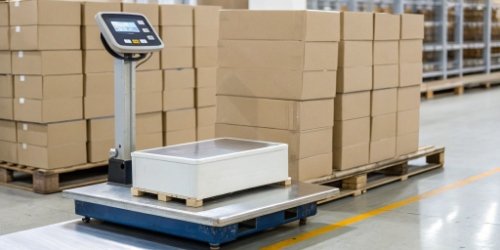
Struggling with slow, error-prone manual weighing and labeling? This inefficiency costs you time and money. An integrated scale can combine these tasks and boost your entire operation's productivity.
Yes, a label printing scale can weigh a pallet and print a License Plate Number (LPN) label at the same time. These devices integrate high-precision weighing with advanced printers, allowing for instant synchronization of weight data with label creation, which greatly streamlines warehouse workflows.
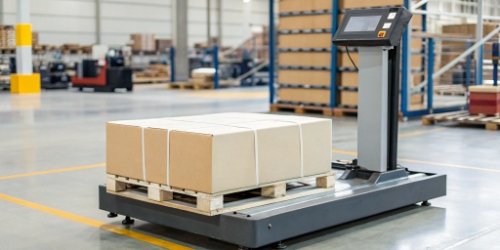
This capability might seem simple on the surface, but the technology that makes it possible is quite advanced. It has completely changed how modern warehouses handle goods. Understanding the details of how these scales work will help you see why they are so valuable. Let’s dive deeper into how this technology can transform your pallet handling process from a multi-step chore into a single, seamless action.
How Do Label Printing Scales Handle Pallet Weighing and LPN Label Printing?
Juggling separate devices for weighing and labeling creates bottlenecks in your workflow. Mistakes happen, inventory gets mixed up, and efficiency drops. Integrating these functions into one device simplifies everything.
Label printing scales handle this by physically and digitally connecting a weighing platform to a printer. The scale captures the weight in real-time, then instantly sends this data to the printer, which generates an LPN label with the weight, barcode, and other tracking information.
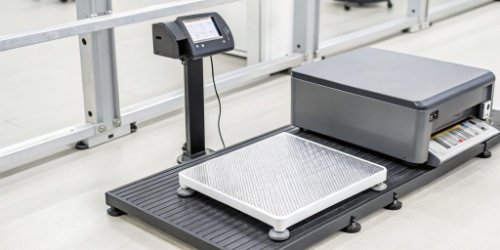
The process is designed for maximum efficiency. When you place a pallet on the scale, high-precision load cells capture the exact weight. This raw data is immediately processed by the scale's internal computer. At the same time, the software pulls pre-set information for the label, such as the product ID, date, time, and a unique LPN. It combines the live weight data with this stored information to create a complete label. The command is then sent directly to the integrated printer. This entire sequence happens in just a few seconds. The system can even detect when the weight on the platform becomes stable and automatically trigger the printing process. This automation removes the need for an operator to press a button, further speeding up the workflow and ensuring that every label is printed with the correct, stable weight, eliminating errors from unstable readings.
Is It Possible for Label Printing Scales to Weigh Pallets and Print Labels Concurrently?
You might worry that combining two important tasks will actually slow things down. A delay in one step could halt your entire production or shipping line. However, concurrent processing is exactly what these scales are designed for.
Yes, it is absolutely possible for these scales to operate concurrently. Their internal processors are powerful enough to manage weighing and printing tasks almost instantly, giving you the experience of a simultaneous action. The entire workflow is seamless and incredibly efficient.

The key to this concurrent operation is the scale's integrated system architecture. The weighing sensors and the printer module are controlled by a single, powerful microprocessor. This central brain handles all calculations and commands without any noticeable lag. As soon as the weight is captured and stabilized, the data is formatted and pushed to the printer queue. One great feature we often highlight to our clients is continuous printing. You can weigh a pallet, print the label, and as soon as you remove it, the scale is ready for the next one. There is no reset time or delay. I remember working with a logistics company that was manually weighing pallets and then having an operator walk to a separate station to print the LPN label. By implementing one of our integrated scale1s, they reduced their pallet processing time by over 50%. The operator could simply place the pallet, take the printed label, and move on.
What Features Enable Label Printing Scales to Weigh and Label Pallets?
Not all industrial scales are created equal. If you choose a scale without the right features, you won't achieve the efficiency gains you are hoping for. You need to look for specific capabilities that enable this powerful dual function.
Key features include high-precision weighing sensors, flexible label editing software, automatic tare functionality, and various connectivity options like USB and Ethernet. Data storage and recall capabilities are also crucial for tracking and auditing, making the entire process robust.
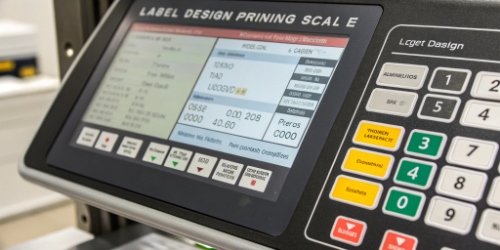
To fully understand their power, it helps to break down the essential features. We build our scales with these core components to ensure they meet the demands of a busy industrial environment. A scale must have both strong weighing fundamentals and smart labeling technology.
Core Functions Breakdown
| Feature Category | Specific Functions | Benefit to You |
|---|---|---|
| Weighing Technology | High-precision load cells, auto-tare, gross/net weight switching. | Ensures every measurement is accurate, saving you from costly shipping errors or inventory mistakes. |
| Labeling Software | Customizable templates, drag-and-drop editor, barcode generation2. | Allows you to create professional LPN labels that fit your exact needs without needing IT support. |
| Data & Connectivity | Onboard data storage, USB/Ethernet ports, Bluetooth option3. | Enables easy integration with your existing WMS or ERP systems and simplifies record-keeping for audits. |
| Hardware Integration | All-in-one design with built-in thermal printer4. | Saves valuable floor space and reduces the number of devices your team needs to manage and maintain. |
These features work together to create a single, powerful tool for your operations.
Can Label Printing Scales Streamline the Process of Weighing and Labeling Pallets?
Your current workflow might feel clunky and slow. This can lead to shipping delays, inventory inaccuracies, and unhappy customers. A streamlined process is the single biggest benefit you'll get from these scales.
Yes, they absolutely streamline the process. By combining two crucial steps into one, these scales reduce manual labor, minimize human error, and save valuable floor space. The intuitive interface and automated functions significantly speed up your entire workflow.
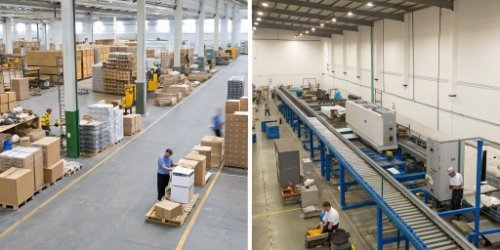
The impact on your daily operations is immediate and significant. Think about the old way of doing things: an operator places a pallet on a floor scale, reads the weight, writes it down on a piece of paper, walks over to a computer, manually types the weight and other information into a program, prints a label, and finally walks back to apply it. Each step introduces a risk of human error—a misread number, a typo, or a lost note. Our integrated label printing scale5s eliminate almost all of those steps. The operator simply places the pallet on the scale, and the correct LPN label prints out automatically right there. This streamlined, one-step process not only saves a huge amount of time but also drastically improves accuracy. By automating data capture and transfer, you ensure that the weight on the label is always the weight on the scale. This boosts efficiency and gives you cleaner, more reliable data for your inventory management system.
Conclusion
In summary, label printing scales are an ideal solution for efficient pallet weighing and LPN labeling. They integrate key functions to simplify your workflow, reduce errors, and boost productivity.
-
Understand the benefits of using integrated scales for efficiency and productivity in your operations. ↩
-
Learn about barcode generation and its role in inventory tracking and management. ↩
-
Find out how Bluetooth connectivity can streamline data transfer and integration with other systems. ↩
-
Understand the advantages of thermal printers in label printing applications. ↩
-
Explore this resource to understand how label printing scales can enhance your operational efficiency. ↩



Comments (0)