

Getting the right measurements is critical for your work. Using the wrong balance can ruin an entire experiment. I will help you understand the right tool for analytical chemistry.
A top-loading balance is not suitable for analytical chemistry experiments that need precision higher than 0.1 milligrams. Its readability is typically between 1 mg and 0.1 mg. This is not enough for most analytical work, which requires an analytical balance.

I have been in the industrial weighing business for 18 years. I have seen many people, especially those new to a lab setting, get confused about which balance to use. It is a very common question. They see a digital scale and think it works for everything. But in chemistry, especially analytical work, precision1 is everything. A tiny error can lead to big problems in your results. Understanding the difference between balances is the first step to getting reliable data. It saves time, materials, and a lot of frustration. Let’s dive deeper into this topic.
Is a top loading balance the same as an analytical balance?
Are you confused about the difference between these two balances? This confusion can lead to buying the wrong equipment and getting inaccurate results. I will make the difference very clear.
No, they are not the same. An analytical balance is much more precise, measuring to 0.0001g (0.1mg) or better, and has an enclosed weighing chamber. A top-loading balance is less precise but has a higher capacity.
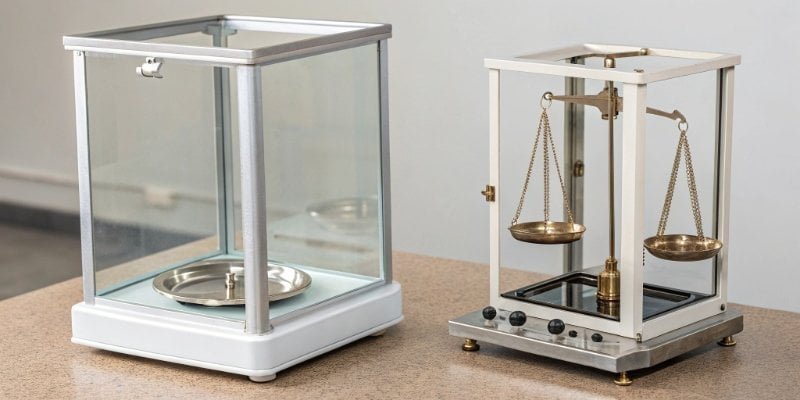
In my experience, the main reason for confusion is that both are digital and used in labs. But they are designed for very different jobs. Think of it like using a kitchen measuring cup versus a tiny syringe for medicine. Both measure volume, but you would never use the measuring cup to dose medication. The same logic applies here. An analytical balance2 is for tasks needing extreme accuracy, like weighing chemicals for a reaction. A top-loading balance3 is for general, less sensitive tasks. To help you see the difference clearly, I have put their key features into a simple table. This is the kind of information we provide to our clients to help them make the right choice for their specific needs.
Key Feature Comparison
We can break down the differences into three main areas: precision, design, and capacity4.
| Feature | Top-Loading Balance | Analytical Balance |
|---|---|---|
| Readability | 0.1g to 0.001g (1mg) | 0.0001g (0.1mg) or better |
| Design | Open weighing pan | Enclosed weighing chamber (draft shield5) |
| Capacity | Higher (several kilograms) | Lower (usually under 300g) |
| Best Use | General weighing, buffers | Quantitative analysis, standards |
Understanding this table is key to equipping your lab correctly.
What are the uses of top loading balance in laboratory?
Wondering where a top-loading balance fits in your lab? Buying the wrong tool for the job costs time and money. Here are its most common and effective uses.
Top-loading balances are used for general weighing tasks in a lab where high precision is not the main goal. This includes preparing buffer solutions, weighing ingredients, simple quality control checks, and weighing larger samples before more detailed analysis.

A top-loading balance is the workhorse of many labs. It is fast, easy to use, and durable. I remember a client who managed a large university teaching lab. They bought dozens of our top-loading balances. They did not need the extreme precision of an analytical balance for introductory chemistry classes. They needed reliable, simple-to-use scales for students to weigh out common reagents for experiments. This is the perfect job for a top-loading balance. It is also great for tasks that happen before the main analysis. For example, you might weigh out a 50-gram soil sample on a top-loading balance before taking a tiny 100-milligram sub-sample to be weighed on an analytical balance. Let's look at some specific jobs it does well.
Common Applications
A top-loading balance shines in several key areas of lab work.
- Buffer and Media Preparation: When you need to mix solutions, you often weigh out powders like salts or sugars. The required precision is usually within grams or milligrams, which is perfect for a top-loader.
- General Sample Weighing: For weighing animals, plants, or other large samples, a top-loading balance provides the necessary capacity and adequate precision.
- Quality Control Checks: In a production setting, you might use a top-loader to quickly check if a product is within its target weight range. This is a fast and effective way to monitor consistency.
Are weighing balance and analytical balance the same?
People often use "weighing balance" and "analytical balance" as if they mean the same thing. This can cause big problems when you order equipment. I will explain the distinction.
No, they are not the same. "Weighing balance" is a general term for any device that measures weight. An analytical balance is a specific, high-precision type of weighing balance used for sensitive chemical analysis.
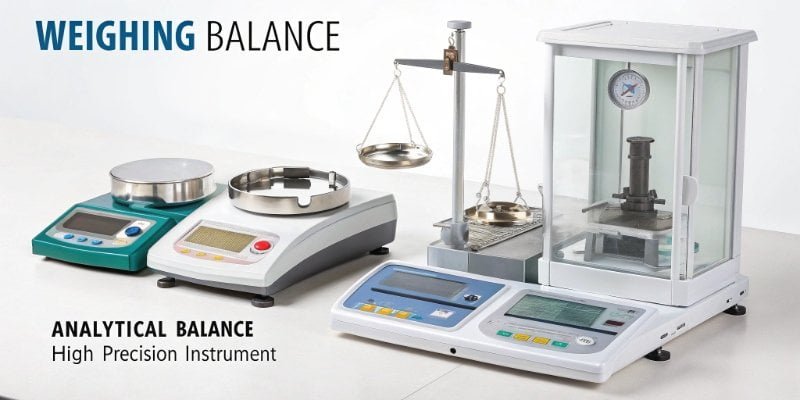
Think of the term "vehicle." A vehicle can be a car, a truck, or a motorcycle. You would not use the word "car" to describe every vehicle. It is the same with balances. "Weighing balance" is the a big category. Inside that category, there are many different types, each built for a specific job. An analytical balance is just one of those types. As a manufacturer, we have to be very clear with our customers about this. If a client just asks for a "weighing balance," we always ask more questions. What do you need to weigh? What level of precision do you need? Answering these helps us recommend the right tool, whether it is a top-loader, an analytical balance, or something else entirely. It prevents costly mistakes.
The Weighing Balance Family
To make it simple, "weighing balance" is the family name. Here are some of the members of that family.
- Top-Loading Balances: The family's general-purpose tool. Good for many jobs, but not for the most delicate ones. Readability is usually around 1mg or more.
- Analytical Balances: The family's specialist. Extremely precise and sensitive, used for tasks where every fraction of a milligram counts. Readability is 0.1mg or better.
- Microbalances: An even more specialized tool. They can measure in the microgram range. They are used in research and for very small samples.
So, all analytical balances are weighing balances, but not all weighing balances are analytical balances.
What are the disadvantages of a top loading balance?
A top-loading balance is very useful, but it has limits. Not knowing these limits can compromise your results. Let’s talk about the key disadvantages to be aware of.
The main disadvantages are its lower precision and readability compared to an analytical balance. It is also very open to environmental changes like air currents and vibrations because it does not have an enclosed weighing chamber.

The open design of a top-loading balance is both a strength and a weakness. It makes weighing large items easy. But it also means that anything in the environment can affect the reading. A simple breeze from an air conditioner or someone walking heavily past the bench can make the numbers jump around. This is why you cannot use it for analytical chemistry. Analytical work depends on stable, repeatable measurements. I once worked with a startup company that was trying to save money. They used a top-loading balance to prepare their chemical standards6. Their results were inconsistent, and they couldn't figure out why. After we talked, they realized their balance was not precise enough and was affected by the building's ventilation system. They switched to an analytical balance, and their problem was solved.
Key Limitations
Let's break down the main issues you might face.
- Limited Precision: The biggest issue is that it just is not sensitive enough for quantitative work. For tasks that require you to know a weight down to the fourth or fifth decimal place, a top-loader will not work.
- Environmental Sensitivity: Without a draft shield, air currents, dust, temperature changes, and vibrations can easily influence the final reading. This makes it unreliable for measuring very small mass changes.
- Unsuitable for Trace Analysis: When working with very small quantities or measuring tiny amounts of a substance (trace analysis7), you need the highest precision possible. A top-loading balance simply cannot provide this.
Conclusion
In short, use a top-loading balance for general lab tasks like mixing solutions. For precise analytical chemistry, you must always choose an analytical balance to get accurate, reliable results.
-
Discover why precision is crucial in experiments and how it impacts results in analytical chemistry. ↩
-
Learn about the precision and features of analytical balances, essential for accurate measurements in chemistry. ↩
-
Explore this link to understand the applications and benefits of top-loading balances in lab settings. ↩
-
Explore how the capacity of balances influences their application in various lab scenarios. ↩
-
Learn about the role of draft shields in ensuring accurate measurements in analytical chemistry. ↩
-
Understand the preparation of chemical standards and the importance of using the right balance. ↩
-
Learn about trace analysis and the necessity for high precision in measuring small quantities. ↩



Comments (0)