

Your scale's accuracy is critical, but calibration service costs can be confusing. You wonder if you can just do it yourself. Let's explore when DIY is okay and when you need a pro.
For non-critical scales with low precision (≤0.1g), you can self-calibrate with certified weights and the user manual. However, for high-precision (≤0.01g), regulated industry, or malfunctioning scales, you must use a professional, accredited service to guarantee accuracy and compliance.

It's a question we get all the time at Weigherps. On one hand, you want to save money and time. On the other, an inaccurate scale can lead to major problems in production, quality control, and customer trust. The right choice depends entirely on your specific equipment and industry requirements. To make an informed decision, you need to understand the trade-offs clearly. Let's break down the details to help you choose the best path for your business.
What Are the Pros and Cons of In-House vs. Third-Party Calibration?
You want to manage calibration on your own schedule and control costs. But the risk of an internal error causing product issues is a serious concern. Understanding the specific trade-offs makes the decision clear.
In-house calibration offers convenience and control but requires investment in certified equipment and staff training. Third-party services provide guaranteed expertise and accredited certificates, removing liability, though they involve scheduling and a direct service cost.
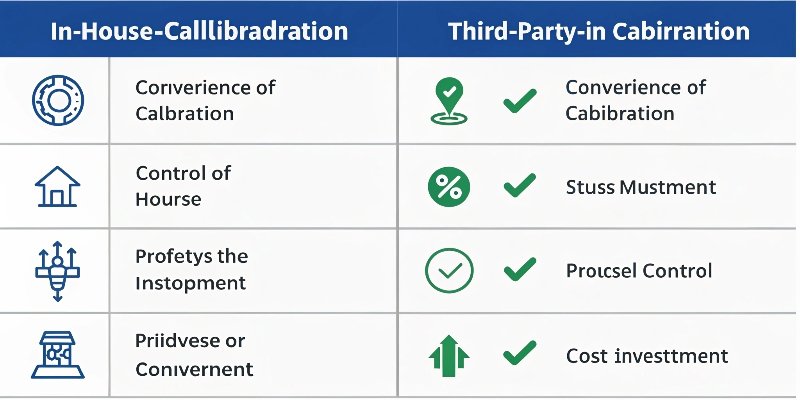
Choosing between doing it yourself and hiring an expert isn't just about the initial cost. It’s about balancing convenience, risk, and the need for certified proof of accuracy. As a manufacturer with 18 years of experience, we've seen clients succeed with both approaches, but only when they choose the right one for their situation. Let's look at a direct comparison.
In-House vs. Third-Party: A Head-to-Head Comparison
| Factor | In-House Calibration | Third-Party Calibration |
|---|---|---|
| Cost | Lower apparent cost, but hidden costs for equipment, training, and staff time. | Higher upfront service fee, but it's a predictable, all-inclusive cost. |
| Control | Full control over scheduling. Calibrate anytime you need to. | Requires scheduling with the service provider. May involve some downtime. |
| Expertise | Relies on the skill of your trained staff. Risk of human error. | Performed by certified technicians with specialized knowledge and tools. |
| Compliance | You are responsible for all documentation and proving traceability1. | Provides an accredited certificate (e.g., ISO 170252) for auditors. |
| Liability | Your company assumes all risk for measurement errors. | The calibration lab is liable for the accuracy of their service. |
For a software provider, data integrity is everything. If your hardware provides bad data, your software is useless. While in-house calibration3 seems appealing for cost control, the risk and documentation burden can be significant. A third-party service provides objective, traceable proof that your weighing equipment is performing correctly.
What Factors Influence the Cost of Professional Calibration Services?
You've decided to hire a professional, but the quotes you're getting are all over the place. You worry about overpaying or getting a cheap service that cuts corners. Knowing what's behind the price will help you budget wisely.
Professional calibration costs are mainly driven by the scale’s type and precision level, the number of test points required, the service location (on-site vs. lab), and the type of certification you need. Travel fees for on-site service also add to the cost.

A quote for calibration isn't just a random number. It's based on the time, equipment, and expertise needed to do the job right. A simple floor scale needs a different process than a high-precision analytical balance that measures to four decimal places. Based on our experience working with global clients, the costs can be broken down into a few key areas. Understanding them ensures you're paying a fair price for the service your equipment demands.
A Guide to Professional Calibration Costs
The price varies based on complexity. Here is a general reference based on what we see in the market.
| Equipment Type | Typical Cost Range (per unit/visit) | Key Considerations |
|---|---|---|
| General Electronic Scale | $100 - $300 | Standard calibration with 1-2 test points. Good for general logistics. |
| Industrial Floor/Bench Scale | $300 - $1,000 | Requires heavier test weights and a multi-point test across a wider range. |
| High-Precision Analytical Balance | $1,000 - $3,000+ | Needs a highly controlled environment, a full set of precision weights, and more time. |
Other factors include:
- On-Site vs. Send-In: On-site service is convenient but includes travel time and costs. Sending your scale to a lab might be cheaper if you can manage the downtime.
- Bulk Discounts: If you have many scales, always ask for a discount. Most providers, including us when we arrange services for clients, will offer a better rate for calibrating multiple units in one visit.
- Accreditation: An ISO 17025 accredited certificate will cost more than a standard certificate of traceability, but it’s essential for regulated industries.
What Equipment and Training Are Required for Compliant Self-Calibration?
You think the DIY approach could save your company money. But without the right tools and knowledge, you risk inaccurate results and failing an audit. Let's outline exactly what you need to do it right.
For proper self-calibration, you must have a set of certified standard test weights appropriate for your scale's capacity. Your team also needs training on the entire procedure, from environmental checks to correctly documenting results for traceability.

Self-calibration is more than just putting a known weight on the scale and pressing a button. To be "compliant," your process must be repeatable, accurate, and documented. This ensures that the results are trustworthy. If you plan to go this route, you can't cut corners on equipment or process. In our consulting work, we advise clients that a half-hearted DIY approach is often worse than doing nothing at all. Here is what you need to have in place.
Your Self-Calibration Checklist
-
Certified Test Weights: This is your most important investment. You cannot use a random dumbbell or a bag of sugar. You must purchase a set of test weights with a certificate of calibration. The weight class (e.g., OIML M1 for industrial scales, F1 for more precise scales) must be appropriate for your scale's readability. These weights also need to be recertified periodically.
-
Proper Procedure & Training: Your staff must be trained to follow the manufacturer's calibration instructions exactly. The typical process involves:
- Warm-up: Turn the scale on for at least 30 minutes before calibration.
- Level Check: Ensure the scale is perfectly level using its spirit bubble.
- Zero Calibration: Calibrate the zero point with nothing on the platter.
- Span Calibration: Use the certified test weight(s) to calibrate one or more points in the weighing range.
-
Rigorous Record-Keeping: If you can't prove it, you didn't do it. Every calibration must be logged. Your log should include:
| Date | Scale ID | Performed By | Weight Used | Reading Before | Reading After | Status |
|---|---|---|---|---|---|---|
| 2024-10-26 | FS-001 | John Doe | 50 kg | 49.98 kg | 50.00 kg | Pass |
This documentation is your proof of compliance for internal quality systems or external auditors.
Why Is It Important to Use an ISO 17025 Accredited Calibration Lab?
You see "ISO 17025 Accredited" on a service provider's website. You wonder if it's just fancy marketing to charge you more, or if it really matters for your business. This accreditation is your absolute guarantee of quality.
Using an ISO 17025 accredited lab confirms their technical competence to produce precise, valid, and traceable results. This is not a quality management certificate; it is a direct endorsement of a lab's testing and calibration capabilities.

In the world of measurement, trust is everything. As a manufacturer whose products are used globally, we know that our clients' success depends on the reliability of our equipment. The same principle applies to calibration services. ISO 17025 is the highest international standard for calibration and testing laboratories. When you choose an accredited lab, you aren't just paying for a service; you are buying confidence and minimizing your business risk.
The Undeniable Benefits of ISO 17025
- Proof of Technical Competence: An accredited lab has been rigorously audited by an independent body. They have proven their staff, methods, and equipment are capable of delivering accurate measurements.
- International Traceability: The calibration performed is traceable to national and international measurement standards. This is a non-negotiable requirement for businesses in regulated sectors like pharmaceuticals, food production, or aerospace, and for companies that export products globally.
- Reduced Risk and Liability: Using an accredited service provides objective evidence that your measurements are accurate. This protects you in case of a product quality dispute, a recall, or a customer complaint. It shifts the liability for measurement accuracy to the expert lab.
- Consistency and Reliability: Accredited labs must follow documented procedures for every calibration. This ensures you get the same high-quality, reliable service every single time, no matter which technician performs the work. For a technology company, this kind of process-driven quality is essential.
Conclusion
For basic, non-critical scales, DIY calibration is a practical option. For any business-critical application, professional calibration from an ISO 17025 accredited lab is the only way to ensure accuracy and compliance.

Comments (0)