
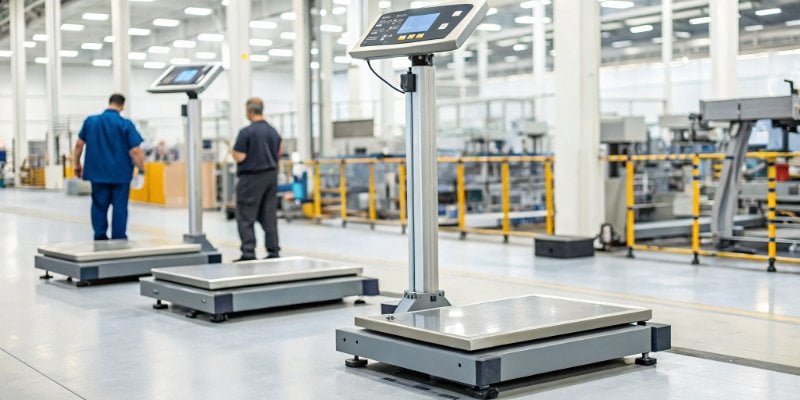
Your current scales are just weighing things, creating slow spots in your workflow. This inefficiency costs you money and time. Modern scales integrate data to boost your factory's overall efficiency.
Today’s industrial scales are more than just precision instruments. They are data collection hubs that connect to your factory's management systems. This integration provides real-time information, driving efficiency and smart decision-making across your production and logistics operations.
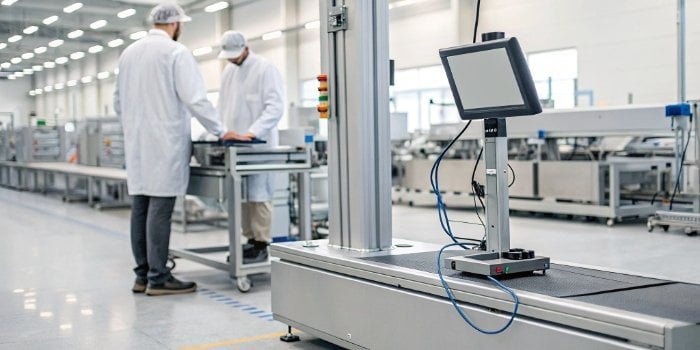
This evolution from a simple measuring device to a smart data hub is a huge leap. But to really use this technology, you first need to understand the basics. What makes a scale truly "industrial," and what are your options? Knowing this will help you see how these tools can change your business. Let's look at the foundational knowledge you need to make the right choice.
What Exactly Defines an Industrial Scale Today?
Thinking any scale will work in a factory is a common and costly mistake. This leads to constant breakdowns and inaccurate data. Understanding what makes a scale industrial saves you a lot of trouble.
An industrial scale is a weighing device built for tough environments. It combines high capacity, durability, and precision. We design them using robust materials and advanced sensors to ensure reliable performance day after day, even in dusty, wet, or high-vibration settings.
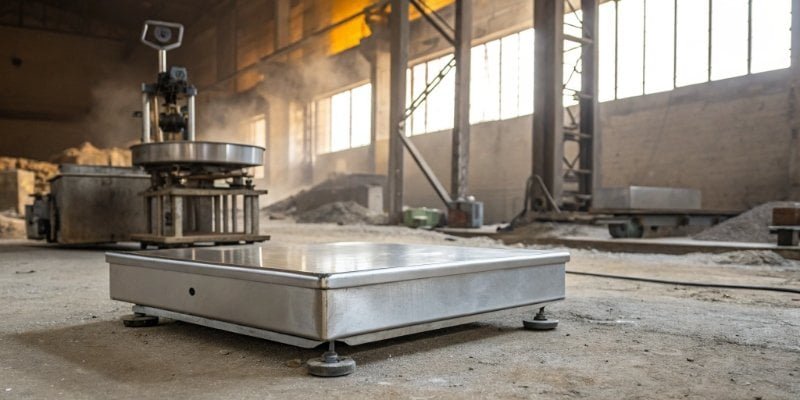
In my 18 years in this business, I've seen countless scales fail because they weren't built for the job. A regular retail scale might last a few weeks in a wet processing plant or a dusty warehouse. An industrial scale is designed to last for years. This is not just about using stronger materials; it’s about smart engineering that considers the entire operational environment. We build them to be a reliable part of your daily process, not a point of failure.
Key Characteristics of an Industrial Scale
The difference is in the details. An industrial scale must have a few key features to be effective. First is durability1. We often use materials like 304 stainless steel that resist rust and are easy to clean. Second is protection from the elements. Look for an IP (Ingress Protection) rating. An IP67 rating2, for example, means the scale is fully protected from dust and can be submerged in water. This is critical in food processing or chemical plants.
From Basic to Industrial
A simple way to see the difference is to compare a standard scale with an industrial one. The gap in performance and longevity is significant.
| Feature | Standard Retail Scale | Weigherps Industrial Scale |
|---|---|---|
| Capacity | Low (e.g., up to 20 kg) | High (e.g., 60 kg to over 10 tons) |
| Material | Plastic | Stainless Steel, Heavy-Duty Steel |
| Environment | Clean, dry indoor areas | Wet, dusty, high-vibration environments |
| Protection (IP) | None or low | IP65, IP67, IP68 (Washdown-ready) |
| Connectivity | Limited or none | Standard (RS-232, Ethernet3, USB) |
What Are the Different Types of Industrial Scales?
Choosing the wrong scale for a task creates an immediate bottleneck. This mistake wastes your money and your team's time. Knowing the main types helps you get it right the first time.
Industrial scales are specialized tools for different jobs. Common types include compact bench scales for small parts, large floor scales for pallets, and dynamic checkweighers for production lines. Each type is designed to optimize a specific part of your workflow.
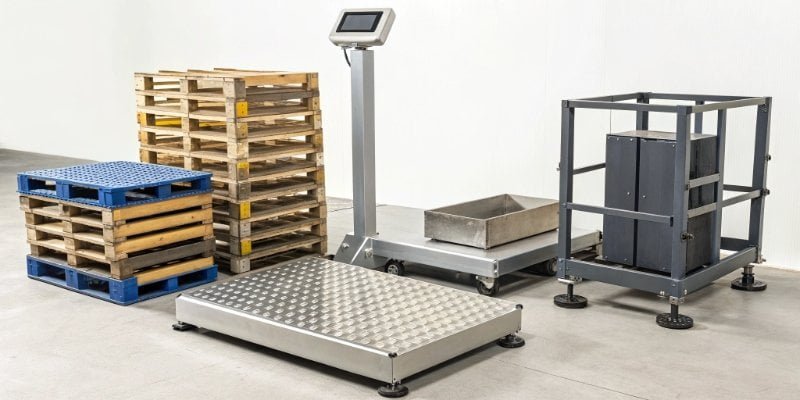
The right scale makes a job easier and more accurate. The wrong one does the opposite. I once visited a client who was using a large floor scale to weigh small boxes of components. Their team wasted time walking back and forth, and the scale wasn't precise enough for small weights. We replaced it with a simple bench scale right on their workbench. Their efficiency for that task immediately doubled. The goal is to match the tool exactly to the task at hand.
Scales for Production and Quality Control
On the production floor, scales are essential for consistency and quality. A bench scale is a compact scale that sits on a workbench, perfect for weighing small parts, ingredients, or packages. A counting scale, a type of bench scale, can count thousands of identical parts like screws or bolts in seconds just by weighing them. A checkweigher is installed directly into a production line to verify that every product is within its target weight range automatically.
Scales for Logistics and Warehousing
In a warehouse, scales handle larger loads. A floor scale is a large, flat platform for weighing pallets, drums, and carts. A pallet truck scale4 combines a pallet jack with a scale, so you can move and weigh a load in one step. For the biggest jobs, a truck scale5 weighs entire vehicles as they enter or leave your facility, which is critical for managing bulk shipments.
| Scale Type | Common Application | Typical Capacity Range |
|---|---|---|
| Bench Scale | Parts counting, recipe mixing, mailroom | 1 kg - 60 kg |
| Checkweigher | In-line product weight verification | 100 g - 50 kg |
| Floor Scale | Weighing pallets, large containers, carts | 500 kg - 10,000 kg |
| Pallet Truck Scale | Mobile weighing in shipping/receiving | 1,000 kg - 2,500 kg |
How Do Modern Scales Become Smart Data Hubs?
Your scales are providing weight, but no useful data. You are missing insights that could streamline your entire operation. Connected scales turn these simple weight numbers into real business intelligence.
Modern scales connect directly to your factory software like an ERP, WMS, or IoT platform. Using interfaces like Ethernet or Wi-Fi, they send real-time weight data automatically. This transforms them from simple measuring tools into active parts of your smart factory.
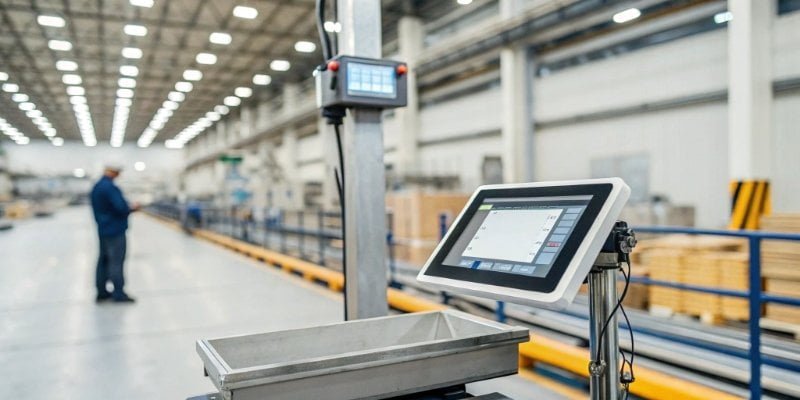
This is where the real revolution is happening. A scale is no longer an isolated island of information. It's a critical data source. For a software provider like you, this is the most important part. Your systems need clean, reliable, real-time data to function. Our scales provide that. They become the bridge between the physical world of your factory floor and the digital world of your management software. This integration is no longer a luxury; it’s the foundation for factory efficiency, management, and growth.
A World of Connectivity
Getting data from the scale to your system requires the right connection. Old-school ports like RS-232 are still common and very reliable for simple data transfer. But modern factories need more. Ethernet allows a scale to plug directly into your local network, making it accessible from anywhere. Wi-Fi and Bluetooth offer wireless connections6, which are perfect for mobile scales like pallet truck scales or for areas where running cables is difficult. As manufacturers, we can equip our scales with any of these options to fit your specific technical needs.
Integrating with Your Core Systems
The true power is unlocked when a scale talks to your business software.
- ERP (Enterprise Resource Planning): Weight data can be sent to your ERP to update inventory levels automatically.
- WMS7 (Warehouse Management System): Scales in the shipping department can confirm package weights and send the data to your WMS to generate shipping labels.
- MES (Manufacturing Execution System): Checkweighers can feed data into your MES to track production yield and quality in real time.
| Connection Type | Speed & Bandwidth | Reliability | Mobility | Best For |
|---|---|---|---|---|
| Wired | High | Very High | Low | Fixed stations, mission-critical tasks |
| Wireless | Medium | Good | High | Mobile weighing, hard-to-cable areas |
Conclusion
Modern industrial scales do more than just weigh things. They are the data-gathering foundation for a smarter, more efficient factory, connecting your physical operations to your digital management systems.
-
Explore how durability impacts the longevity and reliability of industrial scales. ↩
-
Learn about the importance of IP ratings in protecting equipment from environmental factors. ↩
-
Find out how Ethernet connectivity improves data transfer and accessibility. ↩
-
Learn how pallet truck scales streamline the weighing and moving process in warehouses. ↩
-
Understand the critical role of truck scales in managing bulk shipments effectively. ↩
-
Learn about the flexibility and convenience of wireless connections for mobile scales. ↩
-
Learn how WMS enhances warehouse operations and integrates with weighing systems. ↩


[…] bit academic, but it hugely impacts our daily lives and, especially, international business. As an industrial scale manufacturer1 for 19 years, I've seen firsthand how these regulations shape product development and build trust […]
[…] Ingress Protection2, or IP ratings. A truly watertight scale will have a high rating, like IP673 or IP684, clearly stated. This rating is a guarantee, not a marketing […]