
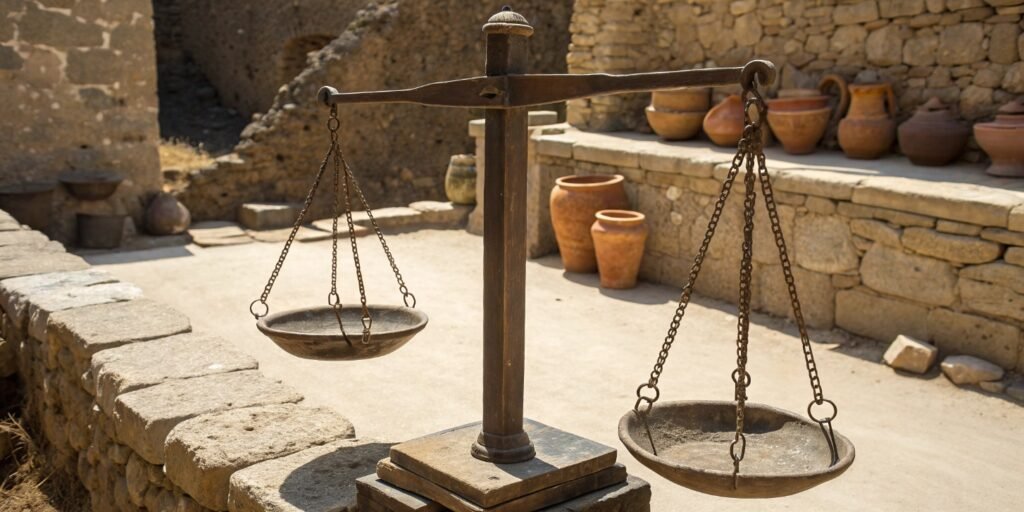
Struggling to imagine trade without digital scales? Think of the chaos and disputes over goods like gold or grain. Ancient innovators solved this using clever balance and lever principles.
Ancient people mainly used balance scales and steelyard scales. Balance scales, from around 2000 BCE, compared an object's weight against known weights. The steelyard scale, using a lever and sliding counterweight, offered a more portable solution for measuring different sized goods with precision.
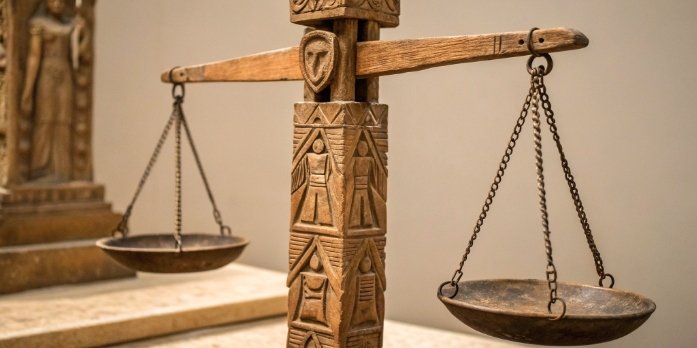
Those early tools were revolutionary, shaping everything from local markets to vast empires. Here at Weigherps, we build on those ancient foundations with today's technology. But to truly understand our journey, we must go back to the beginning. Let's look closer at the first and most fundamental weighing device.
How did the first balance scales actually work?
Ever see an ancient balance scale and wonder how it was truly accurate? Without modern calibration, it seems unreliable. The secret lies in a simple, yet elegant, physical principle: equilibrium.
A balance scale worked using a central pivot, or fulcrum, with a beam balanced across it. An object was placed in one pan, and standard weights were added to the other pan. When the beam became perfectly level, the object's weight equaled the total of the standard weights.

The genius of the balance scale is its reliance on gravity and symmetry. The entire system is designed to find a state of balance.
Key Components and Principles
| Component | Function |
|---|---|
| Fulcrum | The central pivot point. Its sharpness was key to sensitivity. A smaller point of contact reduces friction, allowing the beam to move more freely in response to tiny weight differences. |
| Beam | A rigid bar perfectly balanced on the fulcrum. For accuracy, the beam had to be uniform in density and shape, with the pans attached at precisely equal distances from the center. |
| Pans | Two identical plates or baskets to hold the object and the reference weights. They had to be of equal weight themselves to not throw off the measurement from the start. |
The first evidence of these scales comes from civilizations like Ancient Egypt and Mesopotamia around 2000 BCE. In China, we saw similar dual-pan hanging balances. As scale manufacturers, we know that the quality of these components is everything. An imperfect fulcrum or an unbalanced beam would render the scale useless. Early artisans had to be incredibly skilled to craft these instruments with the precision needed for fair trade, especially when dealing with precious materials like spices and metals. Their work laid the groundwork for the precision engineering we depend on today.
What did ancient civilizations use as standard units of weight?
A balance scale needs standard weights to work. But what did people use? Without a shared standard, trade is chaos. Early societies smartly solved this by creating weights from natural objects.
Early on, people used natural items like seeds or beans as weight units. For instance, the "carat" originated from the carob seed. Later, civilizations like Egypt and Babylon developed standardized weights made of polished stone or metal, often marked with official seals to ensure fairness in trade.
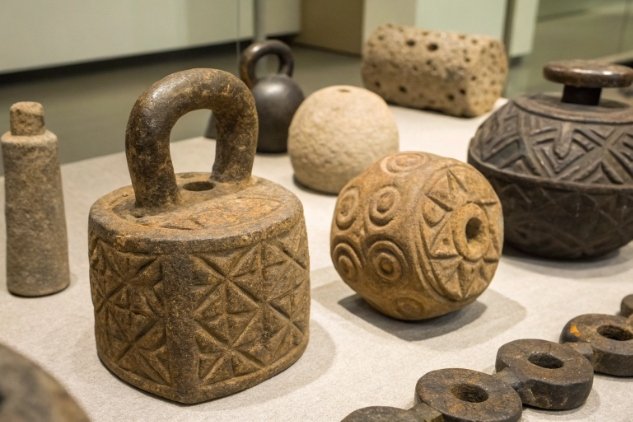
Standardization was the critical step that turned weighing from a rough estimate into a science. It was an act of governance, essential for a functioning economy.
From Nature to Nation
Initially, the most common standards came from agriculture. A grain of wheat or barley was a convenient, fairly uniform unit. This is where units like the "grain" come from, which we still see in some measurement systems today. However, these natural standards had obvious limitations in consistency.
As societies grew, rulers and authorities stepped in. They commissioned the creation of official weights.
- In Mesopotamia, they used units like the shekel and mina, with standardized sets made from polished hematite.
- In the Indus Valley, archaeologists have found remarkably uniform cubed weights made of chert.
- In China, during the Spring and Autumn period, we saw the appearance of 环权 (huán quán), or ring weights. These were incredibly precise for their time, with units as small as the 铢 (zhū), which was about 0.65 grams.
This state-enforced standardization was a massive leap forward. It built trust in the marketplace and allowed for the taxation and administration of a large empire. For us at Weigherps, ensuring our scales comply with international standards like CE is a direct continuation of this ancient tradition of certified accuracy.
How did the invention of weighing impact ancient trade and commerce?
Trading objects directly is clunky and unfair. How do you swap a cow for wheat without arguments? Weighing created a common language of value, making commerce faster and more transparent.
Weighing revolutionized trade by standardizing value. It let merchants accurately price goods like metals and spices, which built trust and reduced disputes. This change fueled complex economies, enabled taxation, and powered long-distance trade routes by making transactions fair and repeatable across different cultures.

Before standardized weighing, trade was personal and limited. You traded with people you knew and trusted. The introduction of weighing depersonalized transactions in the best possible way—it made them objective.
The Pillars of a Modern Economy
- Building Trust: When a seller and buyer could both watch a neutral, mechanical device determine the weight of gold dust or saffron, trust was no longer based on reputation alone. It was based on verifiable fact. This simple act reduced friction in every transaction.
- Enabling Complex Economies: With a common measure of value, concepts like pricing, profit, and debt became easier to manage. This allowed for the rise of professional merchants, bankers, and more sophisticated financial systems. It also made taxation more systematic and fair.
- Powering Global Trade: Long-distance trade routes flourished because a merchant could buy a commodity by weight in one part of the world and sell it by the same weight in another, knowing the value would be understood. Later innovations like the Roman steelyard scale offered a portable and versatile tool perfect for traveling merchants. In China, the Song dynasty's incredibly precise děngzǐ scale was crucial for high-value goods. This idea—empowering customers to grow sales and profits—is exactly what we aim for with our modern weighing solutions.
What is the oldest weighing instrument ever discovered by archaeologists?
We know weighing is ancient, but just how ancient? It's hard to pinpoint the very first evidence. However, archaeologists have found definitive weighing instruments dating back over four millennia.
The oldest discovered weighing instruments are balance scales from the Indus Valley Civilization, in what is now Pakistan. Dating back to around 2400–2000 BCE, archaeologists found balance beams, pans, and a corresponding set of impressively uniform, cube-shaped chert weights alongside them.
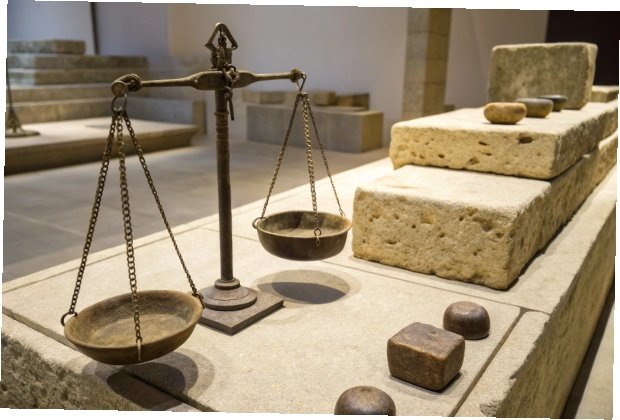
The discovery in places like Mohenjo-Daro and Harappa in the Indus Valley is truly remarkable. It's not just that they found a scale; they found an entire weighing system. This points to a society that was highly organized and deeply invested in principles of fairness and precision.
Clues from the Indus Valley
The artifacts unearthed tell a fascinating story:
- The Weights: The most striking finds are the weights themselves. They were typically cubes made of chert, a hard stone. They were beautifully polished and showed no markings. Their most amazing feature was their standardization. They followed a binary and decimal system, with ratios of 1, 2, 4, 8, 16, 32, etc., up to 12,800. The base unit weighed approximately 13.63 grams.
- The Scales: The scales consisted of copper or bronze pans and beams, often found with the weights. The precision of the weight system implies the scales were sensitive enough to make use of it.
This level of standardization across a vast civilization suggests strong central governance and a sophisticated understanding of mathematics and commerce. While the Egyptians also had balance scales around the same time (c. 2000 BCE), the sheer uniformity of the Indus Valley weight system is unparalleled for that era. It shows that over 4,000 years ago, our ancestors already understood that reliable, trustworthy measurement was the cornerstone of a prosperous society.
Conclusion
Ancient people used balance and steelyard scales with standard weights, revolutionizing trade. These core principles of accuracy and trust are the foundation upon which modern weighing technology is built.



Comments (0)