

Are you struggling to choose between an analog or digital scale? This choice can feel confusing, but picking the wrong one might lead to inaccurate results and operational headaches.
The primary difference lies in how they process signals. Analog scales use mechanical parts to physically show weight, creating a variable electrical signal. Digital scales use electronic sensors and a built-in microprocessor to directly output a clean, highly accurate digital signal for display.
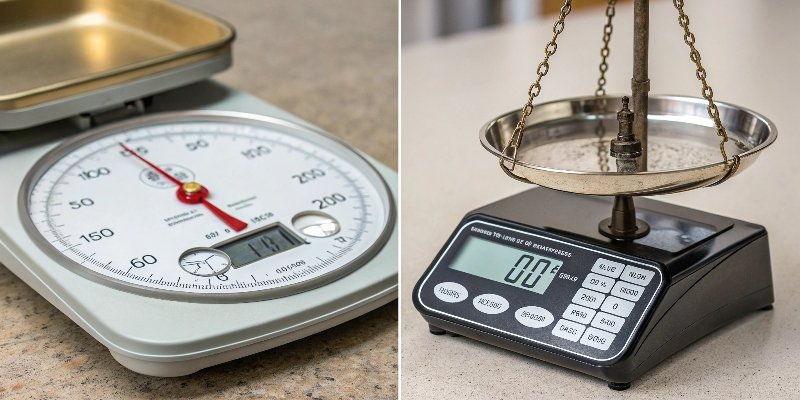
Now that you have a basic overview, you might think the differences stop there. However, the technology behind each type deeply affects their performance, durability, and what they can be used for. Understanding these core mechanics is the key to selecting the perfect scale for your specific needs, whether it's for a simple task or a complex industrial process. Let's dig a little deeper to see what really sets them apart.
What is the difference in working mechanisms between analog and digital scales?
You might think a scale is just a scale, but how they work internally is completely different. This difference impacts accuracy, reliability, and their ability to function in demanding environments.
The key difference is in the signal processing. Analog scales generate a raw analog voltage that is weak and susceptible to interference. Digital scales, however, process and convert this signal into a stable digital format right at the sensor, ensuring robust and accurate communication.

In my 18 years manufacturing industrial scales1, I’ve seen this difference cause major issues. An analog scale relies on a principle called the piezoresistive effect2. A force deforms an elastic component, which changes the resistance of a connected strain gauge. A Wheatstone bridge circuit3 then outputs a tiny analog voltage, usually just a few millivolts. This weak signal must then travel to an external amplifier and an Analog-to-Digital Converter (ADC)4 to become a usable number. Along the way, it's very vulnerable to electromagnetic noise5.
Digital scales handle this completely differently. They have an ADC and a microprocessor built right into the load cell6. The conversion happens immediately, creating a clean digital signal (like RS485). This signal is strong, can travel long distances without degrading, and is far more resistant to interference. This is why they are the standard for high-precision industrial and laboratory settings.
Analog vs. Digital Scale Mechanisms
| Feature | Analog Scale | Digital Scale |
|---|---|---|
| Signal Output | Analog Voltage (e.g., 0-20mV) | Digital Signal (e.g., RS485) |
| Signal Processing | External Amplifier & ADC needed | Internal ADC & Microprocessor |
| Anti-Interference | Weak; requires shielded cables | Strong; robust by design |
| Accuracy | Good (0.1% - 0.01% FS) | Excellent (0.01% - 0.001% FS) |
How do analog scales measure weight and display readings?
Have you ever looked at a classic dial scale and wondered what's going on inside? Its mechanical simplicity is its charm, but it's also the source of its biggest problems.
An analog scale measures weight using springs or levers that physically move when a load is applied. This movement is mechanically linked to a pointer on a dial, which rotates to indicate the weight measurement. The process is entirely mechanical or electromechanical.

At its most basic, an analog scale is a marvel of simple physics. When you put an object on it, the weight compresses a spring or a system of levers. The amount of compression is directly proportional to the force of the weight. This movement is then transferred, often through a rack-and-pinion gear system, to a dial. As the gear turns, it moves the pointer across the printed numbers on the scale's face. It's direct and requires no electricity.
In more industrial analog scales7, the principle is similar but uses electronic components. Instead of just a spring, they use a load cell with a strain gauge. The weight deforms the load cell, and the strain gauge turns this physical change into a small electrical voltage. This analog signal is then sent to an external device for interpretation. I always tell my clients that traditional analog scales are like classic cars: beautifully simple, but they need constant tuning and are easily affected by their environment.
What technology do digital scales use to provide accurate measurements?
How does a digital scale give you that instant, exact number every single time? This precision isn't magic; it comes from smart, integrated technology that works together seamlessly.
Digital scales use a transducer called a load cell to convert the physical force of weight into an electrical signal. An integrated microprocessor then instantly converts this signal into a digital value, which it processes and displays as a precise weight measurement.

The heart of every digital scale is the load cell. This is a specially designed block of metal with sensitive strain gauges bonded to it. When weight is applied, the metal block bends by a microscopic amount. This tiny change in shape alters the electrical resistance of the strain gauges. This creates a weak analog electrical signal, but here is where digital scales change the game.
Unlike an analog system, a digital scale has an Analog-to-Digital Converter (ADC) and a microprocessor built right into its circuitry. The weak signal from the load cell is immediately amplified and converted into a digital format—a series of ones and zeros. The microprocessor then takes this raw digital data and refines it. It automatically corrects for factors like temperature fluctuations or minor non-linearities in the load cell. This processing is what guarantees a stable and highly accurate reading. It's this internal intelligence that allows our IoT-enabled scales to perform self-diagnostics8 and communicate clean data directly to a factory management system.
What are the pros and cons of using analog versus digital weighing scales?
You're facing a choice: the old-school simplicity of analog or the modern precision of digital? Making the right decision depends entirely on understanding the trade-offs that affect your budget and workflow.
Analog scales are inexpensive and simple but less accurate and easily disrupted. Digital scales offer superior precision, smart features, and reliability but require power and a higher initial investment. The better choice depends on your specific application and accuracy needs.

The decision between analog and digital really comes down to matching the tool to the task. An analog scale's biggest advantage is its low cost and simplicity. For tasks where you just need a quick, approximate weight—like in a simple mailroom or kitchen—it’s a cost-effective solution. However, its accuracy can drift, it's sensitive to temperature changes, and it requires regular manual calibration. Plus, getting data from it into a computer system is nearly impossible.
Digital scales are the standard for any professional or industrial application. Their high precision is non-negotiable in labs, manufacturing lines, and logistics. They provide stable, repeatable measurements and often include features like automatic tare, unit conversion, and data output. This connectivity is critical for modern businesses that rely on data for quality control and inventory management. While the upfront cost is higher, the long-term reliability and accuracy provide a much greater return on investment.
Feature Comparison: Analog vs. Digital Scales
| Feature | Analog Scale | Digital Scale |
|---|---|---|
| Cost | Low | Higher |
| Accuracy | Lower, can drift | High and stable |
| Power | Not usually required | Required (Battery or AC) |
| Durability | Prone to mechanical wear | More robust electronically |
| Features | Basic weighing only | Advanced (Tare, memory, etc.) |
| Connectivity | None | Excellent (USB, RS485, IoT) |
| Calibration | Manual, frequent | Software-based, less frequent |
Conclusion
Digital scales offer the precision and connectivity essential for modern industry, while analog scales provide a simple, low-cost solution for basic tasks. Your final choice should depend on your accuracy needs.
-
Learn about the specialized features of industrial scales that make them suitable for demanding environments. ↩
-
Discover how the piezoresistive effect works in analog scales and its impact on measurement accuracy. ↩
-
Learn about the Wheatstone bridge circuit's role in analog scales and its importance in measuring resistance. ↩
-
Explore the critical role of ADCs in digital scales for converting analog signals to digital format. ↩
-
Understand the challenges posed by electromagnetic noise on analog scales and how to mitigate them. ↩
-
Find out how load cells convert weight into electrical signals for accurate digital readings. ↩
-
Explore the benefits of analog scales, including their simplicity and cost-effectiveness for basic weighing tasks. ↩
-
Explore how self-diagnostics enhance the reliability and performance of digital scales in industrial settings. ↩

Comments (0)