
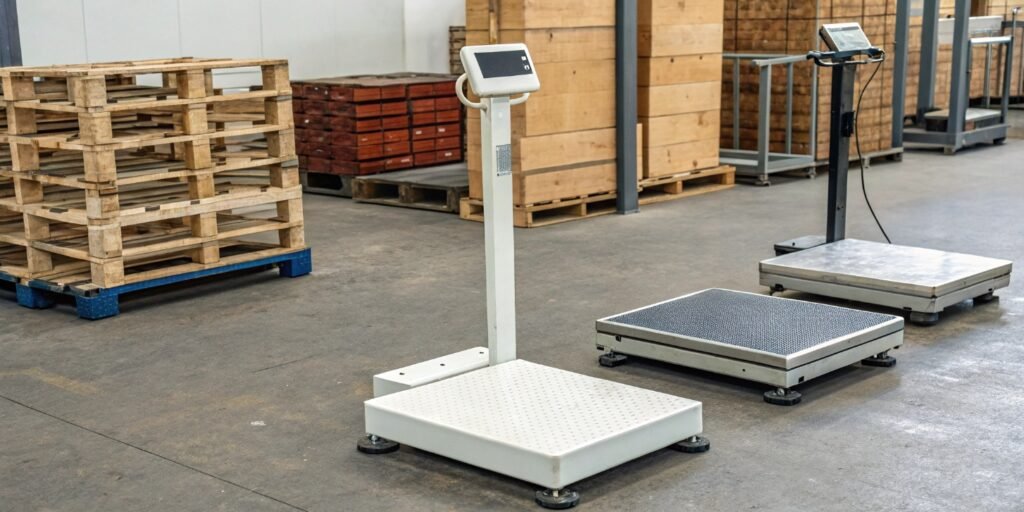
Can't decide on a warehouse scale? Choosing the wrong one leads to costly errors and inefficiencies. This decision impacts your entire operation, from receiving to shipping.
To choose the right industrial scale, you must evaluate your specific needs. Consider the maximum weight and required accuracy, the operating environment, and the type of goods you handle. Matching these factors to the scale's features, like capacity and platform size, is crucial for efficiency.
Selecting the perfect scale might seem complicated, but it's a straightforward process when you break it down. As an 18-year veteran in manufacturing industrial scale1s, I’ve helped countless logistics managers make the right choice. Let me walk you through the essential questions to ask yourself. This will ensure you invest in a tool that boosts your productivity, not hinders it.
What are the key factors to consider when buying a warehouse scale?
Overwhelmed by technical specs? A wrong choice means wasted money and operational headaches. You need a simple way to identify the most critical features for your warehouse.
The key factors are capacity, accuracy, and environmental durability. Ensure the scale's capacity exceeds your heaviest load. Match the accuracy to your business needs, and select materials like stainless steel for harsh conditions to guarantee longevity and reliable performance.
When we help clients choose a scale, we don't just look at a single feature. We look at the entire operational picture. A scale is more than a number on a display; it's a critical control point for your inventory and revenue.
Matching the Scale to Your Workspace
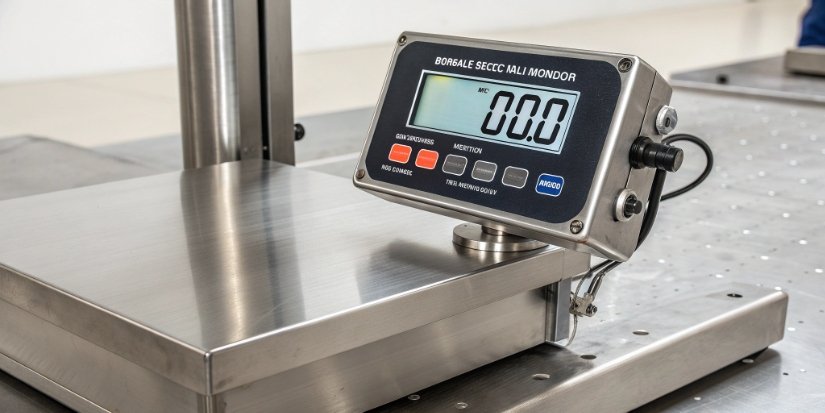
First, consider the physical environment. Is your warehouse dusty, or is it a food-grade facility that requires frequent washdowns? For wet or corrosive environments, you must insist on a scale made from stainless steel with at least an IP65 protection rating. This prevents water damage and rust. Also, think about impact. If you're weighing heavy, unwieldy items, a scale with a reinforced, thick platform or a dual-frame structure can absorb shocks and prevent damage to the sensitive load cells underneath. It’s a small detail that adds years to the scale's life.
Understanding the Technology Inside
The technology inside is just as important. I always recommend digital load cells2 over analog ones. Digital sensors are much better at resisting electrical interference from other machinery, giving you more stable and reliable readings. They also support self-diagnostics, which can alert you to a problem before it causes significant downtime. The indicator, or the scale's "brain," should have the functions you need. Basics include tare and zero. But advanced functions like parts counting or data output3 via RS232 or USB ports are what truly integrate the scale into a modern, data-driven workflow.
When is a "Legal for Trade" certified scale required for a logistics business?
Worried about legal compliance? Using a non-certified scale for trade can lead to heavy fines and lost trust. It's a risk your business can’t afford to take.
A "Legal for Trade" (or NTEP certified in the US) scale is mandatory whenever you charge customers based on weight. This applies to shipping, freight, and any transaction where the product's price is determined by its weight. It ensures fairness and accuracy for all parties.
I've seen companies face serious legal issues because they overlooked this requirement. The term "trade" is broader than most people think, and regulators don't make exceptions. It's a fundamental part of running an honest and transparent business.
Defining "Trade" in a Logistics Context
In logistics, "trade" happens anytime money changes hands based on a weight measurement. It’s not just about selling a product by the pound or kilogram. For example, if you run a third-party logistics4 (3PL) warehouse and bill your client for storage based on the total weight of their pallets, you are engaging in trade. If you are a courier service calculating shipping fees based on package weight, that's trade. A freight forwarder who bills a customer based on the gross weight of a shipment is also conducting trade. In all these cases, a certified "Legal for Trade" scale is not optional; it's the law.
The Value of Certification
Getting a scale certified isn't just about sticking a label on it. It means a government-approved agency has rigorously tested the device to ensure it meets strict standards for accuracy, reliability, and fraud prevention. For you, this certification is your shield. It protects you from customer disputes and potential fines from regulatory bodies like Weights and Measures. More importantly, it’s a mark of trust. It tells your customers that you are committed to fairness and transparency. As a manufacturer, we offer a range of certified scales precisely for this reason. We want to empower our clients to operate with complete confidence.
What is the difference between a floor scale and a pallet jack scale?
Is a slow weighing process bottlenecking your warehouse? Moving every pallet to a fixed scale wastes valuable time and labor. There has to be a more efficient way.
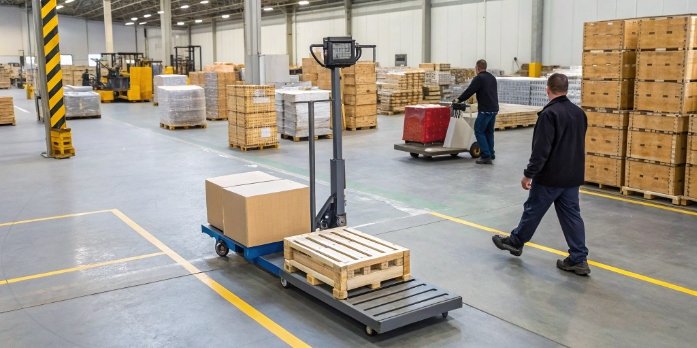
A floor scale is a stationary platform where you place items to be weighed. A pallet jack scale integrates a weighing system into a pallet jack, allowing you to lift, move, and weigh a pallet in a single motion without traveling to a separate scale.
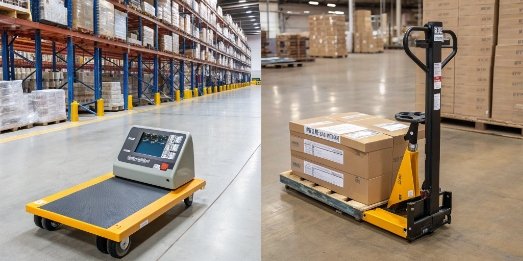
The choice between these two types of scales comes down to one thing: your workflow. One focuses on centralized, heavy-duty weighing, while the other prioritizes mobility and speed. Both are essential tools in modern logistics, but they serve very different purposes.
Optimizing Your Workflow with the Right Scale
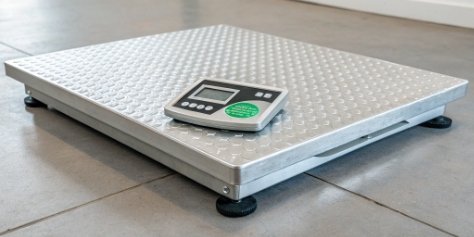
From my experience, the most efficient warehouses use a mix of scale types. A floor scale5 is your traditional workhorse. It's typically a large, robust platform installed in a permanent location, like a receiving dock or a central shipping area. You bring the load to the scale using a forklift or a standard pallet jack. It's ideal for weighing very heavy or oversized items.
A pallet jack scale6, on the other hand, is built for mobility. You take the scale to the load. This simple change eliminates the wasted steps of traveling back and forth to a stationary scale. It's incredibly efficient for tasks like verifying incoming shipment weights right at the loading dock, performing quick inventory counts in the aisles, or preparing multiple orders for shipment. The time saved per pallet adds up significantly over a shift.
A Quick Comparison
| Feature | Floor Scale | Pallet Jack Scale |
|---|---|---|
| Mobility | Stationary | Highly Mobile |
| Workflow | Bring load to scale | Bring scale to load |
| Best For | Central weighing areas, heavy loads | High-volume receiving/shipping, inventory |
| Efficiency | Lower (more steps) | High (fewer steps) |
| Footprint | Fixed, requires dedicated space | Mobile, no fixed space needed |
How do I determine the right capacity and accuracy needed for an industrial scale?
Afraid of buying a scale that’s too weak or too sensitive? The wrong choice can lead to equipment damage or inaccurate charges. You need a clear rule for this.
To determine capacity, identify your heaviest typical load and add a 20-30% safety margin. For accuracy (readability), match it to your operational needs. Use higher accuracy (e.g., 1g) for valuable small items and lower accuracy (e.g., 50g) for bulk pallet weighing.

Getting capacity and accuracy right is a balancing act between performance and cost. Overspending on unnecessary precision is wasteful, but underspending can cost you far more in the long run through errors and disputes.
The Capacity Safety Margin Rule
I always tell my clients to think about their absolute heaviest load, then add 20-30% to that number to determine the right scale capacity. For instance, if the heaviest pallet you ever handle is 500 kg, don't buy a 500 kg scale. You should choose a scale with a capacity of at least 750 kg, or even 1000 kg. This buffer isn't about future-proofing; it's about protecting your investment. It provides crucial protection against shock loading, which is what happens when a load is dropped onto the platform instead of being placed gently. This simple rule dramatically extends the life of the scale’s load cells, which are the most critical and expensive components to replace.
Linking Accuracy to Business Value
Accuracy, or what we technically call readability or division size, should directly relate to the value of what you're weighing. There is no need to use a high-precision scale for low-value bulk goods. For a logistics warehouse weighing full pallets of general merchandise, a 1-ton floor scale with a readability of 50g is perfectly fine and cost-effective. However, if you are a fulfillment center shipping small, high-value electronics, a 30kg bench scale with 1g readability is essential for accurate shipping charges and inventory management. Choosing the correct accuracy prevents disputes with clients and ensures your production processes, if any, are repeatable and reliable.
Conclusion
Choosing the right scale means matching capacity, accuracy, and type to your specific warehouse tasks. This simple strategy ensures efficiency, compliance, and profitability for your business operations.
-
Explore the various types of industrial scales to find the best fit for your operational needs. ↩
-
Understand the benefits of digital load cells for improved accuracy and stability in readings. ↩
-
Learn about data output options that integrate scales into modern data-driven workflows. ↩
-
Explore the importance of scales in third-party logistics for accurate billing and efficiency. ↩
-
Discover the advantages of floor scales for heavy-duty weighing in logistics operations. ↩
-
Understand the differences between pallet jack scales and floor scales for better workflow efficiency. ↩



Comments (0)