
Worried your scales are inaccurate or won’t last? Using a failing scale can lead to costly mistakes, whether in your kitchen, for your health, or in your business.
Industrial scales last much longer, typically 5 to 15 years or more, because they are built with strong materials for tough conditions. Bathroom and kitchen scales, made for light home use, usually only last 2 to 5 years before their accuracy starts to fail.

It's a question I get asked a lot in my 18 years of manufacturing weighing equipment. People want to know if they can trust their scale. The answer isn't just about the brand; it's about the type of scale and what it was built to do. Consumer scales1 are fine for casual use, but they just aren't designed for the long haul or for high-stakes measurements. Let’s look at why their lifespans and reliability are so different.
What is the lifespan of a bathroom scale?
Does your bathroom scale give you a different number every time you step on it? This inconsistency can make it impossible to trust your health data.
A standard bathroom scale is designed to last about 2 to 5 years. Its lifespan is often cut short by the humid bathroom environment and frequent use. After a few years, its internal sensors degrade, leading to unreliable and inaccurate readings.

In our experience as a manufacturer, we see exactly why consumer scales have such a short life. It really comes down to the materials and the environment they are placed in. Most are built with cost-saving in mind, not longevity.
Factors That Shorten a Bathroom Scale's Life
The main job of a bathroom scale is to give a general weight reading, so they are not built to last forever. They use components that are good enough for a few years of casual use.
| Factor | Impact on Lifespan | Why it Matters |
|---|---|---|
| Material Quality | High | Made with plastic bodies and basic load cells that wear out. |
| Environment | High | Humidity2 and temperature changes in a bathroom can damage electronics. |
| Usage Frequency | Medium | Constant use adds mechanical stress, wearing down sensors faster. |
| Build Quality | High | Mass-produced with less strict quality control than industrial equipment. |
This combination means that while your scale might work perfectly for the first year, its performance will almost certainly drop off. For anyone serious about tracking their health, this gradual failure can be misleading. For a business, this level of unreliability is simply not an option.
Do bathroom scales lose accuracy over time?
You've had the same bathroom scale for years. But you might be making decisions based on false information, which completely undermines your health and fitness efforts.
Yes, bathroom scales definitely lose accuracy over time. This happens because their internal sensors, called load cells, wear out from use and get damaged by humidity. This causes "sensor drift," which results in inconsistent measurements. Recalibrating might help, but the decline is unavoidable.

The core reason for this loss of accuracy is a technical issue, but it’s easy to understand. Inside every digital scale is a sensor that bends slightly under weight. A bathroom scale uses a very basic version of this sensor, called a strain gauge.
The Science of Inaccuracy
Over time, two things happen to these simple sensors. First, repeated use causes the metal to get tired and not spring back to its original shape correctly. Think of it like a metal spring that gets stretched out. Second, the electronics are exposed to the moisture in your bathroom, which causes corrosion and interference. This decay is what we call "sensor drift." At first, the readings might only be off by a little, but eventually, the scale becomes completely untrustworthy.
In our industrial manufacturing, we combat this by using completely different materials. Our load cells are hermetically sealed to protect them from moisture and dust. They are made from superior-quality steel alloys built to withstand millions of weighing cycles, not just a few thousand. This focus on durability is why industrial scales maintain their accuracy for a decade or more, even in the toughest factory conditions.
How accurate are industrial weighing scales?
Your business depends on exact measurements for production or shipping. Even small inaccuracies can lead to wasted materials, compliance failures, and unhappy clients, hurting your bottom line.
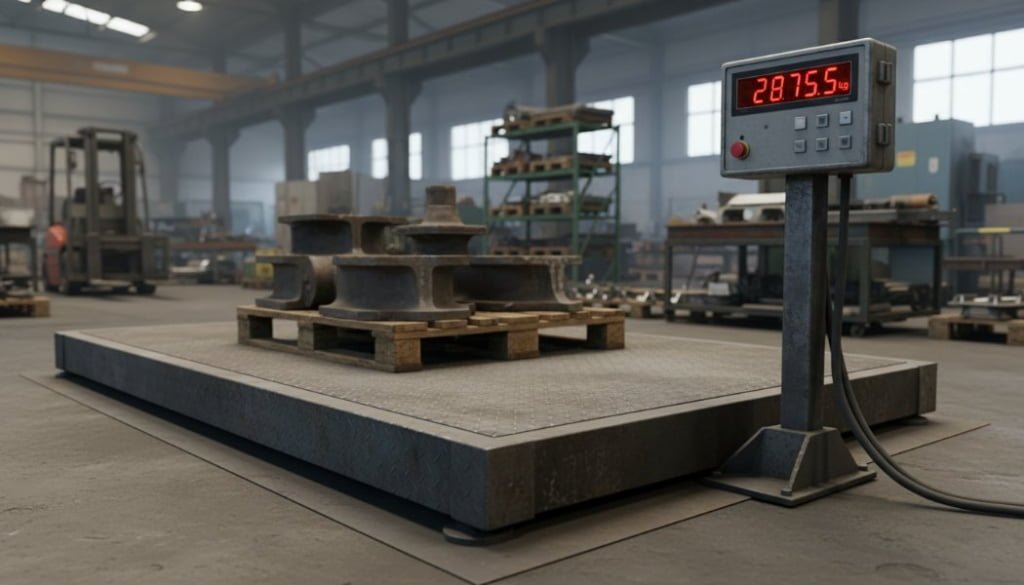
Industrial weighing scales are extremely accurate, and their precision can be customized based on your business needs. They are built to meet strict standards, like CE certification, and are designed to maintain their accuracy for years, even in harsh industrial environments.

When a client comes to us, they don't just ask for a "scale." They have specific operational needs. They might need to measure tiny amounts of an ingredient for a formula or weigh entire truckloads of product. This is where industrial scales shine.
Built for Business, Not Bathrooms
Unlike a consumer scale with one-size-fits-all accuracy, industrial scales are purpose-built. We design solutions tailored to the client's goals. This involves selecting the right type of load cell, indicator, and platform material to guarantee performance. For example, a food processing plant needs a stainless steel, waterproof scale that can be washed down daily, while a logistics company needs a durable floor scale that can handle heavy pallets. We provide IP-rated scales3 for dusty or wet environments and use materials that resist corrosion. This level of customization ensures our clients get measurements they can trust, day in and day out, which is critical for their quality control and profitability.
| Feature | Industrial Scale | Consumer Scale |
|---|---|---|
| Accuracy4 | High & Customizable | Low to Medium |
| Durability5 | Very High (Steel, IP Rated) | Low (Plastic) |
| Lifespan | 5-15+ years | 2-5 years |
| Certifications | Yes (CE, etc.) | Rarely |
Are digital scales more accurate than mechanical scales?
You see both modern digital scales and old-fashioned mechanical ones. Is the new technology always better, or is there a reason to stick with the classic spring-based models?
Yes, in almost every case, modern digital scales are more accurate than mechanical ones. Digital scales use electronic sensors for precise, consistent readings. Mechanical scales rely on springs that wear out, lose tension, and are difficult to read without error.

Having been in this industry as it transitioned from mechanical to digital, the difference in performance is night and day. The technology behind each is fundamentally different, which directly impacts their accuracy and reliability.
Springs vs. Sensors: A Clear Winner
A mechanical scale works by measuring how much a set of springs compress under weight. This measurement is shown by a pointer on a dial. The problem is that springs lose their elasticity over time. They get stretched and don't return to their true zero point, leading to permanent inaccuracies. Also, reading a dial from different angles can give you slightly different results, a problem known as parallax error.
Digital scales6, on the other hand, use an electronic component called a load cell. It provides a precise electrical signal that is directly proportional to the weight. This signal is then converted into a clear, easy-to-read number on a display. This method is not only more precise but also more reliable over the long term. In the industrial world, digital technology is now the standard because business operations require a level of precision and data integration that mechanical scales simply cannot offer.
Conclusion
Industrial scales provide far greater accuracy and a much longer lifespan. To ensure reliable performance, it's essential to choose a scale designed for your specific application and environment.
-
Understand why consumer scales may not be suitable for serious health tracking. ↩
-
Understand the effects of humidity on the performance and lifespan of scales. ↩
-
Find out how IP ratings ensure the reliability of scales in challenging environments. ↩
-
Find tips and best practices to maintain the accuracy of your scales. ↩
-
Explore the materials and design features that enhance the durability of industrial scales. ↩
-
Discover why digital scales are preferred for accuracy and ease of use. ↩



Comments (0)