

Sourcing products but worried about compliance? A fake or incorrect certificate can halt imports and cause huge losses. Learn how to get it right from the start.
To avoid mistakes, you must identify the correct directives, prepare a complete technical file, and ensure the CE mark is applied properly. Always verify the certificate's details match the product and the issuing body is legitimate. This ensures smooth market access.

In my 18 years in manufacturing, I've seen countless compliance issues derail projects. It is frustrating when a simple paperwork mistake costs you time and money. The good news is, these errors are entirely avoidable if you know what to look for. Let's break down the most common pitfalls I see and how you, as a purchasing manager or technical director, can sidestep them effectively. It all starts with understanding the frequent errors tied to the CE mark1 itself.
What are common CE marking mistakes?
You think your product is CE compliant, but is it? A tiny mistake in the marking or paperwork can lead to rejection at customs, costing you dearly.
Common mistakes include using the wrong directives, having incomplete technical files, applying the CE mark incorrectly, or having a certificate that doesn't match the product. For example, the model number on the certificate must exactly match the product label.

I once worked with a software client who sourced hardware with a CE mark, but the technical file2 was missing the circuit diagrams. Their shipment was held at the port for weeks. It is a classic mistake. To prevent this, you need a checklist.
Key Areas to Check
- Directives and Standards: Ensure the correct ones are listed. For many of our electronic scales, both the Low Voltage Directive (LVD) and the Electromagnetic Compatibility (EMC) Directive apply. Confusing them is a frequent error.
- Technical File: This is your proof of compliance. It must be complete.
- CE Mark Application: The mark has specific size and proportion rules. It must be visible and permanent.
Here is a quick table of common blunders I have seen over the years:
| Mistake Category | Specific Error Example | Consequence |
|---|---|---|
| Directives | Citing only EMC when LVD also applies. | Non-compliant, market rejection. |
| Technical File | Missing the user manual or test reports. | Delays, legal challenges. |
| CE Mark | The mark is too small or easily removable. | Product impounded by authorities. |
| Mismatches | Certificate lists model "X-100," but product is "X-100A." | Certificate is invalid for the product. |
What should be on a certificate of conformity?
You receive a certificate, but does it contain all the required information? Missing details can invalidate it, leaving you with a non-compliant product and no recourse.
A valid Certificate of Conformity must include detailed product information (model, name), the manufacturer's address, all applicable EU directives and standards, the notified body's information, and a unique certificate number. It must also contain a formal Declaration of Conformity.
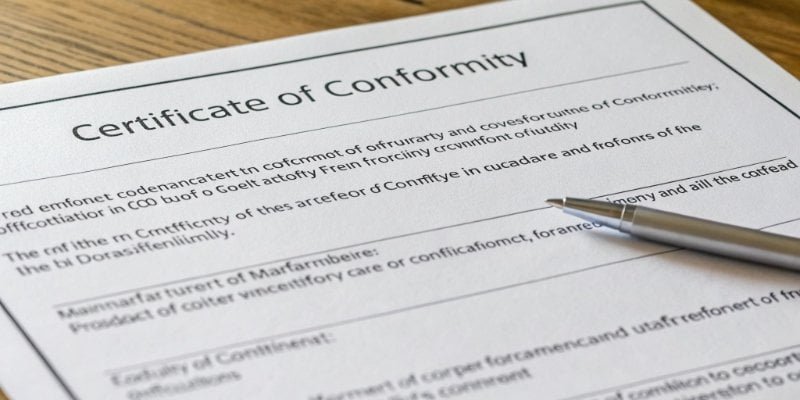
Think of the certificate as your product's passport for the EU market. If any information is missing, it is like having a passport with no photo. It just does not work. For every batch of scales we ship, we double-check that every single field is correctly filled out. It is non-negotiable for us and our clients.
Essential Certificate Components
- Identification: Clear identification of the product and manufacturer is crucial. Any ambiguity can raise red flags.
- Legal Basis: The certificate must explicitly state which laws (directives) and technical standards the product meets.
- Issuing Authority: The body that issued the certificate must be clearly identified so their accreditation can be verified.
Here’s a breakdown of the core contents you should always look for:
| Section | Required Information | Why It's Important |
|---|---|---|
| Product | Model number, product name, serial number range. | Links the certificate to a specific product. |
| Manufacturer | Full legal name and registered address. | Establishes legal responsibility3. |
| Compliance | List of EU Directives & Harmonized Standards. | Shows which safety/performance rules it follows. |
| Authority | Notified Body4 name, address, and number. | Proves a legitimate body assessed the product. |
| Details | Certificate number, issue date, expiry date. | For tracking, verification, and validity. |
What are the requirements for a certificate of conformance?
Frustrated by vague compliance requirements? Simply having a certificate is not enough. Not meeting the underlying technical demands can void your compliance and expose your company to risk.
The core requirement is that the product must fully comply with all applicable EU directives. This compliance must be documented in a comprehensive technical file containing design data, test reports, and production details. The process often requires third-party auditing by a Notified Body.

A certificate is the final piece of a large puzzle. The real work is in the engineering, testing, and documentation that happens beforehand. As a manufacturer, this is where we spend most of our effort—ensuring the product actually meets the standards, not just getting a piece of paper. For our software partners, understanding this process helps them vet hardware suppliers more effectively.
The Three Pillars of Conformance
- Product Compliance: The device itself must pass all tests related to safety, performance, and any other requirements from relevant directives.
- Technical Documentation: You must compile and maintain a technical file that proves compliance. Authorities can request this file for up to 10 years.
- Formal Declaration: The manufacturer must sign a Declaration of Conformity5 (DoC), taking legal responsibility.
The journey to a valid certificate looks like this:
| Step | Action | Key Detail |
|---|---|---|
| 1. Design | Design product to meet relevant standards. | E.g., Electrical insulation for LVD. |
| 2. Testing | Conduct lab tests (self-tested or by 3rd party). | E.g., EMC emissions and immunity tests. |
| 3. Documentation | Compile the Technical File. | Includes drawings, reports, manuals. |
| 4. Audit | Undergo assessment by a Notified Body (if required). | Some high-risk products mandate this. |
| 5. Declaration | Manufacturer signs the Declaration of Conformity. | A legally binding statement. |
| 6. Certificate | A Certificate of Conformity is issued. | The final evidence of the process. |
How do you verify a certificate of conformity?
You have a certificate in hand, but is it real? Counterfeit documents are common and can lead to disastrous import failures. How can you be sure it’s legitimate?
Verify a certificate by checking the certificate number on the issuing body's official website or the EU's NANDO database. Cross-check all information—like the model number and standards—against the physical product. When in doubt, contact the issuing body directly.

Trust but verify. This is my motto after 18 years in this business. We once had a prospective supplier give us a certificate that looked perfect. But a quick check on the notified body's website showed the number was invalid. It saved us a massive headache. Your due diligence here is critical.
A Step-by-Step Verification Process
- Online Database Check: The fastest method. Most accredited notified bodies have an online portal to check certificate validity.
- Information Cross-Check: Mismatches are a huge red flag. Ensure the company name, address, and product model on the certificate are an exact match.
- Direct Contact: If an online tool is not available, email or call the issuing body. They can confirm authenticity.
Here is a checklist for your verification process:
| Verification Method | What to Do | What It Confirms |
|---|---|---|
| Website Lookup | Go to the issuer's website and search the cert number. | If the certificate is real and current. |
| Info Match | Compare certificate details with the product & packaging. | If the certificate applies to your specific product. |
| Accreditation Check | Verify the Notified Body in the EU NANDO database. | If the issuer is authorized for that directive. |
| Direct Inquiry | Email a copy to the issuer's verification department. | Provides definitive proof of authenticity. |
Conclusion
Avoiding certificate mistakes is simple: understand the requirements, check every detail, and always verify. This diligence protects your investment, ensures market access, and builds a reliable supply chain.
-
Proper application of the CE mark is essential for market access; explore the requirements to ensure compliance. ↩
-
A comprehensive technical file is crucial for compliance; learn what to include to avoid pitfalls. ↩
-
Understanding legal responsibility is crucial for manufacturers; explore its implications in compliance. ↩
-
Knowing the role of a Notified Body can help you navigate compliance and certification processes. ↩
-
The Declaration of Conformity is a legal requirement; learn its importance in product compliance. ↩


Comments (0)