

Struggling with inaccurate production data? Outdated scales can’t keep up with your smart factory goals. Choosing the right system is the key to unlocking new levels of efficiency.
To choose the best intelligent weighing system, you must first analyze your specific manufacturing environment, product characteristics, budget, and required certifications. Your deep understanding of your own production line is the most critical factor in making the right choice, even more so than a supplier’s recommendations.

I’ve spent nearly two decades helping businesses implement weighing solutions1. A common mistake I see is companies searching for a single "best" system that will solve all their problems. The reality is, the best system is the one that’s best for you. It’s not about finding a magic bullet, but about finding a perfect fit. This process begins not by looking at catalogs, but by looking at your own operations. Let’s break down how you can find that perfect fit for your factory.
What Factors Should Be Considered When Selecting a Smart Weighing System for Manufacturing?
Worried about making a costly mistake? Choosing the wrong weighing system can halt production and inflate your budget. Let’s outline the essential factors to ensure you make a smart investment.
Consider four primary factors: your production environment (e.g., wet, dusty), product characteristics (e.g., size, value), budget constraints (initial cost vs. total cost of ownership), and necessary compliance standards (e.g., CE). These form the basis for your selection.

Before you even speak to a supplier, you need to do a little homework on your own facility. No one knows your production floor better than you do. A great supplier will ask you these questions, but having the answers ready puts you in control. I always guide my clients to think through these four core areas first. It simplifies the entire process and ensures the final solution actually solves their problem.
Key Selection Factors
Here’s a deeper look at what you need to assess:
- Production Environment: Where will the scale live? Is the area wet, requiring frequent washdowns? Is it dusty, with fine particles that could damage sensitive electronics? The answers determine the necessary IP (Ingress Protection) rating for the equipment. A scale for a dry, clean room is very different from one used in a chemical processing plant.
- Product Characteristics: What are you weighing? Are they small, high-value components where precision is critical? Or large, bulk materials where capacity is more important? Is the weighing static (the item is placed on the scale) or dynamic (weighing on a moving conveyor belt)?
- Budget and Total Cost of Ownership (TCO): Your budget is more than just the initial purchase price. You must consider the TCO, which includes installation, maintenance, potential downtime, and training. A cheaper scale that fails often can cost you far more in lost production than a more reliable, slightly more expensive option.
- Certifications and Compliance: What standards must your equipment meet? For selling in Europe, CE certification is a must. If your scales are used for commercial transactions, they may need to be "legal for trade" certified (like OIML). These certifications are not just paperwork; they are your assurance of quality, accuracy, and safety.
| Factor | Key Question | Why It Matters |
|---|---|---|
| Environment | Is the area wet, dusty, or hazardous? | Determines the required durability and IP rating of the scale. |
| Product | What is the size, weight, and value of the item? | Influences the required capacity, precision, and type of scale. |
| Cost | What is the TCO, not just the upfront price? | Ensures a smart financial investment and avoids hidden costs. |
| Compliance | What certifications (CE, OIML, etc.) are required? | Guarantees quality, safety, and legal market access. |
How Can You Identify the Most Suitable Intelligent Weighing Solution for Your Factory?
Dozens of suppliers claim their solution is perfect for you. This makes it difficult to see what truly fits your needs. I will show you a simple process to cut through the marketing noise.
Identify the most suitable solution by starting with your own needs, not a supplier’s catalog. Document your workflow, pinpoint data integration requirements (like connecting to your ERP), and then screen vendors based on their ability to meet those specific, documented needs.

In my experience, the most successful projects start with a clear, internal audit. I once worked with a software company whose client needed a new weighing system. They were focused on the newest technology. I advised them to pause and first walk the factory floor with the operators. They mapped out every step where a weight was taken, what was done with that data, and what problems the operators faced daily. This simple exercise changed their entire perspective. It shifted their focus from "what is the best technology" to "what is the best solution for our process."
A Practical Approach to Identification
- Document Your Workflow: Create a simple map of your production process. Where does material enter? Where is it processed? Where is it packaged and shipped? Mark every single point where weighing occurs or should occur. Note the speed, the environment, and who performs the task. This visual map is incredibly powerful.
- Define Your Data Needs: This is especially critical for you as a software vendor. What data must the scale capture? Is it just the weight? Or do you need a timestamp, operator ID, product code, or batch number? Most importantly, where does this data need to go? It must integrate seamlessly with your client’s ERP, MES, or your own software platform. Define the API requirements and data format upfront.
- Create a Non-Negotiable Checklist: Based on your workflow and data needs, create a checklist. This list should include things like "Must have an IP67 rating," "Must integrate with SAP via REST API," "Must have a capacity of 300kg with 50g accuracy." This checklist becomes your objective tool for evaluating suppliers. It keeps you grounded and focused on what you truly need, preventing you from being distracted by features that sound good but add no real value to your operation.
What Criteria Determine the Effectiveness of Weighing Systems in Production Settings?
Is your new system actually improving things? It is easy to get lost in technical specifications and lose sight of real-world results. Let’s focus on the metrics that truly matter for success.
The effectiveness of a weighing system is determined by its accuracy, reliability, integration capability, and ease of use. A truly effective system provides consistent, precise data, operates with minimal downtime, connects seamlessly with other factory systems, and requires little training for operators.

A system is only effective if it makes your job easier and your business more profitable. It’s not about having the most features; it’s about having the right features that perform flawlessly. Over the years, I’ve seen that the best systems excel in four specific areas. When we design and build our scales, these are the pillars we build upon. Our quality inspection department performs comprehensive tests on every single unit before it ships, focusing specifically on these criteria, because we know this is what determines success in the real world.
The Four Pillars of an Effective System
- Accuracy and Repeatability: An effective scale must be accurate. But even more importantly, it must be repeatable. This means it gives you the same correct weight every single time. Consistency is king in manufacturing. It impacts everything from raw material costs to final product quality. Inconsistent weighing leads to waste, rework, and customer complaints.
- Reliability and Uptime: Any time your scale is down, your production line is at risk. A scale is a critical control point. Reliability comes from robust design, high-quality components, and rigorous testing. You should ask potential suppliers about the system’s durability and what they do to ensure maximum uptime. This is why our products come with a 12-month service guarantee; we stand behind their reliability.
- Integration and Scalability: As a software vendor, this is your territory. An intelligent scale is useless if it’s an information island. Its effectiveness is multiplied when it can communicate with other systems. How easily does it connect to your software? Does it use standard protocols? Can the system grow with the business? A solution that is effective today must also be scalable for tomorrow’s needs.
- Ease of Use: The most advanced system in the world will fail if the operators on the floor can’t use it properly. An effective system should have an intuitive interface that requires minimal training. This reduces human error, speeds up processes, and ensures that you get clean, reliable data from the very first day.
How Do Different Intelligent Weighing Systems Meet Manufacturing Needs?
Confused by all the different types of scales? Bench scales, floor scales, checkweighers… it can be a lot. I will help you match the right type of system to the right job on your factory floor.
Different systems serve specific functions. Bench scales are for manual tasks, floor scales handle pallets, checkweighers perform automated quality control, and custom systems solve unique challenges. Choosing the right type depends entirely on the specific application within your production flow.
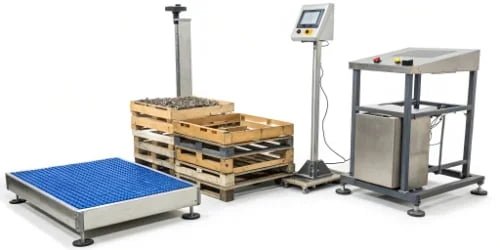
You wouldn’t use a screwdriver to hammer a nail. The same principle applies to weighing systems. The key is to match the tool to the task. At my company, we don’t just sell scales; we provide weighing solutions. That means we first work to understand the specific job that needs to be done. Sometimes a simple bench scale is all that’s needed. Other times, a complex, custom-built system is the only way to solve the problem. The goal is always to find the most efficient and cost-effective tool for that specific manufacturing application.
Matching the System to the Application
Let’s break down the most common types of intelligent weighing system2s and where they fit best. Many modern factories use a combination of these, all connected to a central software system to create a truly smart production environment3.
| System Type | Primary Use Case | Key Benefit for Manufacturing |
|---|---|---|
| Intelligent Bench Scales | Manual weighing, parts counting, quality spot-checks at workstations. | Offers high precision and versatility for smaller items, improving accuracy in formulation and component verification. |
| Intelligent Floor Scales | Weighing incoming pallets, outgoing shipments, and large containers. | Provides high capacity for managing bulk inventory and ensuring accurate shipping and receiving records. |
| In-line Checkweighers | Automated, high-speed weight verification on a conveyor line. | Guarantees every product meets weight specifications, rejects non-compliant items automatically, and reduces waste. |
| IoT Weighing Systems | Remote monitoring, real-time data analysis, process automation. | Connects scale data directly to cloud platforms, giving you powerful insights for process optimization and remote management. |
| Custom Weighing Systems | Unique applications like tank weighing, hopper weighing, or onboard vehicle scales. | Solves specific, non-standard weighing challenges that off-the-shelf products cannot address effectively. |
For example, a food processing client might use an IoT-enabled floor scale to weigh incoming raw ingredients, a series of intelligent bench scales4 for recipe formulation, and an in-line checkweigher on the packaging line. All these systems would feed data in real-time to the central ERP, which a software vendor like you would help manage. This creates a complete, transparent view of their material flow and production efficiency.
Conclusion
Remember your environment, product, cost, and standards. You know your needs best. This knowledge is your most powerful tool in selecting the right intelligent weighing partner for your success.
-
Find out how to choose the best weighing solutions tailored to your manufacturing needs. ↩
-
Explore how intelligent weighing systems can enhance your manufacturing processes and boost efficiency. ↩
-
Understanding the impact of your production environment can help you select the right weighing system. ↩
-
Learn how intelligent bench scales can improve accuracy in manual weighing tasks. ↩



Comments (0)