

Struggling with slow, inaccurate manual counting? These errors waste time and money, leading to messy inventory and lost profits. A smart scale is the simple solution you need.
A smart scale simplifies piece counting by using an initial sample to determine the Average Piece Weight (APW). It then divides the total weight of a bulk load by this APW to instantly and accurately calculate the number of pieces, saving time and eliminating human error.

I've been in the industrial weighing business for nearly two decades. I've seen countless companies struggle with the same tedious problem: counting thousands of tiny parts. It's a bottleneck that slows down everything from inventory checks1 to order fulfillment. But I've also seen the incredible change that happens when they adopt a new way of thinking. The solution isn't to count faster; it's to count smarter. This technology doesn't just speed up a task. It completely transforms your workflow. Let's break down exactly how it can do the same for you.
How to use scale to count pieces?
Starting with new technology can seem complex. You worry about a steep learning curve for your team and potential disruptions. But the process is actually very straightforward and intuitive.
To use a counting scale, you first place a small, known quantity of items on it to set a sample. The scale calculates the average piece weight. Then, put the full container on the scale, and it will show you the exact total count instantly.

The real power of a counting scale2 lies in its simplicity. We designed these systems to be easy to use right out of the box. You don't need to be a technical expert to get accurate results in minutes. It’s a simple, four-step process.
Step-by-Step Counting
- Create Your Sample: Start by placing a small, known number of your items on the scale. For example, you can use 10, 20, or even 100 pieces. A larger sample size generally leads to a more accurate Average Piece Weight (APW)3.
- Lock in the Weight: Press the 'Sample' or a similar key on the scale. The internal software instantly calculates and stores the APW. This is the reference point for all future counting of this specific item.
- Weigh the Bulk Load: Remove the sample pieces. Now, place the large box, bin, or container filled with the same items onto the scale.
- Get an Instant Count: The scale's display will immediately show the total number of pieces. It automatically does the math for you, dividing the total weight by the stored APW. It's that fast.
How does the smart scale work?
That instant calculation might feel like magic. You need to understand the technology behind it, especially if you plan to integrate it with your own software systems. It's all about reliable hardware working with smart software.
A smart scale works by using a high-precision load cell to convert weight into an electrical signal. A powerful microprocessor then processes this signal, runs the counting algorithm, and uses its connectivity ports (like USB or RS-232) to share data with your other business systems.
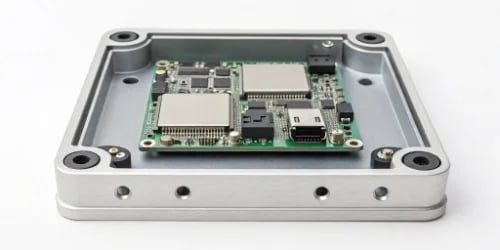
From the outside, it looks like a simple weighing machine. But inside, it’s a sophisticated data processing tool. As a manufacturer, I focus on making sure every component works together perfectly. This ensures that the data you get is not only fast but also incredibly accurate. For a software vendor, this reliability is everything. The scale becomes a trusted data source for your inventory or enterprise resource planning (ERP) system. Here are the core components that make it happen:
- High-Precision Load Cell: This is the heart of the scale. It's a transducer that turns the physical force of weight into a measurable electrical signal. The quality of the load cell determines the scale's sensitivity and accuracy. We use only high-grade load cells to ensure consistent and dependable measurements every time.
- Microprocessor and Software: This is the brain. It takes the raw signal from the load cell and turns it into useful information. Our 19 years of experience have gone into refining this software to be stable, fast, and user-friendly. It handles the APW calculation, tares the container weight4, and displays the final count.
- Connectivity Options: A smart scale5 needs to talk to other systems. That's why we build them with multiple connectivity options6, including RS-232, USB, and even IoT capabilities like Wi-Fi. This allows seamless data transfer7 to computers, printers, or your cloud-based software.
How do counting scales work?
You might wonder if a counting scale is just a regular scale with a calculator built-in. It's a fair question, but the process is more integrated and elegant. The principle behind it is simple and powerful.
A counting scale operates on the principle of Average Piece Weight (APW). It establishes this APW by weighing a small, known sample of identical items. It then calculates the total quantity by dividing the net weight of a large batch by the stored APW.
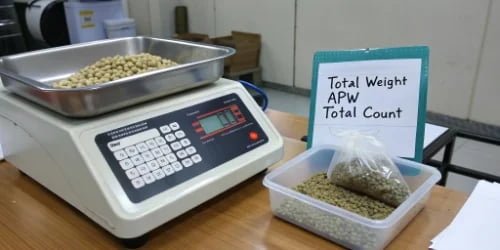
The core idea is a complete shift in thinking. Instead of counting items one by one, we use weight to solve the problem. It’s an example of using one physical property (weight) to accurately determine another (quantity). This is the key insight my team and I used when perfecting our counting systems. This method only works when the items you are counting are uniform in weight. Tiny variations are okay, but the sample must be truly representative of the whole batch.
Here's how this approach revolutionizes the workflow when compared to doing it by hand.
| Feature | Manual Counting | Scale Counting |
|---|---|---|
| Speed | Very slow, especially with small parts. | Extremely fast, almost instantaneous. |
| Accuracy | Prone to human error, fatigue, and miscounts. | Highly accurate and consistent every time. |
| Labor Cost | High. Requires dedicated staff time. | Low. Frees up employees for other tasks. |
| Data Flow | Requires manual data entry, risking errors. | Automates data transfer to other systems. |
This is how we help businesses solve packing and sorting tasks efficiently. We change the angle of the problem from "how many are there?" to "how much does the whole group weigh?"
Do those smart scales actually work?
You've seen the specs and heard the promises. But the most important question is, can you rely on this technology day in and day out? A faulty system could create bigger problems than it solves.
Yes, smart counting scales absolutely work and are extremely reliable for uniform parts. Their success depends on the scale's precision and a good initial sample. For thousands of businesses, they provide a clear return on investment by cutting labor costs, preventing errors, and streamlining inventory control.

I understand the skepticism. That’s why our approach is built on trust and proven performance. I remember a client who manufactures small electronic components. They spent two full days each month with a team of four people just counting resistors and capacitors for inventory. It was a huge drain on their resources. After they integrated two of our counting scales into their workflow, they reduced that entire process to just three hours with one person. The scales paid for themselves in less than two months.
Of course, the technology has its rules. The items must be uniform. You can't mix M4 and M5 screws in a bin and expect an accurate count. But when used correctly for batches of identical items, the accuracy is incredible. This is why our quality assurance is so critical. Every single scale we produce goes through a comprehensive series of tests8—for the load cell, the software, and the battery—before it ships. We guarantee that the machine you receive will deliver on its promise of speed and accuracy from day one.
Conclusion
Smart scales transform the tedious task of piece counting into a fast, accurate, and automated process. They boost your operational efficiency and bring a new level of reliability to your business.
-
Find out how smart scales can make inventory checks faster and more accurate. ↩
-
Discover the mechanics behind counting scales and their benefits for accurate inventory management. ↩
-
Understanding APW is crucial for accurate counting with smart scales, ensuring efficiency in inventory management. ↩
-
Understand the importance of taring in achieving accurate measurements with smart scales. ↩
-
Explore how smart scales can revolutionize your inventory process, saving time and reducing errors. ↩
-
Explore the various connectivity options that allow smart scales to integrate with your systems. ↩
-
Discover the methods of data transfer that ensure seamless integration with your business systems. ↩
-
Discover the rigorous testing processes that ensure the reliability and accuracy of smart scales. ↩



Comments (0)