

Struggling with complex hardware integrations? These delays waste development time and frustrate your team. Our scale's SDK/API offers a simple, fast solution for seamless connection.
Integrating your application is straightforward. We provide a clear, well-documented SDK and API, backed by our expert technical team. This ensures a quick and stable connection between your software and our scales, requiring minimal development effort from your side.

You've seen that integration1 is easy, but you probably want to know more about the actual process. As a company with our own front-end software development capabilities, we understand the importance of clear communication between systems. We designed our SDK/API2 with developers like you in mind. Let’s break down the process, explore potential challenges, and see how our approach makes everything smoother for your team.
What Are the Steps for Seamlessly Integrating Your Application with Our Scale’s SDK/API?
Facing project uncertainty because of unclear integration steps? Without a clear roadmap, you can't budget time or resources. We provide a simple, step-by-step process for guaranteed success.
Integration is a clear, four-step process. First, get developer portal access. Second, review our detailed documentation and code samples. Third, connect your application. Finally, test the integration. Our support team is ready to help you at every stage.
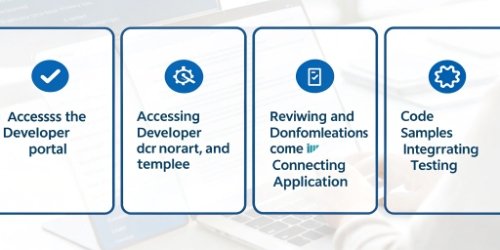
Step 1: Access and Setup
Getting started is simple. You just contact our team, and we will create a developer account for you. This gives you access to our secure developer portal3. There you will find the SDK, API keys, and all necessary credentials to begin.
Step 2: Documentation and Learning
We believe in clear, comprehensive documentation4. Once inside the portal, you will find guides that explain every API endpoint and SDK function. We also provide practical code samples5 in various languages to get your developers started quickly. A recent client of ours in the logistics software space told me they were able to understand our API structure in less than an hour, which was a huge relief for their project manager.
Step 3: Development and Testing
Your team can now start building. Using our provided tools, they can call weight data, trigger functions on the scale, and receive status updates. We offer a sandbox environment6 so you can test your integration thoroughly without affecting live production scales. This ensures everything works perfectly before you deploy. The table below outlines the streamlined process.
| Step | Action | Key Benefit |
|---|---|---|
| 1. Setup | Request access and receive credentials. | Quick and secure onboarding. |
| 2. Learn | Review documentation and code samples. | Reduces developer learning curve. |
| 3. Develop | Use SDK/API in a sandbox environment. | Risk-free development and testing. |
| 4. Deploy | Go live with support from our team. | Confident and smooth launch. |
How Can You Ensure Smooth Integration Between Your App and Our Intelligent Scale?
Worried about integration failures causing project setbacks? A failed integration wastes money and can damage your company's reputation. We have proven processes to guarantee a smooth connection every time.
Ensure a smooth integration with our comprehensive documentation, dedicated developer support, and a robust testing sandbox. This allows your team to build and validate the connection risk-free before deployment. We make sure you have everything you need for success.

The Power of Strong Support
Integration is not just about code; it's about partnership. We are an industrial scale manufacturer with our own software team, so we understand both sides of the process. Our technical support7 team is not a call center. They are the same engineers and developers who built the SDK/API. When you have a question, you talk to an expert who can solve your problem quickly. We pride ourselves on responsive, professional support because we know your project timeline8 depends on it.
Documentation That Works for You
We have all seen bad documentation. It is often confusing, outdated, or incomplete. That is why we invested heavily in creating clear, practical, and up-to-date resources. Our documentation includes not just technical specifications but also use-case examples and best practices9. We want your developers to feel confident, not confused, when working with our products.
Realistic Testing in a Sandbox
A key to smooth integration is testing in an environment that mimics reality. Our sandbox environment allows your application to interact with a virtual scale. You can simulate various scenarios, from simple weight requests to error conditions. This ensures your software handles everything gracefully. This pre-flight check is crucial for a flawless launch.
What Challenges Might Arise When Integrating Applications with Our Scale’s SDK/API?
Unforeseen integration challenges can completely derail your project schedule. Hidden problems often lead to frustrating scope creep and budget overruns. We help you anticipate and solve these challenges upfront.
Challenges like network configuration, data format mismatches, or handling asynchronous events can occur. Our SDK is designed to simplify these common issues. Plus, our documentation provides clear troubleshooting guides to resolve any problems quickly and keep your project on track.

Challenge 1: Network and Environment Differences
Your application and our scale need to communicate over a network. Sometimes, enterprise firewalls, proxy servers, or specific network protocols can create hurdles. We have been doing this for 19 years and have seen many different setups. Our documentation includes a dedicated section on network configuration10. We provide checklists for IT departments and clear instructions for establishing a stable connection. This is true whether you deploy on-premise, in a private cloud, or use a specific OS like Linux or Windows.
Challenge 2: Data Handling and Synchronization
A scale is a real-time device11. Your software needs to handle data streams effectively. A frequent challenge is ensuring that data format12s are aligned. Another is making sure your application can handle asynchronous events13, like a weight becoming stable. Our API standardizes data output into common formats like JSON. Our SDK provides simple event listeners so your application can react instantly to scale events without complex polling logic. This saves your team significant development effort.
Challenge 3: In-House Expertise Gap
Sometimes, a client's software team might not have deep experience with hardware integration. This is a common concern we hear. That is exactly why we built our support system. Think of us as an extension of your team. We can provide the specific guidance needed to bridge any knowledge gaps. We ensure a smooth process regardless of your team's prior experience.
How Does Our Intelligent Scale’s SDK/API Enhance Application Compatibility?
Need your solution to work across different platforms? Being locked into a single technology limits your market reach and future growth. Our flexible SDK/API is designed for maximum compatibility.
Our SDK/API uses standard RESTful protocols and offers libraries for popular languages. This ensures your application connects seamlessly, whether it's a desktop, web, or mobile app running on Windows, Linux, or in the cloud, maximizing your compatibility.

Built on Universal Standards
To ensure broad compatibility, we built our API on principles that are universal in modern software development. We use a RESTful architecture, which is the standard for web services today. This means any programming language or platform that can make a standard HTTP request can interact with our scales. Your developers will not need to learn any proprietary or outdated protocols. Data is exchanged in JSON format. This format is lightweight, human-readable, and easily parsed by virtually every modern development framework. This approach future-proofs your integration and gives your team the freedom to use the tools they know best.
Platform and Language Agnostic
We know that software vendors14 serve diverse markets. Your solution might be a C# desktop application for Windows. It could be a Python-based server on Linux, or a JavaScript web application running in a browser. We designed our solution to support all of them. Our SDKs provide ready-made wrappers for popular languages. And even without an SDK, the underlying REST API is accessible from any environment. This flexibility empowers you to expand your business. You can deploy your integrated solution wherever your customers are, without being limited by our hardware.
Conclusion
In short, our well-documented SDK/API, expert support, and commitment to open standards make integrating with our intelligent scales a simple, fast, and reliable process for any software application.
-
Explore best practices for integration to avoid common pitfalls and ensure project success. ↩
-
Understanding SDK/API is crucial for seamless integration, enhancing your software's capabilities. ↩
-
Learn how a developer portal can streamline your integration process and provide essential resources. ↩
-
Discover the key elements of effective documentation that can simplify your development process. ↩
-
Accessing code samples can significantly reduce your learning curve and speed up development. ↩
-
Understanding sandbox environments can help you test integrations safely without affecting live systems. ↩
-
Effective technical support can be a game-changer in resolving integration issues quickly. ↩
-
Effective timeline management is key to successful project delivery; learn how to optimize it. ↩
-
Adopting best practices can streamline your integration process and improve outcomes. ↩
-
Proper network configuration is essential for successful integration; learn how to set it up correctly. ↩
-
Understanding real-time devices is crucial for applications that require immediate data processing. ↩
-
Familiarize yourself with data formats like JSON to ensure smooth data exchange between systems. ↩
-
Learn techniques for managing asynchronous events to improve your application's responsiveness. ↩
-
Understanding integration from a vendor's perspective can enhance collaboration and success. ↩



[…] problem disappeared overnight when we provided them with scales that had software capable of direct API integration1. It's not just about getting the weight right; it's about making that data instantly and […]
[…] plug-and-play experience. We provide your development teams with the Software Development Kits (SDKs3) they need to communicate with our hardware effortlessly. This isn't about forcing you to adapt to […]