
Worried your high-precision lab scale might fail unexpectedly? This uncertainty can disrupt critical experiments. It's a common problem for labs that rely on accurate data for their work.
A well-maintained precision laboratory scale can last between 5 and 15 years. The exact lifespan depends heavily on the quality of the scale, how often it is used, and the consistency of its care and calibration. Some high-end models can even exceed 20 years.
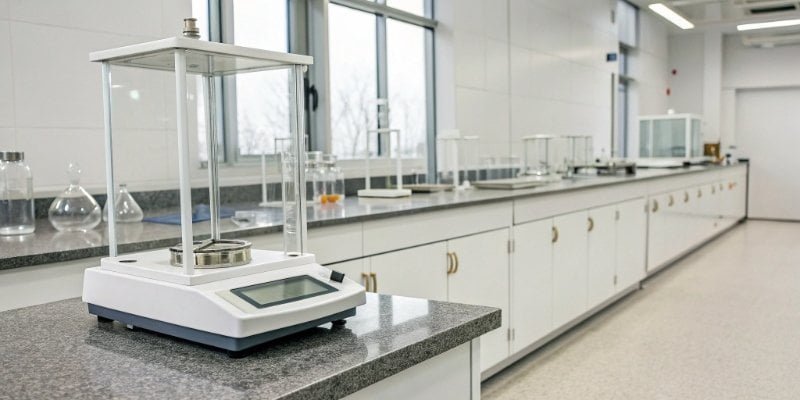
Investing in a precision lab scale is a significant decision for any laboratory or software company integrating with such hardware. You expect it to perform reliably for years. But you also know that no equipment lasts forever. The real question is not just how long it can last, but how you can ensure it delivers accurate results throughout its entire service life. Understanding the factors that affect its longevity and knowing the signs of when to replace it are key to maintaining operational excellence. Let's explore this topic in more detail.
What is the Expected Lifespan of a Precision Laboratory Scale?
Are you wondering if your scale's lifespan will match its price tag? Budgeting for new equipment is tough when you can't predict how long your current tools will last.
The expected lifespan ranges from 5 years for basic models under heavy use to over 15 years for premium scales with proper maintenance. The key is the combination of manufacturing quality and the environment. A controlled lab setting significantly helps a scale last longer than one in a harsh industrial place.

The lifespan of a precision scale is not one-size-fits-all. Several factors create this wide range. As manufacturers, we have seen this firsthand. A gentle, climate-controlled laboratory is the perfect home for a scale, protecting sensitive electronic components from dust, moisture, and temperature swings1. This is very different from the factory floor where our industrial scales operate. The demands of a lab, including high precision down to 0.01mg, also mean these scales are built with extremely high-quality components. When you combine this with the rigorous maintenance2 schedules common in laboratory settings, you create the best possible conditions for a long life. Below is a simple breakdown of what you might expect.
| Scale Tier | Usage Intensity | Expected Lifespan |
|---|---|---|
| Entry-Level | Heavy Daily Use | 5-7 years |
| Entry-Level | Light Weekly Use | 7-10 years |
| Mid-Range | Heavy Daily Use | 8-12 years |
| High-End | Heavy Daily Use | 12-15+ years |
This table shows that investing in a higher-quality scale often pays off with a longer, more reliable service life, especially when it's a critical part of your daily workflow.
How Can You Extend the Life of Your Precision Lab Scale?
Do you want to get the most out of your equipment investment? Replacing a lab scale is expensive and disruptive. You need a simple way to protect your asset.
You can significantly extend your scale's life through consistent, proper care. This includes regular professional calibration, daily user checks, gentle handling, and keeping the scale clean and free from spills or debris. Following these simple steps protects your investment and ensures accuracy.

From my 19 years of experience, I can tell you that user habits are just as important as the scale's build quality3. A top-of-the-line scale can fail early if misused, while a modest one can last for a decade with great care. Simple, consistent routines make all the difference. Think of it like a car; you wouldn't skip oil changes and expect the engine to last. Your precision scale is a finely tuned instrument that needs the same level of attention to perform well for years.
Key Maintenance Practices
- Regular Calibration: This is non-negotiable. Professional calibration4 should happen at least annually. For critical applications, it might be quarterly. This not only ensures accuracy but can also catch potential problems before they become serious failures. It's the best health check you can give your scale.
- Proper Cleaning: Always use a soft, lint-free cloth and approved cleaning solutions5. Never spray liquid directly onto the scale. Follow the manufacturer's guidelines to avoid damaging sensitive sensors or displays. Spills should be cleaned up immediately to prevent corrosion.
- User Training: Ensure everyone who uses the scale knows how to handle it. This includes not dropping items onto the pan, avoiding overloading the scale, and allowing it to warm up properly before use. Simple training prevents the most common types of damage.
I remember a client who managed a university research lab6. They implemented a simple daily checklist for cleaning and checking with a reference weight. They doubled the average lifespan of their scales compared to other departments, saving their budget thousands of dollars.
What Factors Influence the Durability of Lab Scales?
Have you ever wondered why two identical scales have different lifespans? It can be frustrating when one fails years before the other, causing unexpected costs and downtime for your projects.
Durability is influenced by four main factors: the initial build quality and materials, the stability of the operating environment, the consistency of maintenance and calibration, and the training and care of the operators. Each factor plays a critical role in how long the scale will perform accurately.
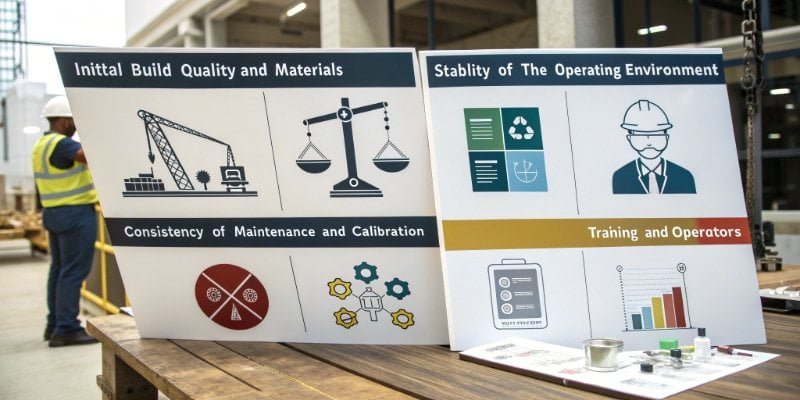
As an OEM/ODM provider, we focus heavily on the first factor: build quality. A scale is a complex piece of equipment, and its longevity starts with the design and the materials we choose. However, once that scale leaves our factory, its life is in the hands of the user and their environment. It’s a partnership. We build it to last, but the user's actions will determine if it actually does. Let's break down these influencing factors.
The Core Influences on Durability
- Build Quality: This is the foundation. It includes the quality of the load cell7, the stability of the housing, and the reliability of the internal electronics. A scale with a robust metal housing will naturally withstand more wear and tear than one made of cheap plastic.
- Operating Environment: Lab scales love consistency. Big swings in temperature and humidity can cause internal components to expand and contract, leading to drift and failure over time. Drafts from air vents and vibrations from other machinery can also strain the sensitive weighing mechanism.
- Maintenance Routine: A scale that is regularly cleaned and calibrated will always outlast one that is neglected. Dust and chemical residue can work their way inside the housing, causing damage over time. Regular calibration ensures the scale isn't being pushed past its limits.
The impact of these factors can be summarized in the following way:
| Factor | Low Impact (Longer Life) | High Impact (Shorter Life) |
|---|---|---|
| Environment | Stable temperature, low vibration | Fluctuating temp, high vibration |
| Usage | Trained users, careful handling | Untrained users, dropping items |
| Maintenance | Regular calibration and cleaning | No maintenance schedule |
| Quality | High-grade materials, robust design | Low-cost components, plastic housing |
When Is It Time to Replace a Laboratory Scale for Optimal Performance?
Are you using a scale that might be costing you accuracy? An old, unreliable scale can compromise your data integrity and lead to costly errors in research or production processes.
It's time to replace your scale when it requires frequent recalibration, shows inconsistent or drifting readings, has visible physical damage, or lacks the modern connectivity features, like data output, that your workflow requires. Waiting for a complete failure is often too late.
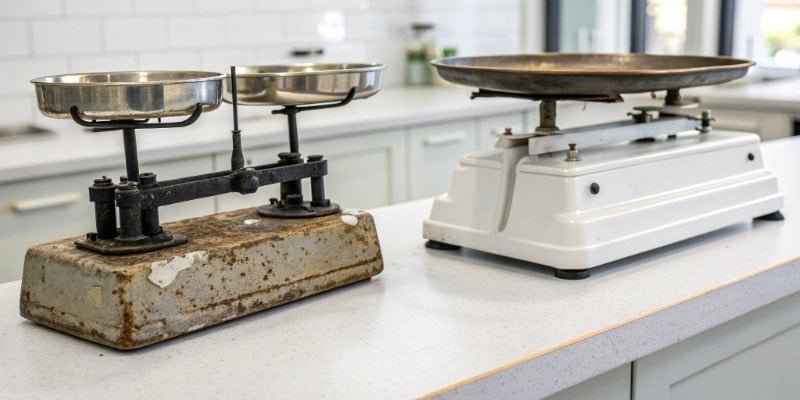
Deciding to retire a piece of equipment that still "works" can be tough. But with a precision instrument like a lab scale, performance degradation is a more important signal than outright failure. I’ve spoken with many technical directors who delayed a replacement, only to discover later that months of data were flawed due to a drifting scale. The cost of those flawed results was far greater than the cost of a new scale. For our clients in the software space, a lack of modern data integration is another huge reason to upgrade. An old scale without a USB or Ethernet port creates a data bottleneck in an otherwise automated system.
Clear Signs It's Time for an Upgrade
- Constant Need for Calibration: If you find your team has to calibrate the scale daily or even multiple times a day just to get a stable reading, the load cell is likely wearing out.
- Inconsistent Results: If you weigh the same standard weight multiple times and get different readings beyond the accepted tolerance, you can no longer trust the scale. This is a major red flag.
- Lack of Features: As labs become more connected, scales need to keep up. If your scale cannot communicate with your LIMS or other software systems, it is hindering your lab's efficiency and creating opportunities for manual data entry errors.
Here's a quick guide to help your decision:
| Symptom | Potential Problem | Recommended Action |
|---|---|---|
| Readings drift slowly | Load cell fatigue or damage | Professional service or replace |
| Fails calibration test8 | Major internal fault | Replace immediately |
| Physical damage/corrosion | Compromised integrity | Replace immediately |
| No data output9 options | Obsolete technology | Upgrade for efficiency |
Conclusion
A quality lab scale is a long-term investment. Its lifespan depends on its initial quality, its environment, and most importantly, the care you give it through regular maintenance and proper use.
-
Temperature stability is crucial for maintaining scale accuracy and longevity. ↩
-
Proper maintenance can significantly extend the life of your lab equipment and ensure accurate results. ↩
-
Understanding build quality helps in selecting durable and reliable lab scales. ↩
-
Calibration ensures accuracy and reliability, which are crucial for experimental integrity. ↩
-
Using the right cleaning solutions protects sensitive components and maintains accuracy. ↩
-
Best practices can help ensure that your research data remains reliable and accurate. ↩
-
Understanding load cells can help you appreciate the technology behind accurate measurements. ↩
-
Understanding calibration tests can help you ensure your scale is functioning correctly. ↩
-
Modern scales with data output capabilities enhance efficiency and reduce manual errors. ↩


Comments (0)