
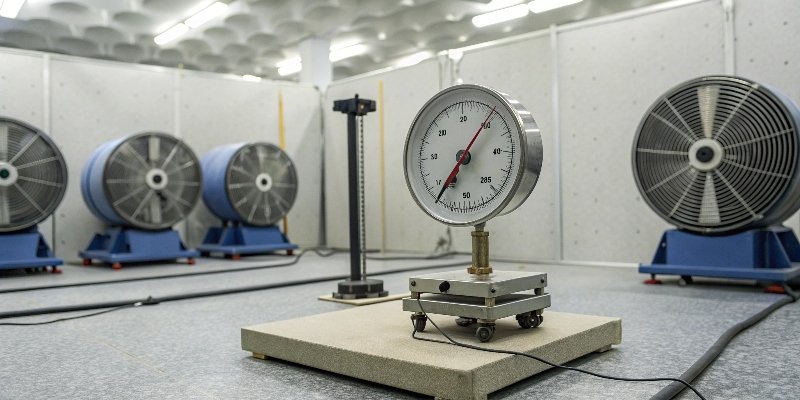
Are your scale readings frustratingly inconsistent? These errors can disrupt your processes and cost you money. The problem is often the environment your scale operates in, not the scale itself.
To get accurate readings, you must control the environment. Temperature changes cause material in the scale's sensor to expand or contract, causing drift. Air drafts create pressure on the weighing pan. Vibrations from the floor or bench make the reading unstable. Managing these ensures precision.

Over my 18 years in the industrial scale business, I’ve seen this countless times. A client invests in a top-of-the-line weighing system but gets unreliable data. They blame the hardware, but a quick investigation often points to a drafty room or a shaky workbench. These environmental factors are like invisible gremlins sabotaging your accuracy. Understanding how they work is the first step to getting the reliable data you depend on. Let's explore exactly how these factors interfere with your measurements and what you can do about them.
Why are my scale readings fluctuating or inconsistent?
Are your scale’s numbers jumping all over the place? This inconsistency can ruin your data and compromise product quality. Let’s pinpoint the common, often overlooked environmental causes.
Fluctuating readings usually come from an unstable environment. Air currents from vents, people walking by, or even slight temperature shifts can make the scale's sensitive load cell give inconsistent results.

When a customer tells me their readings are unstable, I immediately ask about the scale’s location. More often than not, the issue isn't a faulty scale but one of three environmental culprits. It's crucial for your team to understand these so you can trust the data your systems rely on.
The Three Main Culprits
- Temperature Changes: A scale's load cell is a finely tuned instrument, often containing metal components. As the room temperature changes, these components expand or contract. This physical change alters the sensor's electrical resistance, leading to "sensor drift1." The scale's zero point can shift, or its sensitivity can change, making a 1kg weight read as 1.001kg. Extreme or rapid temperature swings are the worst offenders.
- Air Drafts: High-precision scales are sensitive enough to measure a feather. A gentle breeze from an HVAC vent or an open door is like a constant, invisible force pushing on the weighing pan. This creates "buoyancy interference2" and makes the reading bounce around, never settling on a stable value.
- Vibrations: Vibrations from heavy machinery, nearby elevators, or even footsteps can travel through the floor and up the workbench to your scale. This constant shaking makes it impossible for the internal mechanisms to get a stable reading. Over time, strong vibrations can even damage the delicate internal structure of the load cell.
| Environmental Factor | How It Affects the Scale | Result |
|---|---|---|
| Temperature | Causes sensor components to expand/contract | Inaccurate readings, zero point drift |
| Air Drafts | Creates pressure and lift on the weigh pan | Unstable, fluctuating numbers |
| Vibrations | Shakes the entire weighing mechanism | Jumpy readings, potential sensor damage |
How can you create a stable environment for a high-precision balance?
Do you need rock-solid, repeatable measurements every time? An unstable environment can sabotage even the most advanced scale. Here is how you can build a stable weighing station.
Place your scale on a solid, vibration-free table far from doors, windows, and HVAC vents. Keep the room temperature constant. For high-precision models, always use a draft shield.

Creating a "weighing sanctuary3" is critical, especially when integrating scales with software that demands high accuracy. The goal is to isolate the scale from as many external interferences as possible. As a manufacturer, we design our scales to be robust, but they perform best in a controlled space. Here are the practical steps we advise all our clients to take.
Building Your Fortress of Accuracy
-
Vibration Control: The foundation is key. Use a dedicated, heavy weighing table, preferably an anti-vibration table made of granite or steel. These are designed to absorb and dampen vibrations from the floor. For larger industrial scales, we sometimes recommend a separate concrete foundation that isn't connected to the main factory floor. At a minimum, place the scale in a low-traffic corner of the room, away from slamming doors or heavy equipment.
-
Airflow Management: A draft shield4 is non-negotiable for any balance with a readability of 0.001g or better. For larger scales without shields, strategic placement is everything. Position them away from air conditioning vents, fans, windows, and doorways. Even the heat rising from other electronic equipment can create air currents.
-
Temperature Stability: Ideally, the scale should live in a climate-controlled room with minimal temperature fluctuations. Before using the scale for the first time each day, turn it on and let it acclimate to the room's temperature for at least 30-60 minutes. This allows its internal components to stabilize.
What are the best practices for calibrating a scale to ensure accuracy?
Is your scale truly accurate, or is it just giving you a consistent number? Incorrect calibration routines lead to hidden, costly errors. Let’s review the proper procedure for trustworthy results.
Calibrate your scale regularly with certified weights. Perform the calibration in the exact location where the scale is used, and only after it has warmed up. Document every calibration for quality control and traceability.

Calibration is like tuning a musical instrument. You can have the best violin in the world, but if it's out of tune, the music will be wrong. Similarly, a scale must be calibrated to provide accurate measurements in its specific environment. It's a fundamental process that connects the scale's electronic output to a known physical mass. As a solutions provider, ensuring your clients follow these best practices will guarantee their systems produce reliable data.
Your Calibration Checklist
-
When to Calibrate: Calibration isn't a one-time setup activity. It needs to be a routine. We recommend calibrating:
- On a regular schedule (daily, weekly, or monthly, depending on the application's tolerance).
- After the scale is first installed or moved to a new location.
- After a significant change in ambient temperature or air pressure.
- After the scale has been leveled or serviced.
-
How to Calibrate: Always use the correct certified calibration weights. The tolerance of the weight should be better than the scale's readability. For example, don't use a hardware store weight to calibrate a laboratory balance. Follow the manufacturer's instructions, which typically involves putting the scale in calibration mode and placing one or more specific weights on the pan. Many modern scales have an internal calibration feature, which is great for quick checks, but it doesn't replace routine external calibration with certified weights.
-
Documentation: Keep a logbook for every scale. Record the date, time, result (pass/fail), and the person who performed the calibration. This is essential for quality audits and for troubleshooting any future accuracy issues.
Besides the obvious, what other hidden factors can affect a scale's precision?
You've controlled the temperature, drafts, and vibrations, but are still seeing strange errors? Hidden factors can still undermine your precision. Let’s uncover these less obvious culprits.
Static electricity can attract or repel items being weighed. Magnetic fields from nearby equipment can interfere with the load cell. Even an unstable power supply or the operator's technique can introduce errors.

Once you've managed the big three—temperature, drafts, and vibration—you enter the next level of precision weighing. In my experience, these subtle factors trip up even experienced users. They can cause drifting readings or non-repeatable results that are incredibly hard to diagnose if you don't know what to look for. As a technical director or purchasing manager, being aware of these issues helps you design more robust systems and provide better support to your end-users.
Unmasking the Secret Saboteurs
-
Static Electricity: This is a major issue, especially in dry environments or when weighing insulating materials like plastic powders or films. A static charge on the sample or container can exert a force on the weigh pan, artificially increasing or decreasing the weight. You'll see the reading slowly drift. Using an anti-static ionizer or ensuring proper grounding can neutralize this effect.
-
Magnetic Fields: High-precision balances use an electromagnetic force restoration (EMFR) mechanism. Strong magnetic fields from large motors, stir plates, or other equipment can interfere with this mechanism, causing incorrect readings. Keep magnetic sources away from your sensitive scales.
-
Unstable Power Supply: A scale's electronics need clean, stable power to function correctly. Power sags, spikes, or "dirty" power from the grid can cause electronic noise, leading to fluctuating readings or system errors. We always recommend plugging high-precision scales into a dedicated circuit with a power conditioner or an uninterruptible power supply (UPS).
-
Operator Technique: The user can also be a source of error. Leaning on the bench while weighing, placing the sample off-center on the pan, or weighing a sample that is still warm or cold can all lead to inaccurate results.
Conclusion
Temperature, drafts, and vibration are key enemies of scale accuracy. By creating a stable environment, calibrating correctly, and watching for hidden factors, you ensure reliable measurements every time.
-
Learn about sensor drift and how to prevent it for more reliable scale readings. ↩
-
Explore buoyancy interference and its effects on scale accuracy to improve your weighing processes. ↩
-
Creating a weighing sanctuary can enhance measurement precision; learn how to set one up. ↩
-
A draft shield is essential for precision; find out how it helps maintain stable readings. ↩



[…] close the draft shield1. Position the balance away from vents and high-traffic […]