

Your truck scale's accuracy is drifting, causing financial losses with every weighment. Don't let inaccurate readings eat into your profits. Here’s how to ensure precision every time.
To calibrate a truck scale, you must first prepare the site and check the equipment. Then, perform a zero point calibration, a span (or range) calibration using certified weights, and finally, a corner load adjustment. This ensures accuracy across the entire platform.
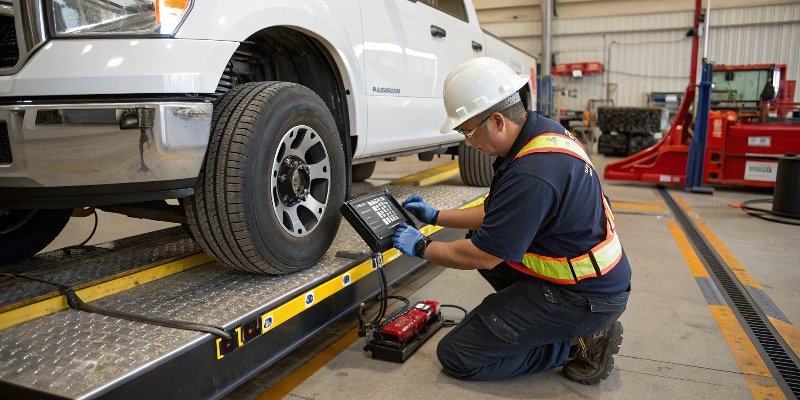
I've seen businesses lose thousands of dollars simply because of a poorly calibrated scale. It is a silent profit killer that slowly eats away at your margins. The good news is that the calibration1 process is straightforward when you know the steps. Understanding the 'how' is crucial for protecting your business, so let's walk through the exact procedure to get it right and keep your weighments honest.
How do you calibrate a truck scale?
You need to calibrate your scale but feel overwhelmed by the technical steps. A wrong move could make things worse. Here’s a simple, step-by-step guide to follow.
Calibration involves a three-stage process: zeroing the empty scale, calibrating the span with known weights, and adjusting for corner load differences. This ensures every part of the scale reads correctly. Following this sequence is key to achieving accurate results and legal-for-trade compliance.
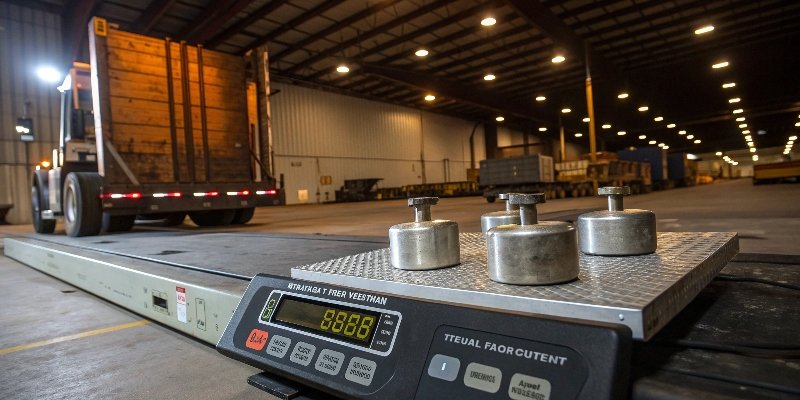
I'll break down the calibration process from my 18 years of experience. It's not as complex as it sounds if you treat it like a checklist. We always start with preparation.
Preparation is Key
Before you touch any buttons, you must prepare the environment. The scale platform must be perfectly level, with an error of less than 1 millimeter per meter. Make sure the area is free from strong electrical interference from motors or transformers. We also do a visual inspection of the load cells2 to check for any damage, corrosion, or loose connections. Using scales with IP68-rated sensors3 is a big advantage here, as they are better protected from moisture and dust, which are common causes of issues.
The Calibration Workflow
We follow a strict order for calibration to ensure consistent and reliable results. I have created a table that simplifies the core steps my team and I use every day.
| Step | Action | Key Detail |
|---|---|---|
| 1. Zero Calibration | Clear the scale deck completely. Enter calibration mode and save the zero point. | We recommend repeating this 3 times to get a stable, accurate average. |
| 2. Span Calibration | Place certified test weights on the scale (e.g., 20 tons for a 100-ton scale). | Adjust the instrument's gain parameter until the display matches the test weight. |
| 3. Corner Calibration | Place about 1/3 of the scale's capacity on each corner of the deck, one at a time. | Adjust the junction box potentiometers until all corners read the same amount. |
Following this process carefully is the only way to ensure accuracy. Rushing these steps or skipping one will only lead to incorrect readings and problems down the road.
How often should truck scales be calibrated?
You're unsure if you're calibrating too often or not enough. Wasting money on unnecessary service or risking fines for non-compliance are both bad options. Let’s establish the right schedule.
The frequency depends on usage and regulations. For general industrial use, we recommend calibration every three months. For high-volume environments like ports, quarries, or mines, a monthly calibration is safer. Always check local legal requirements, as they take precedence.
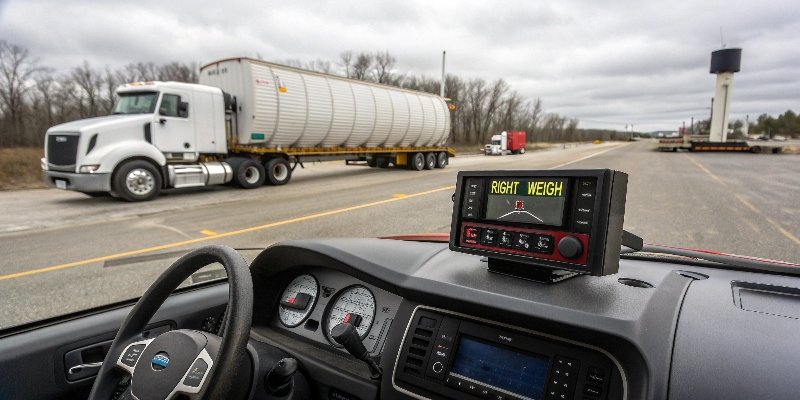
Deciding on a calibration schedule is a balancing act between cost and risk. Over the years, we've developed a simple framework to help our clients determine the best frequency for their specific operations. It’s not a one-size-fits-all answer.
Factors Influencing Calibration Frequency
Several factors can affect how often your scale needs attention. High traffic volume is the most obvious one. More weighments mean more wear and tear. Extreme weather changes can also cause metal components to expand and contract, affecting accuracy. The value of the goods being weighed is another key consideration. A scale weighing inexpensive gravel might need less frequent checks than one weighing valuable chemical products, where small errors add up to big financial losses.
Establishing a Baseline Schedule
Here is a general guide that we provide to our partners. You can use this as a starting point and then adjust it based on your operational needs and risk assessment.
| Usage Environment | Recommended Frequency | Rationale |
|---|---|---|
| Low Volume / Internal Use | Every 6-12 months | Lower risk of significant drift when the scale is not used heavily. |
| General Industrial Use | Every 3 months (Quarterly) | A good balance for most manufacturing or logistics operations. |
| High Volume / Harsh Environment | Every 1 month (Monthly) | Heavy use at ports, mines, or waste facilities causes faster wear. |
| After Maintenance or Relocation | Immediately | Any repair, like replacing a load cell, requires full recalibration. |
Also, I always stress to our clients the importance of keeping detailed calibration records. You should keep these logs for at least two years. This documentation is crucial for passing audits and maintaining your quality control standards.
How do you calibrate Right Weigh truck scales?
You have a Right Weigh onboard scale and the readings seem off. Calibrating an onboard system feels different than a static platform scale. Here’s how to approach it correctly.
Right Weigh onboard scales are calibrated by weighing the empty truck on a certified in-ground scale. Then, load the truck and weigh it again on the certified scale. You input these two values—empty and loaded—into the Right Weigh device to set its calibration.
While my company, Weigherps, specializes in static industrial scales, many of our clients also use onboard systems like Right Weigh in their logistics fleets. The underlying principle is the same: you have to teach the scale what an empty load and a full load feel like.
The Two-Point Calibration Method
Onboard scales don't use load cells like a traditional truck scale4. Instead, they typically estimate weight by measuring the pressure in the truck's air suspension system. The calibration process simply syncs this pressure reading with actual, certified weights5. It creates two reference points—empty and full—and the device calculates all the weights in between.
Step-by-Step Onboard Calibration
The process is actually much simpler than performing a corner load test on a static scale because there are fewer mechanical parts to adjust.
| Step | Action | Purpose |
|---|---|---|
| 1. Find a Certified Scale | Go to a public weighbridge or use a certified industrial truck scale you trust. | You absolutely need a reliable and accurate baseline weight. |
| 2. Weigh Empty | Weigh the truck completely empty with a normal amount of fuel. Record this weight. | This sets the zero point or "empty" reference for your onboard system. |
| 3. Input Empty Weight | Enter the calibration mode on your Right Weigh device and input the recorded empty weight. | The device now knows what pressure corresponds to "empty." |
| 4. Weigh Loaded | Load the truck to a known, heavy weight. Weigh it on the certified scale again. | This sets the span, or the "full" reference point. |
| 5. Input Loaded Weight | Enter the recorded loaded weight into the Right Weigh device and save the calibration. | The device now has two points of reference to make accurate estimates. |
This process makes your onboard scale a reliable tool for checking load distribution and avoiding overweight fines. However, it's important to remember it is an estimation tool, not a substitute for a certified static scale for commercial transactions where weights are used for billing.
How do you calibrate your weighing scale?
Your scale's readings are inconsistent, but you don't know where to start. Is it a simple fix or a major problem? Let's clarify the universal calibration principles.
To calibrate any weighing scale, you need to verify and adjust its zero point and its span. This is done by first ensuring the scale reads zero when empty, and then placing a known, certified weight on it and adjusting the scale until it displays the correct weight.
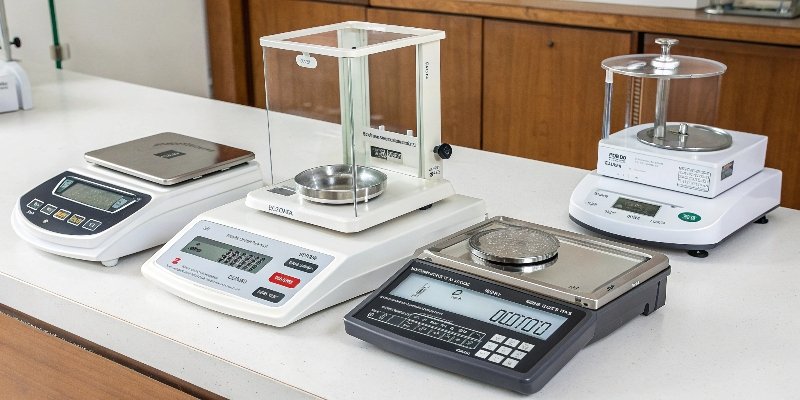
This is a broad question, but the core principles apply to everything from a small laboratory balance to a 100-ton truck scale. As a manufacturer for 18 years, I can tell you that we see the same fundamentals everywhere. The key difference is the scale of the tools you use.
The Importance of Certified Weights
You cannot calibrate a scale without a reference point that you can trust. This is where certified test weights are essential. I've seen people try to use things with an unknown or estimated weight, like a person or a barrel of water. This will only lead to an inaccurate calibration. Using a known, certified weight is the only way to guarantee that your adjustments are correct. It’s the foundation of any good calibration.
General Calibration Steps
Whether it’s a small bench scale in a workshop or a massive weighbridge on the road, the logic is consistent. The steps can be applied to almost any modern electronic scale.
| Step | General Principle | Truck Scale Example |
|---|---|---|
| 1. Stabilize & Zero | Ensure the scale is on a stable, level surface and clear of any load. Set the reading to '0'. | Clear the deck of all debris, wait for a stable reading, and press the 'Zero' button. |
| 2. Apply Test Weight | Place a known, certified weight on the platform. | Load the scale with certified test weights, often using 20% to 100% of its total capacity. |
| 3. Adjust & Verify | Adjust the scale's internal settings (often called 'gain') until the display matches the test weight. | Access the calibration menu on the indicator and adjust the parameters to match the test load. |
| 4. Test Linearity (Optional) | Check accuracy at multiple points across the range (e.g., 25%, 50%, 75% of capacity). | Perform a linearity test with different weight combinations to ensure accuracy for both light and heavy loads. |
If you find that the scale's deviation is greater than 0.3% and it cannot be corrected through these adjustments, it often points to a deeper issue. This could be a faulty load cell, a damaged cable, or a problem in the junction box. At that point, the equipment requires a professional inspection and repair.
Conclusion
Proper truck scale calibration is a non-negotiable process. Follow a regular schedule, always use certified weights, and keep detailed records to ensure accuracy, compliance, and protect your bottom line.
-
Understanding calibration frequency is crucial for maintaining accuracy; this link provides insights into best practices. ↩
-
Learn about load cells, their function in scales, and their impact on calibration accuracy. ↩
-
Learn how IP68-rated sensors can enhance the durability and accuracy of your weighing scales. ↩
-
Explore this resource to learn essential maintenance tips that can help you keep your truck scale accurate and reliable. ↩
-
Explore the importance of using certified weights in calibration to ensure accuracy and compliance. ↩



Comments (0)