

Choosing the right vendor for industrial scales can be a complex and risky decision. A wrong move can lead to integration headaches and unexpected costs. I'll show you how to choose wisely.
To select an industrial scale vendor, you must evaluate their technical capabilities, production quality, after-sales support, and total cost-effectiveness. The right partner understands your software integration needs and has a solid supply chain, often found in hubs like China, ensuring innovation and reliability for your business.

Finding the right partner is more than just getting a good price. In my 18 years of experience manufacturing scales, I’ve learned that a vendor is an extension of your own team. For you, a software vendor, this is even more critical. You need a hardware partner who speaks your language—the language of integration, data, and reliability. The journey from sourcing to a successful partnership requires a clear roadmap, and that’s what I want to share with you. Let’s dive into what makes a vendor truly great, and how you can find one that will help your business grow.
What are the criteria for choosing a supplier?
You have dozens of potential suppliers, and every website claims they are the best. It's easy to get lost in the noise and make a choice you'll regret. Let's focus on the criteria that truly matter.
Key criteria include technical expertise, especially in software integration, quality certifications like CE, comprehensive after-sales service, and a transparent pricing structure. A supplier's ability to customize solutions for your market and provide robust documentation is also crucial for a successful partnership.

In today's market, an industrial scale is no longer just a simple weighing tool. It’s a smart device, a data collection point at the heart of your client's operations. The best suppliers understand this. They are not just metal fabricators; they are technology companies. When I built my team, I brought together experts from industrial weighing, automation control, and IoT. This is the kind of cross-disciplinary expertise you should look for. A supplier’s location is also a strategic advantage. I based my factory in China because it has the world's most complete supply chain1 and a massive pool of skilled talent. This allows us to innovate quickly and cost-effectively, a benefit we pass directly to our partners. A good supplier isn't just selling you a product; they are offering you a competitive edge built on a foundation of deep expertise and supply chain mastery.
Beyond the Basics: What Really Matters?
| Criterion | Why It's Critical for a Software Vendor | What to Look For |
|---|---|---|
| Technical & R&D Strength | Your software needs a stable, advanced hardware platform. Poor hardware integration will reflect badly on your product. | An independent R&D team with experts in IoT, automation, and software. Ask about their API and integration support. |
| Quality Control System | Faulty hardware leads to downtime and angry support calls for you. Reliability is non-negotiable. | A multi-step quality inspection process. We test every single unit for weight, battery, and software before it ships. |
| Customization Capability | Your clients have unique needs. A one-size-fits-all scale vendor limits your market potential. | A vendor who listens to your needs and can tailor solutions. They should see you as a partner, not just a purchase order. |
| After-Sales Support | When a problem occurs, your reputation is on the line. Slow or incompetent support from your vendor is a liability. | A clear warranty (we offer 12 months) and a dedicated, responsive technical support team. |
What are the 7 steps of the supplier selection process?
Starting the supplier selection process without a plan can feel chaotic. You risk missing critical details or getting bogged down in comparisons. Let's create a clear, actionable plan.
The 7 steps are: 1. Identify needs. 2. Search for suppliers. 3. Request for Information (RFI). 4. Evaluate and shortlist. 5. Request for Proposal (RFP) & negotiate. 6. Select and contract. 7. Onboard and monitor performance. This ensures a thorough, organized selection.

Following a structured process removes guesswork and emotion from the decision. As a technical director or purchasing manager, you know the value of a good system. This framework helps you dig deep and compare suppliers on an even playing field, ensuring no stone is left unturned. I've seen many companies rush this process, only to face compatibility issues and service problems down the line. A little discipline upfront saves a lot of trouble later. This isn't just about ticking boxes; it's about building a foundation for a long-term, profitable relationship. It’s a method I use myself when evaluating my own upstream suppliers for raw materials and components, because a strong chain is built from strong links.
A Step-by-Step Guide to a Perfect Match
- Identify Business and Technical Needs: Before you even start searching, document everything. What level of accuracy is needed? What environment will the scale operate in? Most importantly for you, what are the software integration2 requirements, data output formats3, and security protocols?
- Initial Supplier Search: Use professional tech websites, industry trade shows, and peer recommendations to create a long list of potential vendors. Look for vendors who specialize in your target market.
- Request for Information (RFI) & Initial Screening: Send a brief RFI to your long list to gather basic information about their company, product range, and capabilities. Weed out any that clearly don't meet your core requirements.
- Evaluate and Shortlist: Based on the RFI responses, narrow your list down to 3-5 serious contenders. Now is the time for deeper research, like checking their reputation and client feedback.
- Request for Proposal (RFP) & Negotiation: Send a detailed RFP to your shortlist. This should include your specific technical specs, support requirements, and desired pricing. This is where you might request a proof-of-concept trial.
- Final Selection and Contracting: Choose the supplier that offers the best overall value—a balance of technology, quality, support, and cost. Carefully review the contract, paying close attention to warranty, service-level agreements4 (SLAs), and intellectual property.
- Onboarding and Performance Monitoring: The work isn't over. Integrate the supplier into your processes. Set up regular check-ins and key performance indicators (KPIs) to monitor their performance and ensure they continue to meet your standards.
What are the 5 key supplier evaluation criteria?
You've done the research and narrowed your list down to a few potential suppliers. Now, how do you compare them fairly to make the final call? Let's use five key criteria to score them.
The 5 key evaluation criteria are: 1. Technical Capability, assessing R&D and software skills. 2. Quality Assurance, reviewing their testing processes. 3. Cost-Effectiveness, looking at long-term value. 4. Service & Support, judging responsiveness. 5. Reliability & Reputation, confirming their track record.
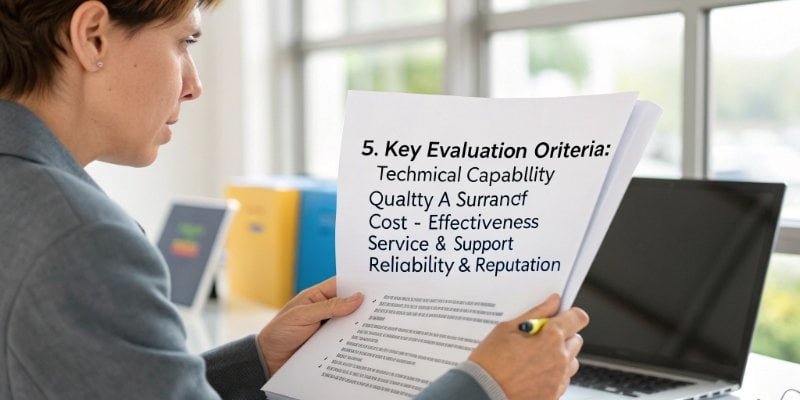
Over my 18 years in this business, I’ve found that these five areas are where a supplier partnership either thrives or fails. A low price is tempting, but it means nothing if the product is unreliable or if you can't get technical support when you need it. For a software provider like you, technical capability is paramount. You need to know that your hardware partner can keep pace with your innovation. I remember working with a software company that was launching a new AI-driven inventory system. They chose a cheap scale vendor, and the hardware couldn't provide data fast enough. Their launch was delayed by six months as they scrambled to find a new partner. That's why evaluating a supplier is about assessing their overall value, not just their price tag.
Rating Your Potential Partners
Use a simple scoring system (e.g., 1-5) to rate each of your shortlisted suppliers against these five criteria.
- 1. Technical Capability: Does their team understand modern software development and IoT? Ask to speak directly with their engineers. A good partner will welcome this. A great one will show you their development roadmap and how it aligns with future tech trends like cloud computing and AI.
- 2. Quality Assurance: Don't just take their word for it. Ask for their quality control documentation. What certifications do they hold, like CE? A committed supplier will be transparent and proud of their processes, like our comprehensive pre-shipment testing on every single scale.
- 3. Cost-Effectiveness (Total Cost of Ownership): Look beyond the sticker price. Factor in potential costs from maintenance, downtime, and the technical support your team might need. A slightly more expensive but highly reliable scale with excellent support often has a much lower total cost over its lifespan.
- 4. Service & Support: This is where partnerships are tested. What are their guaranteed response times? Who will you be talking to—a call center agent or an actual technician? A 12-month warranty is a good start, but the quality of the support behind it is what counts.
- 5. Reliability & Reputation: How long have they been in business? Can they provide references from clients similar to you? An experienced OEM/ODM manufacturer has a proven track record of bringing products to market, navigating complex supply chains, and delivering on promises.
How to choose a weighing scale?
You've finally selected your ideal vendor partner. Now you face another choice: which specific scale model is right for your project? The wrong model can be just as bad as the wrong vendor.
To choose a weighing scale, consider its capacity, platform size, and required features like software connectivity or IoT capability. Match the scale's specifications directly to your specific application and operational environment to ensure accuracy, efficiency, and a good return on investment.

Choosing the right scale model is the final piece of the puzzle. The best vendor in the world can't help you if the hardware isn't suited for the job. This is where a true partnership shines. A great supplier acts as a consultant. They won't just send you a catalog; they will ask detailed questions about your client's workflow, the environment, and the data you need to capture. I always tell my team that our job is to provide clients with a targeted and cost-effective solution, not just a product. The right scale should feel like a natural extension of your software and the user's workflow, something that makes their job easier, not harder.
Matching the Scale to Your Needs
Think of this as a final checklist before you place an order. A good vendor will walk you through this process.
- Application and Environment: What is being weighed? Where will the scale be used? A dusty warehouse needs a scale with a high IP rating for protection, while a lab requires one with extreme precision. The physical environment dictates the durability and materials required.
- Capacity and Readability: Capacity is the maximum weight the scale can handle. Readability is the smallest increment it can display. You need a capacity5 that can handle the heaviest loads, but a readability that is fine enough for your required precision. Don't pay for precision you don't need.
- Connectivity and Features: This is your domain. What data protocols does the scale need to support (e.g., RS-232, USB, Ethernet, Wi-Fi)? Does it need built-in functions like parts counting or checkweighing? Ensure the scale's firmware and hardware can deliver the data and functionality your software expects.
- Platform Size and Type: The scale platform must be large enough to safely accommodate the items being weighed. Consider the type as well—a low-profile floor scale is great for rolling carts on, while a compact bench scale is perfect for workstations.
Conclusion
Choosing the right industrial scale vendor is about finding a technology partner. Focus on their technical expertise, quality, and support to ensure long-term success for your business.
-
Learn how a strong supply chain can enhance the reliability and innovation of your scales. ↩
-
Explore best practices to ensure seamless software integration with your chosen scales. ↩
-
Explore the various data output formats to ensure compatibility with your systems. ↩
-
This resource outlines key elements to include in SLAs for better vendor relationships. ↩
-
Learn how to assess the capacity needs for your specific applications. ↩



Comments (0)