

Confused by scale specs like resolution and accuracy? This confusion often leads to costly mistakes, preventing you from getting the reliable data your business depends on.
A high-resolution scale can detect and display very small changes in weight. However, this is different from accuracy, which is how close the measurement is to the true, correct weight. A scale can be high-resolution but still inaccurate.

I've been manufacturing industrial scales1 for 18 years, and I've seen this confusion trip up even experienced managers. People often think that a scale showing many decimal places must be super accurate. This isn't always true. Understanding the real meaning behind these terms is the first step to choosing the right tool for the job. Let's break down what these concepts really mean for your operations and how you can get the data you can truly trust.
What is the difference between scale resolution and readability?
Do you pick a scale just by looking at its fancy digital display? This can lead to big errors in your work, costing you time and materials. Let's clarify.
Readability is the smallest increment a scale's display can show (e.g., 0.01g). Resolution is the smallest change in weight the scale's sensor can actually detect. A scale can have high readability but low resolution, meaning the display is misleading.

Let's dive deeper into this. Think of readability2 as what you see. It's a feature of the screen. If the display shows two decimal places, like 10.55g, its readability is 0.01g. Now, resolution is about what the scale can feel. This is determined by the quality of the internal load cell3 or sensor. A high-quality sensor can detect a tiny piece of paper being added to the scale. A low-quality one might not register that change at all, even if its screen has enough digits to show it. In my experience, this is where many software integrators face issues. Their systems need data that reflects real-world changes. A high-readability, low-resolution scale sends misleading information, which can corrupt an entire automated process4.
| Feature | Readability | Resolution |
|---|---|---|
| What is it? | The smallest number shown on the display. | The smallest weight change the scale can detect. |
| Example | 0.01g | 0.05g |
| Tells you | How detailed the screen is. | How sensitive the internal sensor is. |
How to determine the accuracy of a scale?
You need a truly accurate scale for your process. Relying only on the manufacturer's spec sheet can be risky and lead to quality control failures down the line.
To determine a scale’s accuracy, you must test it with certified calibration weights. Place a weight of a known value on the scale and compare the reading. Repeat this test across the scale's capacity to ensure it is accurate everywhere.

Accuracy simply means how close a measurement is to the real, true value. The only way to know this for sure is to test it. At our production facility, we perform these tests on every single scale before it leaves the door. We use certified weights, which are the industry standard for truth. You can do this too. First, check for repeatability5 by placing the same weight on the scale multiple times. The readings should be identical or extremely close. Second, check for linearity6. This means testing the scale at different points in its capacity, like 25%, 50%, and 100%. Some scales are accurate with light loads but inaccurate with heavy ones. This test reveals that. Remember, factors like vibration or air drafts can also affect accuracy7, so always test in a stable environment.
| Test Type | Purpose | How to Perform |
|---|---|---|
| Repeatability | Checks for consistency. | Place the same weight on the scale 5-10 times. |
| Linearity | Checks accuracy across the entire weigh range. | Use different weights (low, mid, high capacity). |
| Corner Load | Checks if the reading changes with placement. | Place a weight on each corner and in the center of the pan. |
What is the difference between scale accuracy and resolution?
Many people in the industry use "accurate" and "high-resolution" to mean the same thing. This big mistake leads to buying the wrong equipment and getting flawed data.
Accuracy is how close the scale's reading is to the actual weight. Resolution is the smallest weight change the scale can detect. A scale can have high resolution and detect tiny changes, but still be inaccurate if its readings are consistently wrong.
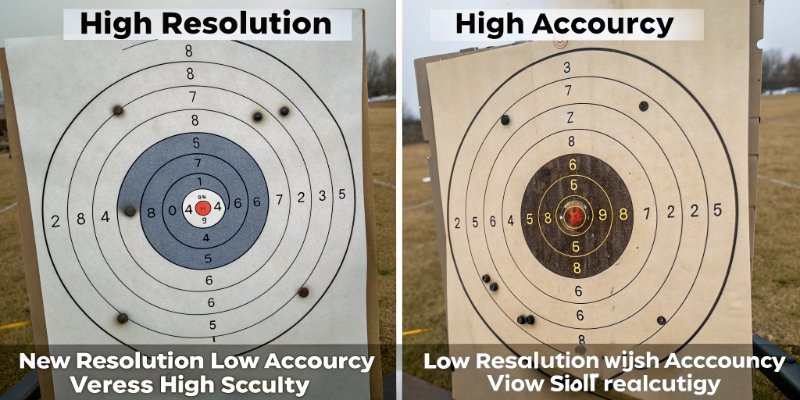
This is the most critical distinction I explain to my clients. I want you to imagine a target. An archer with high resolution but low accuracy will shoot a tight cluster of arrows (very consistent), but the whole cluster misses the bullseye. The scale is consistent but consistently wrong. Now, an archer with high accuracy but low resolution will have arrows scattered around the bullseye. They aren't as precise with each shot, but their average is right on target. For a software vendor, knowing this difference is vital. If your customer is tracking a slow chemical reaction, you need high resolution to see the tiny changes, even if the absolute weight is off by a fraction of a gram. You can correct that offset in your software. But for a shipping company, accuracy is everything. They need the weight to be correct for billing.
| Concept | What It Means | Analogy |
|---|---|---|
| High Resolution | Can detect very small changes. | Tight group of arrows |
| High Accuracy | Measurement is very close to the true value. | Arrows hit the bullseye |
Why might you seem heavier on some digital scales?
You step on a new digital scale and the number is higher than you expect. Is the new scale broken, or is your old one wrong? Let's look at the facts.
A new digital scale might show a different weight because it is properly calibrated, while your old scale may have become inaccurate over time. Also, high-resolution scales show small fluctuations from things like hydration levels that less sensitive scales miss.

While this question often comes from home users, the principle is the same in industry. The number one reason for a difference is calibration8. In our QC department, we guarantee every scale is calibrated to a precise standard before shipment. An older scale, however, can drift from its original calibration. It might be consistently showing a lower weight than the true value. Another factor is sensitivity9. A high-resolution industrial floor scale might show that a pallet of cardboard has gained weight overnight simply by absorbing moisture from the air. A lower-resolution scale would not detect this subtle change. Finally, make sure the scale is on a perfectly level and stable surface. An uneven floor can distribute the load incorrectly and lead to inaccurate readings. Different scales, especially ones with different technologies, will always have slight variations. The key is to trust the one that has been recently and professionally calibrated.
Conclusion
Understanding the difference between readability, resolution, and accuracy is essential. It helps you select the right scale and ensures your systems operate on data you can actually trust.
-
Explore the various types of industrial scales and their applications in different sectors. ↩
-
Discover how readability affects the display of measurements and why it matters for precision. ↩
-
Learn about load cells and their critical role in the accuracy and functionality of scales. ↩
-
Explore the relationship between scales and automation, and how accuracy affects production. ↩
-
Explore the concept of repeatability and its significance in achieving consistent measurements. ↩
-
Learn about linearity testing and its importance for accurate measurements across a scale's range. ↩
-
Learn about the importance of accuracy in measurements and how it impacts your operations. ↩
-
Learn about the calibration process and its importance for maintaining scale accuracy over time. ↩
-
Find out how sensitivity affects the performance of scales and their ability to detect small changes. ↩



Comments (0)