
Are you struggling to keep your lab measurements accurate? Using the wrong balance or improper maintenance can cause major errors, wasting both time and resources. This guide clarifies everything.
The main difference is in the required precision and frequency. Analytical balances demand frequent, meticulous calibration (every 1-3 months) with high-grade weights in a controlled setting due to their high sensitivity. Toploading balances are more robust, require less frequent maintenance, and can be calibrated every 3-6 months.

Understanding these differences is crucial for any lab that relies on precise measurements. The choice between these two types of balances affects not just your daily workflow but also the reliability of your final data. Let's dig deeper into what sets them apart so you can make the best choice for your needs. We will explore the key distinctions to help you manage your equipment more effectively.
What is the key difference between a toploading and an analytical balance?
Choosing a balance seems simple. But picking the wrong one can easily ruin your experiment or production batch. The precision you need is the most important factor in this decision.
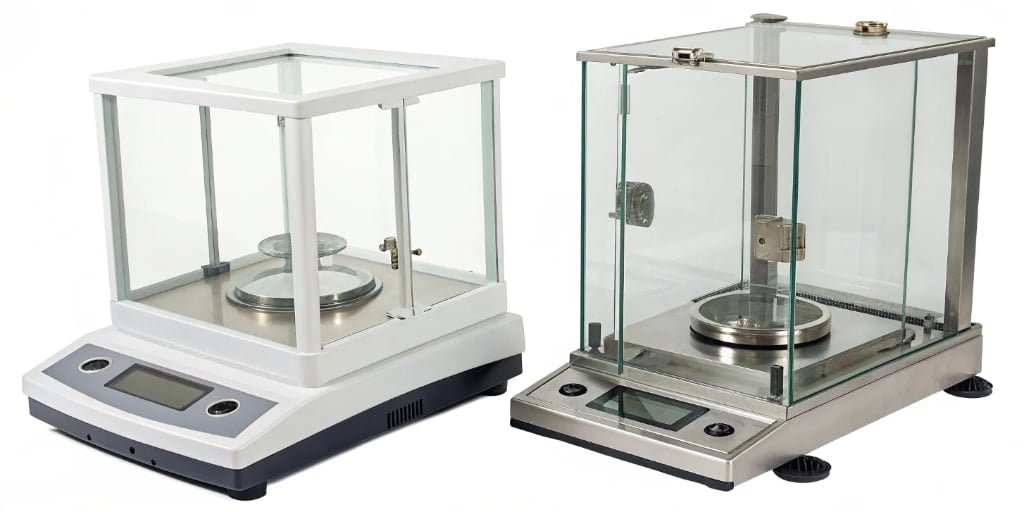
The key difference is readability and design. Analytical balances are built for maximum precision, measuring to at least four decimal places (0.0001g), and always include a draft shield. Toploading balances offer lower readability (0.01g to 0.001g) and are designed for speed and durability.

As a manufacturer for over 18 years, I've seen how this basic difference impacts daily operations. An analytical balance is a highly specialized instrument. It uses an electromagnetic force restoration (EMFR) sensor, which is incredibly sensitive to even the slightest environmental changes1. That's why it's enclosed in a glass or plastic draft shield2. Air currents from a person walking by or an HVAC system can throw off the measurement. Toploading balances, which we also produce, are the workhorses of the lab. They are built to withstand tougher conditions and deliver quick, reliable results when ultra-high precision3 isn't the top priority. Think of it like using a scalpel versus a utility knife; both cut, but you choose one based on the specific task.
Design and Application Comparison
| Feature | Analytical Balance | Toploading Balance |
|---|---|---|
| Readability | 0.0001g to 0.00001g | 0.01g to 0.001g |
| Design | Enclosed with draft shield | Open weighing pan |
| Environment | Requires a stable, vibration-free room4 | More tolerant of environmental changes |
| Use Case | Chemical analysis, formulation, density determination | Sample prep, quality control5, general weighing |
What are the two main types of balance calibration?
Your balance shows a reading, but can you trust it? An uncalibrated instrument can lead to bad data and costly mistakes. Knowing these two calibration methods can save you a lot of trouble.
The two main types are internal and external calibration. Internal calibration is an automatic function where the balance uses a built-in weight to adjust itself. External calibration is a manual process where you use certified, traceable weights to verify and adjust the balance's accuracy.

In our production facility, we rely on both methods. Internal calibration is fantastic for daily use. Many modern balances, including some of our IoT-enabled models, can be programmed to self-calibrate at certain times or when a temperature change is detected. This provides a good level of consistency for routine checks. However, it does not replace the need for external calibration6. External calibration is the true test of a balance's performance. It is essential for meeting quality standards like ISO 90017 or for customers in regulated industries. Using a set of certified external weights, we can test the balance at several points across its capacity to ensure it is accurate and linear. This is a service we always emphasize to our clients because it guarantees their equipment provides truly reliable data.
Internal vs. External Calibration
| Aspect | Internal Calibration | External Calibration |
|---|---|---|
| Method | Automatic, using a built-in mass | Manual, using certified external weights |
| Convenience | High; can be done with a button press | Lower; requires specific weights and procedure |
| Purpose | Corrects for minor drifts (e.g., temperature) | Verifies linearity and accuracy for compliance |
| Traceability | Limited to the internal mass | Fully traceable to national/international standards |
What are the pros and cons of analytical vs. toploading balances in a lab setting?
You need a new balance for your lab, but which one is right for the job? An overly sensitive balance can be just as problematic as one that isn't precise enough.
Analytical balances offer superior precision, which is a major pro for formulation or analysis. However, they are slower and more delicate. Toploading balances are faster and more durable, but their lower precision makes them unsuitable for tasks requiring the highest accuracy.
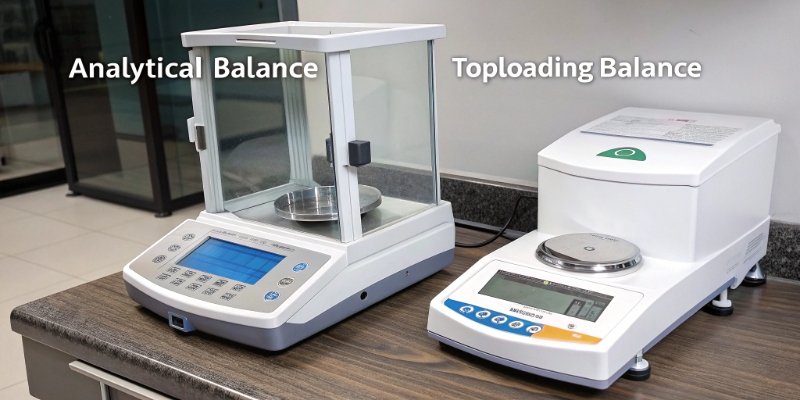
This is a classic trade-off between speed and precision. I always advise our customers to map out their weighing processes. For a medical lab, for example, preparing a chemical reagent might demand the 0.1mg readability8 of an analytical balance. For that same lab, weighing patient samples for a general test may only need 0.01g readability, making a fast and durable toploading balance the better choice. Using an analytical balance for a task that doesn't need its precision just slows down the workflow and introduces unnecessary risk of damage to a costly instrument. The environment is also a huge factor. Analytical balances need a special, quiet corner of the lab. Toploading balances can be placed on almost any sturdy bench, making them far more flexible for a busy lab.
Choosing the Right Balance for Your Lab
| Balance Type | Pros | Cons |
|---|---|---|
| Analytical Balance | ● Extremely high precision and accuracy |
● Necessary for analytical chemistry
● Provides traceable measurements | ● Sensitive to environment (vibrations, air)
● Slower to stabilize
● Higher cost and maintenance |
| Toploading Balance | ● Fast and easy to use
● Durable and portable
● Higher capacity ranges available | ● Lower precision
● Not suitable for analytical tasks
● More susceptible to sample placement error |
What does calibrating an analytical balance involve?
Your analytical balance is a powerful tool. But without proper calibration, its power is meaningless. This delicate process is often misunderstood, which leads to inaccurate measurements and failed quality audits.
Calibrating an analytical balance involves a meticulous procedure using certified weights in a controlled environment free from drafts and vibrations. The process confirms accuracy at multiple points across the balance's range to ensure its measurements are linear, repeatable, and traceable.
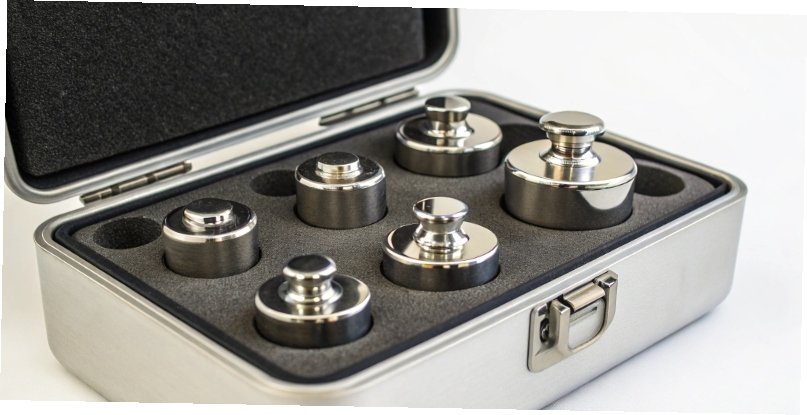
Based on my experience, this isn't a task to be taken lightly. At our facility, every balance we produce undergoes a comprehensive quality inspection that includes rigorous calibration. For an analytical balance, this means more than just placing one weight on the pan. It's a multi-step process9. First, the balance must be perfectly level and given time to acclimate to the room's temperature. Then, using high-class weights (like OIML E2), we perform a linearity test. This involves checking the reading at several increments up to the balance's full capacity. For example, on a 220g balance, we might test at 50g, 100g, 150g, and 200g. This ensures the balance is accurate whether you're weighing a small or large amount. This level of detail is what separates a reliable measurement from a questionable one.
Simplified Analytical Balance Calibration Steps
| Step | Action | Why It's Important |
|---|---|---|
| 1. Preparation | Level the balance and let it warm up for at least 30 minutes in a stable room. | Ensures the internal components are at operating temperature and free from tilting errors. |
| 2. Zeroing | Tare or zero the balance with an empty weigh pan. | Establishes a correct starting point for all measurements. |
| 3. Linearity Test | Place certified weights at different capacities (e.g., 25%, 50%, 100%) and record readings. | Verifies that the balance is accurate across its entire measurement range, not just at one point. |
| 4. Adjustment | If readings are out of tolerance, perform an adjustment procedure as per the manual. | Corrects any systematic errors found during the test, restoring the balance to its specified accuracy. |
Conclusion
In summary, analytical balances require frequent, precise maintenance for high-accuracy tasks. Toploading balances are more robust and forgiving. Your choice depends entirely on your specific precision and environmental needs.
-
Understand the impact of environmental factors on balance performance and how to mitigate them. ↩
-
Discover how a draft shield enhances the accuracy of analytical balances by minimizing environmental interference. ↩
-
Explore the significance of precision in lab measurements and how it affects experimental outcomes. ↩
-
Learn about the importance of a stable environment for achieving accurate measurements with analytical balances. ↩
-
Learn about the importance of balances in maintaining quality control standards in laboratory settings. ↩
-
Find out why external calibration is crucial for compliance and accuracy in laboratory measurements. ↩
-
Discover the significance of ISO 9001 standards in ensuring the reliability of laboratory equipment. ↩
-
Learn about readability in balances and how it impacts the choice of equipment for specific tasks. ↩
-
Discover the detailed steps involved in calibrating an analytical balance for optimal performance. ↩



Comments (0)