

Confused by IPX water ratings on equipment? Choosing the wrong level can lead to costly damage and downtime. This guide will help you understand what each rating really means.
IPX ratings are an international standard that defines the level of protection a device has against water. The 'X' is a placeholder for dust resistance, while the number indicates water protection, from 0 (none) to 9K (high-pressure, high-temperature jets). A higher number means better protection.
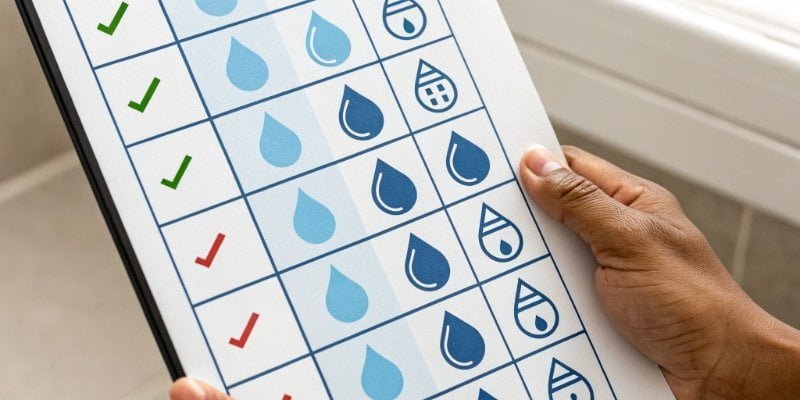
Understanding these ratings is essential, especially in industrial settings. In my 19 years of manufacturing industrial scales1, I've seen firsthand how a mismatch between the environment and the IP rating can destroy perfectly good equipment. This isn't just about buying a "waterproof" device; it's about choosing the right level of protection for your specific needs. Let's break down what these codes mean so you can make an informed decision and protect your investment for years to come.
What Does Each IPX Water Rating Represent?
Struggling to tell the difference between IPX4 and IPX7? This confusion can lead to buying equipment that is either under-protected or unnecessarily expensive. We will explain each level clearly.
Each IPX rating represents a specific and tested level of water resistance. Lower numbers like IPX1 and IPX2 protect against simple drips, while mid-range ratings like IPX5 and IPX6 handle water jets. Higher ratings like IPX7 and IPX8 mean the device can be submerged in water.

To really understand what you are getting, you need to know the test conditions behind each number. The system is designed to be progressive. A device that passes a higher level test does not automatically mean it passed all the lower ones, though it is usually implied. At Weigherps, we test our scales rigorously to ensure they meet the certified rating.
From Drips to Immersion
The IPX scale is quite detailed. Here is a simple breakdown of what each level signifies in a practical sense.
| IPX Rating | Protection Against | Real-World Example |
|---|---|---|
| IPX0 | No protection | An open-circuit board. |
| IPX1 | Dripping water (vertical) | Light condensation in a controlled room. |
| IPX2 | Dripping water (tilted at 15°) | Slight splashing from a nearby task. |
| IPX3 | Spraying water | Light rain or water spray. |
| IPX4 | Splashing water | Splashes from any direction. |
| IPX5 | Water jets | Cleaning with a low-pressure hose. |
| IPX6 | Powerful water jets2 | Washdown procedures in food processing. |
| IPX7 | Immersion up to 1m | Accidental drop into a container of water. |
| IPX8 | Immersion beyond 1m | Continuous use underwater (conditions specified). |
For most industrial scales, the relevant ratings start from IPX4 and go up to IPX7. It's rare to need protection only against vertical drips.
How Do IPX Ratings Indicate Water Resistance Levels?
Do you see the "IP" code but not really know how it translates to real-world durability? This can make comparing products difficult. You might end up with a device that fails when you need it most.
IPX ratings indicate water resistance through a standardized numbering system where a higher number means greater protection. The tests for each level are progressively more intense, moving from light drips and sprays to powerful jets and full submersion, giving you a clear scale of durability.
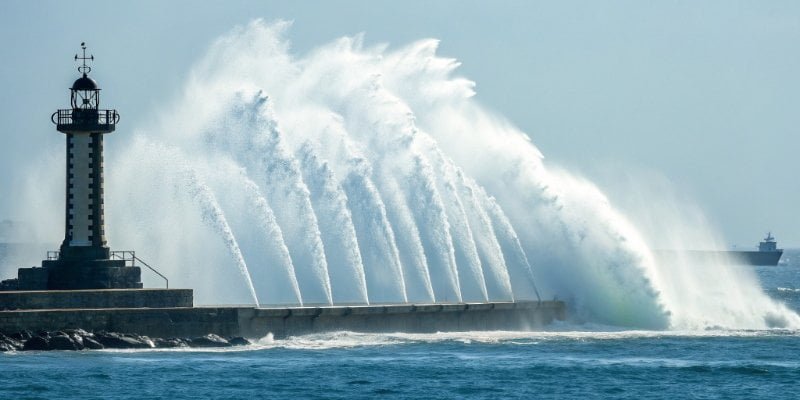
The system is designed for clarity. The letters "IP" stand for "Ingress Protection." The first digit after IP indicates dust protection, but here we focus on water, so we use an 'X' as a placeholder. The final digit is the water rating we've been discussing. Think of it as a report card for how well a device keeps water out. At our company, we help clients understand this report card so they can see the value and security they are getting. A rating isn't just a number; it is a promise of performance under specific conditions.
The Science Behind the Numbers
The reliability of IPX ratings3 comes from the standardized testing process. Each level has specific criteria that a product must meet.
- Understanding "X": The "X" in IPX simply means the device was not tested for dust resistance4. If it were, you would see a number from 0 to 6, like IP67. For our discussion, we focus only on the water rating.
- Progressive Intensity: The tests become much harder as the number increases. IPX1 involves only vertical drips for 10 minutes. By the time you get to IPX6, the device is being blasted with powerful water jets from a 12.5mm nozzle at 100 liters per minute from 3 meters away.
- Jets vs. Immersion: There is a big difference between IPX6 and IPX7. IPX6 means the device can withstand powerful jets but is not designed for submersion5. IPX7 means the device can be fully submerged in up to 1 meter of water for 30 minutes. This is a key distinction for devices used in very wet environments.
What Are the Differences Between Various IPX Water Ratings?
Are you paying for an IPX7 scale when an IPX5 would be enough? Overspending happens when you do not understand the practical differences. This can hurt your budget without adding real value.
The main differences are the type and intensity of water contact a device can handle. IPX4 handles splashes, IPX5/IPX6 handle washdowns with water jets of increasing power, and IPX7/IPX8 are for full submersion. Choosing correctly means matching the rating to your daily cleaning and operational environment.
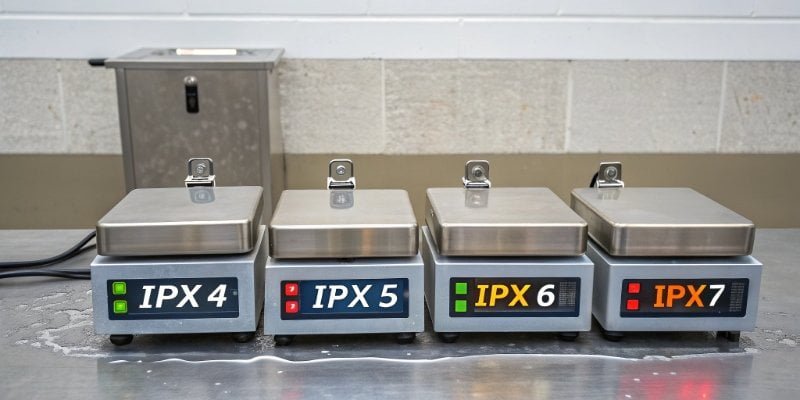
In my experience, this is where most clients need guidance. I once worked with a fish processing plant that bought scales with an IPX4 rating. They thought "splash-proof" was sufficient. However, their daily cleanup involved hosing down all equipment. Within months, the scales started to fail from water ingress. We replaced them with our IPX6-rated models, which are designed for that kind of washdown. They have been running without a single issue for years. This shows how crucial it is to understand the practical application of each rating.
Key Industrial Ratings Compared
Not all IPX ratings are equally relevant for industrial equipment6. In most factories, food processing plants, or outdoor sites, you will encounter a few key ratings. Let's compare them directly.
| Feature | IPX4 | IPX5 | IPX6 | IPX7 |
|---|---|---|---|---|
| Protection | Splashes from any direction | Low-pressure water jets | High-pressure water jets | Immersion up to 1 meter |
| Test Condition | Water splashing against the enclosure | Water from a 6.3mm nozzle | Water from a 12.5mm nozzle | Submerged for 30 minutes |
| Ideal For | Environments with occasional splashes. | Light cleaning with a hose. | Heavy washdown environments. | Areas with risk of falling into liquid. |
| Common Use Case | General warehouse, some labs. | Food prep areas. | Meat/fish processing, chemical plants. | Mobile weighing, field use near water. |
This table shows why the client from the fish plant needed IPX6. Their cleaning routine used high-pressure jets, which is far beyond what IPX4 is designed for. Understanding this chart helps you avoid similar costly mistakes.
How Can You Choose a Device Based on Its IPX Water Rating?
Afraid of choosing the wrong equipment? The risk of premature failure and operational disruption is high if you don't match the IPX rating to your needs. This can be a costly error.
To choose a device, first assess your work environment and daily procedures, especially cleaning. Then, match those conditions to the corresponding IPX rating. For complex electronic scales, a high rating like IPX6 is excellent, while simpler scales can more easily achieve IPX7 for immersion protection.
As a manufacturer, our goal is to provide a reliable product that lasts. This means helping you choose the right one. It is not always about getting the highest IPX number possible. It is about getting the appropriate one. A scale with many ports for data and power has more potential points of failure than a simple, self-contained weigh-only scale. We design our products with this in mind, ensuring even our most complex systems offer robust protection for their intended environments.
A Practical Selection Guide
Choosing the right IPX rating is a strategic decision. Here is how we guide our partners to make the best choice.
- ### Assess Your Environment
Does your process involve dust, light moisture, heavy splashes, or full washdowns? Do you use low-pressure hoses or high-pressure jets for cleaning? Is there a risk of the device being dropped into liquid? Answering these questions gives you a clear picture of the level of protection you need. - ### Match the Rating to the Task
For an environment with only ambient moisture or light splashes, an IPX4 rating might be enough. For daily washdowns with a standard hose, you should look for at least IPX5. If you use powerful jets for deep cleaning, as seen in many food-grade facilities, IPX6 is the minimum. If the scale might fall into a tank, IPX7 is necessary. - ### Consider the Scale's Complexity
This is an important insight from my years in production. It is easier and more cost-effective to make a simple, compact scale achieve a high rating like IPX7 or IPX8. For a complex industrial scale with multiple electronic components, ports, and displays, achieving a fully submersible IPX7 rating can be very expensive and often unnecessary. For these devices, a robust, well-sealed IPX6 design often provides the perfect balance of protection, functionality, and cost-effectiveness for 99% of industrial washdown applications.
Conclusion
Choosing the right IPX rating is simple when you know what to look for. By assessing your environment and understanding each level, you can select equipment that ensures reliability and performance.
- Discover top-rated industrial scales designed for wet environments to ensure durability and reliability. ↩
- Understanding the impact of water jets on equipment can help you choose the right protection level. ↩
- Explore this resource to gain a comprehensive understanding of IPX ratings and their significance in equipment protection. ↩
- Explore the relationship between dust resistance and IP ratings for a complete understanding of protection. ↩
- This resource will explain how submersion affects devices and what ratings to look for. ↩
- This resource will guide you through key considerations for selecting industrial equipment. ↩



[…] A key specification to look for is the IP rating3. […]