
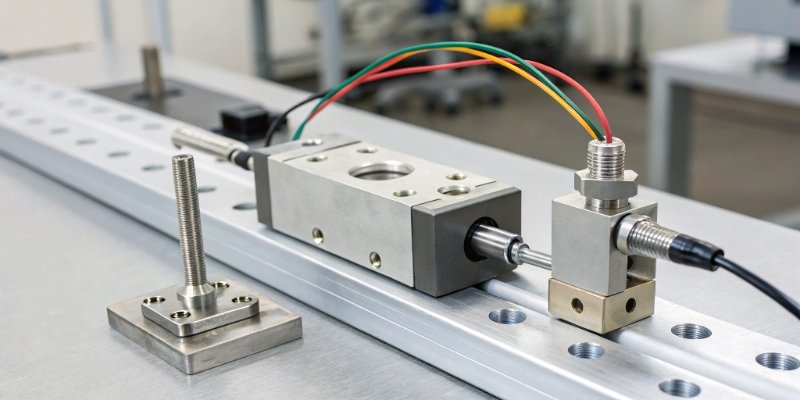
Confused by load cell specs like 'mV/V'? A wrong choice leads to inaccurate readings. Let's demystify this crucial rating to ensure your system performs perfectly.
The 'mV/V' rating on a load cell, meaning millivolts per volt, defines its sensitivity. It tells you how many millivolts of electrical signal the load cell will output for every volt of excitation voltage applied when it's under its maximum rated load.
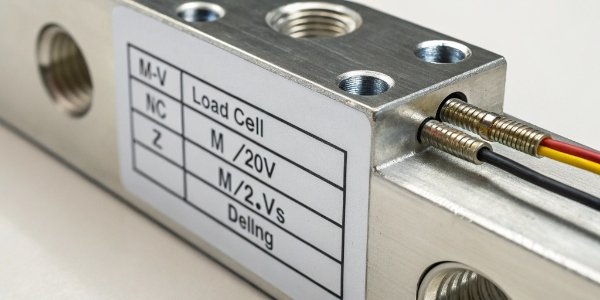
I remember the first time I saw '2.0 mV/V1' on a spec sheet. It looked like just another number. But, as I learned over 18 years in this industry, this small number has a huge impact on everything from simple scales to complex IoT weighing systems. It’s the heart of the measurement. But knowing the definition is one thing; using it correctly is another. So, let’s break down how this value works in the real world.
How do you calculate the output voltage of a load cell using its mV/V rating?
Need to predict a load cell's signal? Miscalculations can lead to incompatible electronics. Let's look at the simple formula to get it right every time.
To calculate the output voltage, multiply the load cell's sensitivity (in mV/V) by the excitation voltage (in V). This gives you the full-scale output in millivolts (mV). For partial loads, multiply this result by the percentage of the applied load.
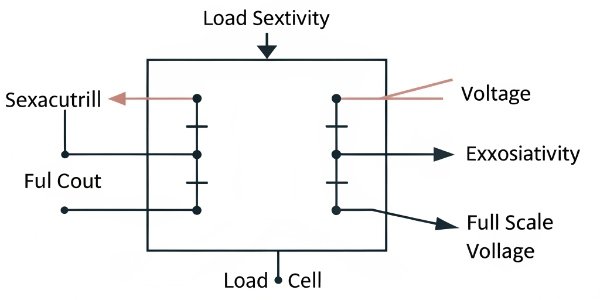
The formula is the foundation of our work here at Weigherps. It's Output Voltage (mV) = Sensitivity (mV/V) * Excitation Voltage (V) * ([Applied Load / Rated Capacity](https://www.britannica.com/technology/mercury-processing/Extraction-and-refining)[^2]). Let's break this down.
- Sensitivity (mV/V): This is the value from the datasheet, like 2.0 mV/V or 3.0 mV/V.
- Excitation Voltage (V): This is the voltage you supply to the load cell, typically 5V or 10V from your indicator or PLC.
- Applied Load / Rated Capacity: This is the ratio of the weight currently on the scale to the maximum weight the load cell is designed for.
Let me give you a practical example from our production line. We often test a 100 kg capacity load cell with a sensitivity of 2.0 mV/V. We use a standard 10V excitation.
| Applied Load | Calculation | Output Voltage |
|---|---|---|
| 100 kg (Full Load) | 2.0 mV/V 10V (100kg / 100kg) | 20 mV |
| 50 kg (Half Load) | 2.0 mV/V 10V (50kg / 100kg) | 10 mV |
| 0 kg (No Load) | 2.0 mV/V 10V (0kg / 100kg) | 0 mV |
This simple calculation is crucial for our clients, especially software vendors. You need to know the expected signal range2 to configure your data acquisition hardware and software correctly. If you anticipate a 20 mV signal but your system is set up for 10 mV, you'll get saturated or clipped data, which is completely useless. That's why we always provide detailed datasheets.
Is a higher mV/V sensitivity rating always better for a load cell?
Think a higher mV/V rating is always best? This common mistake can create a noisy, unstable system. Let's see why the "best" rating depends on the job.
Not always. A higher mV/V sensitivity provides a stronger signal, which can improve resolution. However, it can also make the load cell more susceptible to noise and temperature variations. The ideal rating balances signal strength with stability for your specific application.

As a manufacturer for over 18 years, I've seen many clients default to the highest mV/V rating available. But it's a nuanced decision. A stronger signal from a high-sensitivity load cell (e.g., 3.0 mV/V) is easier for your electronics to read. It can lead to finer resolution, meaning you can detect smaller changes in weight. This is great for lab scales or high-precision industrial processes.
However, there's a flip side. A more sensitive sensor is like a more sensitive microphone; it picks up everything. This includes electrical noise from nearby motors, slight temperature shifts that cause the metal to expand or contract, and even physical vibrations. For our software vendor clients, this means more complex filtering algorithms3 might be needed to get a stable reading.
| Feature | High Sensitivity (e.g., 3.0 mV/V) | Standard Sensitivity (e.g., 2.0 mV/V) |
|---|---|---|
| Pros | Stronger output signal, better resolution. | More stable, less prone to noise. |
| Cons | More sensitive to noise & temperature. | Weaker signal, may need better amplification. |
| Best For | High-precision, controlled environments. | General industrial use, harsh environments. |
For many industrial applications4, a standard 2.0 mV/V load cell is the workhorse. It provides a reliable signal that is robust enough for factory floors. The key is to match the sensitivity to the environment and the required precision, not just picking the biggest number.
How does load cell sensitivity affect the resolution and accuracy of a scale?
Want high resolution but get unstable readings? The problem might be your load cell's sensitivity. Let's connect sensitivity to the accuracy and resolution you actually achieve.
Higher sensitivity provides a larger signal change per unit of weight. This allows the indicator's analog-to-digital converter (ADC) to detect smaller weight increments, increasing resolution. However, ultimate accuracy depends on managing noise and other errors, not just on sensitivity alone.
Let’s think about what happens inside the weighing indicator5. It has a component called an Analog-to-Digital Converter (ADC)6. The ADC takes the tiny millivolt signal from the load cell and converts it into digital "counts" that your software can understand. The number of counts the ADC can produce is its own resolution.
Now, let's see how sensitivity plays a role. Imagine a 10V excitation and a 100 kg scale.
- Load Cell A (2.0 mV/V): Full-scale output is 20 mV.
- Load Cell B (3.0 mV/V): Full-scale output is 30 mV.
The ADC has to divide its available counts across this voltage range. With Load Cell B, each digital count corresponds to a smaller change in voltage, and therefore a smaller change in weight. This means you get higher resolution. You can theoretically measure finer increments.
But here's the critical point I always stress with my clients: resolution is not accuracy. High resolution with a noisy signal is useless. If your highly sensitive load cell is picking up electrical noise, the last few digits of your reading will be jumping around randomly. Accuracy is about how close your stable reading is to the true weight. So, while higher sensitivity can enable higher resolution, achieving true accuracy requires a stable, low-noise system where that resolution is meaningful. That’s why our QC department tests every single unit for stability before it ships.
Why is it important to match a load cell's mV/V rating to the signal conditioner or indicator?
Are your scale readings wrong after connecting a new load cell? This mismatch wastes time and money. Matching the mV/V rating to your indicator is essential.
It's crucial to match them because the indicator is designed to accept a specific input voltage range. If the load cell's output, determined by its mV/V rating, is too low or too high for the indicator, you risk poor performance, instability, or even damage.
Every signal conditioner7 or weighing indicator has a specified "input signal range." This is often listed in its datasheet, sometimes also in mV/V. For example, an indicator might be designed to work with load cells from 1.5 mV/V to 3.5 mV/V. Think of this like a doorway. If your signal is too small, it's like trying to hear someone whispering from across a loud factory. The indicator's internal amplifier has to work overtime, and it ends up amplifying the background noise just as much as your signal. The result is an unstable, fluctuating reading.
On the other hand, if the signal is too large—for instance, using a 4.0 mV/V load cell with an indicator designed for a maximum of 3.5 mV/V—you get a problem called "saturation" or "clipping." The indicator simply cannot process a voltage that high. Your readings will hit a ceiling and won't increase, even if you add more weight. For our clients developing software, this is a nightmare scenario. Your software will receive corrupted data without any warning, leading to incorrect inventory management, batching, or process control. This is why we always confirm a client's existing electronics when providing a custom weighing solution. A successful system isn't just about a quality load cell; it's about all the components working together perfectly.
Conclusion
In summary, the mV/V rating is more than a number. It defines your scale's sensitivity, resolution, and stability. Choosing the right one ensures accurate and reliable weighing data.
-
Understanding mV/V is crucial for selecting the right load cell for accurate measurements. ↩
-
Learn why matching signal ranges is essential for optimal load cell performance. ↩
-
Explore how filtering algorithms help stabilize readings from sensitive load cells. ↩
-
Learn about the various industries that rely on load cells for accurate measurements. ↩
-
Understanding weighing indicators is crucial for effective load cell integration. ↩
-
Learn how ADCs convert load cell signals into digital data for processing. ↩
-
Learn how signal conditioners work with load cells to ensure accurate readings. ↩


Comments (0)