

Tired of manually counting small parts? It is a slow process that often leads to errors. This can cause major problems with inventory and production, costing you time and money.
A counting scale works by first weighing a small, known number of identical items to find the average piece weight. Then, it weighs a large batch of the same items and divides the total weight by this average to calculate the quantity, giving you an accurate count in seconds.
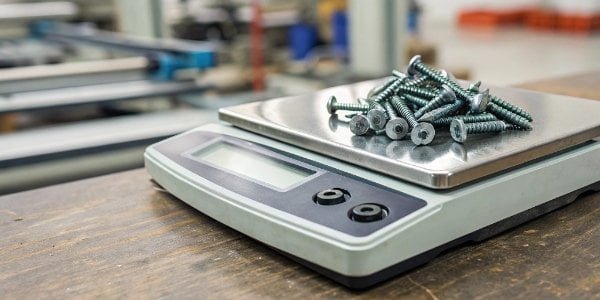
But a counting scale1 is more than just a regular weighing machine. It has special features designed for a very specific job. Understanding what makes it unique is the key to using it right and making your business more efficient. Let's look closer at what sets it apart and how you can use it to get perfect counts every time. This knowledge will help you run your operations much more smoothly.
What is the difference between a counting scale and a standard weighing scale?
Have you ever tried using a regular scale to count parts? It seems like it should work, but it usually doesn't. A standard scale misses the most important function, which leads to inaccurate inventory.
A standard scale only measures total weight. A counting scale has special software that calculates the average piece weight from a sample. It then uses this data to convert the total weight of a batch into a precise quantity, a feature standard scales completely lack.

When I started in this industry 18 years ago, I saw many clients trying to use standard scales for inventory. They would weigh one screw, then divide the total weight of a box by that single weight. The problem is that not every screw is exactly the same. Tiny variations add up, and their final counts were always off. A counting scale solves this by using an average. Its internal software is the real difference-maker. It has a much higher internal resolution2 than most standard scales, which means it can detect tiny weight differences. This makes the average piece weight calculation much more accurate.
Here is a simple breakdown of the main differences:
| Feature | Standard Weighing Scale | Digital Counting Scale |
|---|---|---|
| Primary Use | Measuring total weight | Counting large quantities of identical items |
| Display | Usually one screen (Total Weight) | Three screens (Total Weight, Piece Weight, Count) |
| Core Function | Tare, Zero, Weigh | Tare, Zero, Weigh, Sample, Count |
| Software | Basic weighing logic | Advanced logic for calculating average piece weight |
So, while a standard scale is great for shipping or general weighing, a counting scale is a specialized tool. It is built from the ground up to provide fast, accurate piece counts, which is something a standard scale just cannot do reliably.
How do you use a sample to get an accurate parts count?
Getting an inaccurate count is very frustrating, and it often comes down to one simple step. If your sample is wrong, your entire count will be wrong. So let's make sure you get it right.
To get an accurate count, place a known quantity of items on the scale—10 or 25 pieces is a good start. Then, press the 'Sample' key. The scale calculates the average piece weight. For the best accuracy, always use a larger sample size.
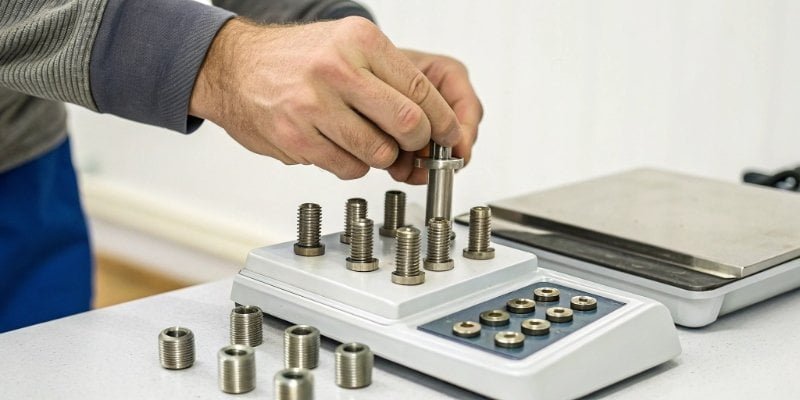
Getting the sampling process right is the most important part of using a counting scale. Over the years, we've taught thousands of clients this simple process, and it works every time. Think of it as teaching the scale what one item weighs. The better you teach it, the better it will count for you. A larger sample gives the scale more data, which helps it calculate a more precise average piece weight. This is very important when your parts have small variations in weight.
Here is the step-by-step process:
- Prepare the Scale: First, make sure your scale is on a flat, stable surface. Turn it on and press the 'Tare' or 'Zero' button to clear the display. If you are using a container, place the empty container on the scale first and then press 'Tare' to remove its weight.
- Count Your Sample: Carefully count out a sample of your items. A good starting point is 10 pieces. However, for very small or lightweight items, we recommend using 25, 50, or even 100 pieces. The more pieces in your sample, the more accurate the count will be.
- Enter the Sample: Place the counted sample on the scale. Use the keypad to enter the number of pieces you placed (e.g., type '10'). Then, press the 'Sample' or 'PCS' key.
- Confirm the Weight: The scale will now display the Average Piece Weight (APW) it has calculated. It is now ready to count.
- Start Counting: Remove the sample and place the large batch of items you want to count onto the scale. The display will instantly show you the total quantity.
The most common mistake is using too small of a sample. One single piece is never enough. Always use at least 10, and more if you can.
What are the main business applications for a digital counting scale?
These scales are for more than just warehouses. Many different industries depend on them for speed and accuracy. You might be surprised where they can boost efficiency and help you save money.
Counting scales are essential in manufacturing for counting components like screws and resistors. They are used in pharmaceuticals for pills, in logistics for inventory checks, and in retail for packaging small items. Any business that deals with large quantities of identical small parts benefits from them.

We have manufactured scales for businesses of all sizes, from small electronics workshops to massive distribution centers. The goal is always the same: replace slow, error-prone manual counting with fast, automated accuracy. A client of ours who manufactures circuit boards used to have three employees spend a full day each week counting tiny resistors for kits. After they started using our counting scales, one employee could do the same job in just two hours. That is a huge saving in labor costs. The scales paid for themselves in less than a month.
Here are some of the most common applications we see and the precision they usually require:
| Industry Type | Typical Application Scenario | Recommended Accuracy Level |
|---|---|---|
| Electronics | Counting resistors, capacitors, and microchips | High (e.g., ≤0.1g) |
| Pharmaceuticals | Dividing pills and capsules for packaging | Very High (e.g., ≤0.05g) |
| Logistics/Warehouse | Checking inventory of nuts, bolts, and parts | Standard (e.g., ≤0.5g) |
| Printing & Mail | Counting flyers, envelopes, or business cards | Standard (e.g., ≤1g) |
| Retail | Kitting and packaging small craft or hardware items | Varies based on item |
In every case, the scale reduces human error, speeds up processes like order fulfillment and inventory management3, and provides data that helps businesses make better decisions. It is a simple tool that delivers a powerful return on investment.
What features should I look for when buying a scale for inventory management?
Not all counting scales are created equal. Buying the wrong one can be a costly mistake that slows you down. Knowing what to look for ensures you get a tool that truly helps your business.
Look for the right capacity and accuracy for your parts. A scale with high internal resolution provides better counts. Other key features include a large memory for storing piece weights, a rechargeable battery for portability, and connectivity options like RS-232 for data transfer.

When a new client asks for advice, the first question I always ask is, "What is the lightest single item you need to count?" The answer to this question determines everything. The accuracy of the scale, or its readability, must be fine enough to reliably detect that single piece. A good rule of thumb is that the scale's readability should be at least ten times smaller than the weight of the item. For example, if your lightest part weighs 1 gram, you need a scale with a readability of 0.1 grams or better.
Here are the key things to consider:
- Capacity and Readability: Capacity is the maximum weight the scale can handle. Make sure it is high enough for your bulkiest batches. Readability (or accuracy) is the smallest weight increment it can display. This is critical for counting light parts.
- Sensor Type: Most scales use a strain gauge sensor, which is affordable and reliable for general use. For very high-precision needs, like in pharmaceuticals or labs, an electromagnetic force restoration sensor provides the best accuracy, but it costs more.
- Useful Functions:
- Piece Weight Memory (PLU): Look for a scale that can store the average piece weights of your most commonly counted items. This saves you from having to re-sample every single time.
- Portability: A built-in rechargeable battery4 is a must-have if you need to move the scale around your warehouse or workshop.
- Durability: A stainless steel weighing pan is easy to clean and resists corrosion. Overload protection is also important to prevent damage if something too heavy is accidentally placed on it.
- Connectivity: An RS-2325 or USB port allows you to connect the scale to a printer or a computer. This is great for printing count records or sending data directly to your inventory software.
Choosing the right features ensures your scale is a long-lasting and effective tool for your business.
Conclusion
In short, a counting scale saves time and improves inventory accuracy. By choosing the right model and using it correctly, you can streamline your operations and reduce costly errors.
-
Explore this link to understand how counting scales can revolutionize your inventory management. ↩
-
Explore how internal resolution affects the precision of counting scales. ↩
-
Find out how counting scales can streamline your inventory processes and reduce errors. ↩
-
Learn about the benefits of portability and convenience with rechargeable counting scales. ↩
-
Explore how RS-232 connectivity enhances data transfer and integration with inventory systems. ↩



Comments (0)