

Struggling with manual data entry? Facing errors in your production counts? You need a system that delivers accuracy and real-time control to eliminate these costly problems.
Industrial intelligent weighing software connects your scales to your business systems. It automates data collection, turning raw weight information into valuable insights. This software acts as the central brain for your weighing processes, optimizing production and boosting efficiency.

This powerful software is the key to unlocking a more efficient and profitable operation. But to understand its full potential, we first need to look at the foundation it's built upon. Let’s explore the world of industrial weighing and see how everything connects.
What is industrial weighing?
Are you losing materials in your production line? Unsure about your shipment weights? Industrial weighing provides the certainty you need for quality control and cost management in your operations.
Industrial weighing is the use of heavy-duty scales in manufacturing, logistics, and production. It ensures accurate measurements for everything from raw materials to finished goods, which is critical for quality control, cost management, and meeting industry regulations.

Industrial weighing is more than just getting a number; it is a core part of the production chain. These scales are built to be tough, handling harsh conditions and heavy loads day after day. Since my company, Weigherps, started building these systems 19 years ago, I've seen them used in nearly every industry. From controlling the ingredients in a food product to making sure a truck is safely loaded, accuracy is everything. Even small errors can add up to big costs or safety issues. That’s why we focus on building robust equipment that our clients, especially software vendors who need reliable data, can trust.
Key Applications of Industrial Scales
| Application Area | Purpose | Importance |
|---|---|---|
| Logistics & Shipping | Weighing trucks, containers, and pallets. | Ensures compliance with transport regulations and accurate shipping costs. |
| Manufacturing | Batching, filling, and quality control1 checks. | Guarantees product consistency and reduces material waste. |
| Agriculture | Weighing livestock, harvests, and feed. | Manages inventory and ensures fair trade. |
| Waste Management | Measuring waste for recycling and disposal. | Facilitates accurate billing and regulatory compliance. |
This process ensures that from start to finish, the weight data is precise and reliable, which is the foundation intelligent software builds upon.
How do I connect my weighing scale to my computer?
Tired of writing down weights by hand? Facing transcription errors that cost you money? Connecting your scale directly to a PC automates this entire process for you.
You can connect a scale to a computer with a cable using ports like RS-232, USB, or through a network connection like Ethernet or Wi-Fi. Once connected, software is used to automatically capture and log the weight data, creating a direct link for error-free records.

I remember a client who ran a busy warehouse. Every day, his team would write down hundreds of weights, and every week, they spent hours fixing errors from manual entry. The solution was simple: we helped him connect his scales directly to his inventory management system. This is a common problem we solve. For many of our software vendor clients, this connection is the most critical part. Their software needs good, clean data, and a direct link from the scale is the only way to guarantee it. The process is straightforward and eliminates the weakest link in data collection2: human error.
Common Connection Methods
| Connection Type | Ease of Use | Best For | Technical Note |
|---|---|---|---|
| USB | Very Easy | Quick connection to a single, nearby computer. Often plug-and-play. | May require a specific driver from the scale manufacturer to appear as a COM port. |
| RS-232 | Moderate | A traditional and very reliable method for industrial equipment. | This is a standard serial port and remains a common, robust connection type. |
| Ethernet / Wi-Fi | Advanced | Connecting scales across a large facility or for remote data access. | Allows multiple users to access data and integrates easily into a company's network. |
Setting up this connection is the first step toward building a truly intelligent weighing system.
How does an industrial scale work?
Ever wonder how a massive platform scale can detect a tiny change in weight? The technology behind it is both strong and incredibly sensitive. Let's look at how it works.
An industrial scale works using a component called a load cell. When you place an object on the scale, the load cell bends slightly. This changes an electrical signal, which an indicator then converts into the precise weight you see on the display.

At the heart of every modern electronic scale is this amazing device: the load cell3. Think of it as the soul of the machine. I’ve spent countless hours in our production facility watching our teams test and calibrate these with extreme care. The load cell is a piece of metal, often steel or aluminum, with very sensitive sensors called strain gauges bonded to it. When a load presses down, the metal bar deforms by a microscopic amount. This stretching or compressing of the strain gauges changes their electrical resistance. This change, although tiny, is directly proportional to the force applied.
The Path from Weight to Digital Reading
- Force is Applied: An object is placed on the scale platform.
- Load Cell Bends: The force is transferred to the load cell, causing it to bend.
- Signal is Created: The strain gauges on the load cell change their electrical resistance, creating a weak analog signal.
- Signal is Converted: The scale’s indicator, or terminal, uses an Analog-to-Digital Converter (ADC) to change this analog signal into a digital value.
- Weight is Displayed: The processor in the indicator translates this digital value into a clear, readable weight, like kilograms or pounds.
This entire process happens almost instantly, giving you a fast and accurate measurement you can rely on.
What is the instrument used to measure weight?
Do you need a scale or a balance for your work? Using the right instrument is the first step to getting accurate results. Let's clarify which tool is right for industrial needs.
The primary instrument used to measure weight is a scale. While a balance is used to measure mass by comparing it to known masses, a scale measures the force of gravity on an object. In industry, scales are used for their durability and high capacity.
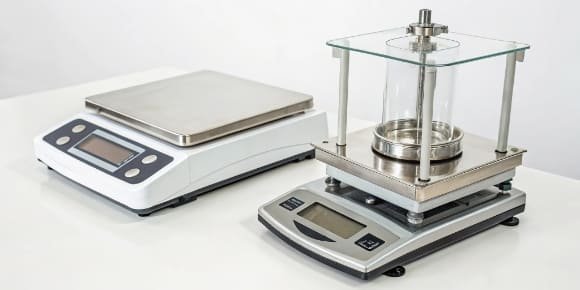
In my 19 years in this business, I've seen customers use the terms "scale" and "balance" interchangeably. While they both measure things, they work differently. A balance, like the one you see in a science lab, has two pans and compares an unknown mass to a known one. A scale, on the other hand, measures downward force or weight. For industrial work—weighing pallets, trucks, or large batches of product—you need an industrial scale. It is designed for heavy loads and tough environments. Balances are for high-precision, low-capacity tasks, like in a laboratory. Choosing a robust scale is the foundation for any serious weighing operation.
Scale vs. Balance: What's the Difference?
| Feature | Scale | Balance |
|---|---|---|
| Measures | Weight (Force of Gravity) | Mass |
| Principle | Measures force using springs or load cells. | Compares an unknown mass to a known mass. |
| Typical Use | Industrial, commercial, shipping, logistics. | Laboratory, pharmaceutical, scientific research. |
| Capacity | High (kilograms to tons). | Low (milligrams to kilograms). |
For any industrial application, from manufacturing4 to logistics, a scale is the right tool for the job.
Conclusion
Intelligent software transforms your scale from a standalone tool into a powerful data hub. It brings accuracy, efficiency, and real-time control to your entire production and logistics process.
-
Find out how accurate weighing is crucial for maintaining quality standards in production. ↩
-
Learn about the benefits of automated data collection in reducing errors and improving operational efficiency. ↩
-
Discover the technology behind load cells and their significance in industrial scales. ↩
-
Understand how weighing is integrated into manufacturing for efficiency and accuracy. ↩


Comments (0)