

Are your scales giving inconsistent readings at different weights? This problem can corrupt your data and compromise your entire production process, pointing to a critical issue with performance.
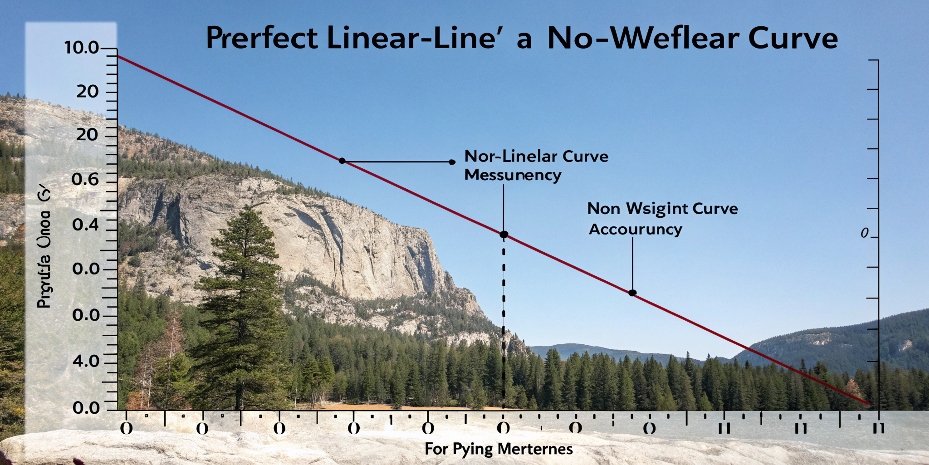
Scale linearity is a measure of how consistently accurate a scale is across its entire weighing range. It ensures that if you place 10g, 50g, or 100g on the scale, the reading remains proportionally true to the actual weight, preventing costly errors.
Understanding this concept is the first step. But knowing what it is and knowing how to ensure it are two different things. It reminds me of the first time we designed a custom weighing system for a client. They focused only on maximum capacity accuracy1, but soon found their smaller, partial batches were completely off. This experience taught us that true reliability isn't just about one number; it's about consistent performance. Let's explore how you can guarantee your scales are always performing at their best.
How do you perform a linearity test on a weighing scale?
Worried your scale isn't accurate across its full capacity? A simple test using standard weights can reveal hidden errors. Not performing this test risks inconsistent product quality.
To perform a linearity test, you place certified standard weights on the scale at several points across its range, from zero to full capacity. You record the difference between the actual weight and the displayed reading at each point to check for proportional accuracy.
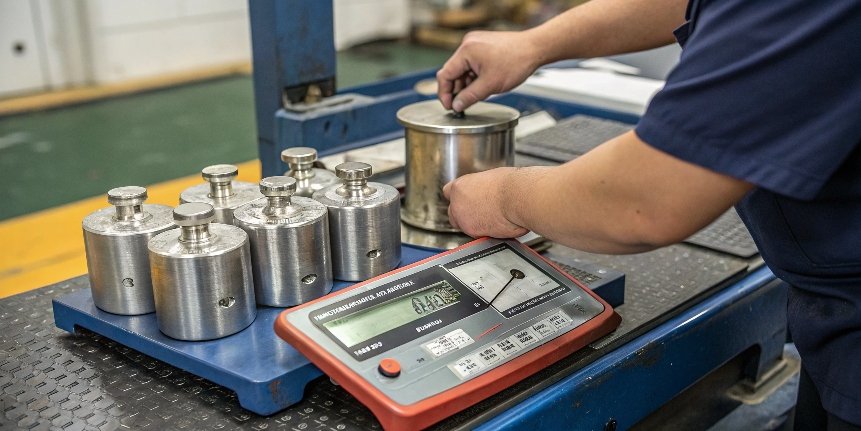
Performing a linearity test2 is a straightforward but essential maintenance task. At Weigherps, we advise our clients to follow a simple procedure to ensure their equipment remains reliable. First, you need a set of calibrated weights3 that are traceable to national or international standards. You can't test accuracy with an inaccurate tool. Start with the scale at zero. Then, select between five and ten test points that cover the scale's full range. For a 100 kg scale, you might choose 10 kg, 20 kg, 50 kg, 80 kg, and 100 kg. Place each certified weight on the scale one by one and record the displayed reading. The goal is to see if the error changes proportionally. A small, consistent error might be acceptable, but a deviation that grows or shrinks unpredictably indicates a linearity problem that needs immediate attention.
| Test Weight | Scale Reading | Deviation |
|---|---|---|
| 10.000 kg | 10.001 kg | +0.001 kg |
| 50.000 kg | 50.005 kg | +0.005 kg |
| 100.000 kg | 100.010 kg | +0.010 kg |
What's the difference between scale linearity, accuracy, and repeatability?
Do terms like accuracy and linearity confuse you? Misunderstanding them leads to buying the wrong equipment. This confusion can be a costly mistake for your quality control process.
Accuracy is how close a measurement is to the true value. Repeatability is how consistent readings are when weighing the same item multiple times. Linearity ensures this accuracy is maintained proportionally across the scale's entire capacity, not just at one point.
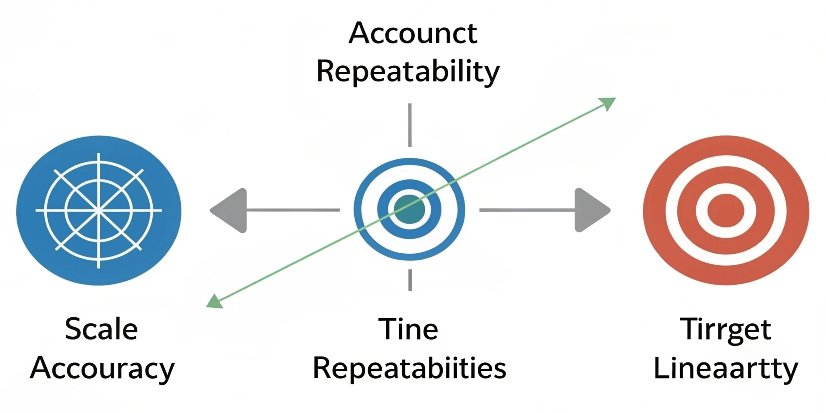
I often use a target shooting analogy to explain this to our clients. Imagine you are aiming at a bullseye.
Accuracy
Accuracy is how close your shot is to the center of the bullseye. If you aim for 10 kg and the scale reads 10 kg, it's accurate at that point. A single correct reading defines accuracy for that specific weight.
Repeatability
Repeatability is about clustering your shots together. If you weigh the same 10 kg object five times and get 10.5 kg each time, your scale is not accurate, but it is highly repeatable. The results are consistent, even if they are consistently wrong. This indicates a stable system that likely just needs calibration.
Linearity
Linearity is the most complex of the three. It's like having targets at 10, 50, and 100 meters. You might hit the bullseye perfectly at 10 and 100 meters, but your shots consistently land low on the 50-meter target. This means your performance isn't proportional across the entire range. Your scale has a linearity problem.
| Metric | Description | Analogy |
|---|---|---|
| Accuracy | Closeness to the true value at a single point. | Hitting the bullseye. |
| Repeatability | Consistency of multiple measurements of the same item. | Shots are tightly grouped. |
| Linearity | Accuracy across the entire measurement range. | Hitting bullseyes at all distances. |
How do linearity errors affect measurements across a scale's full weighing range?
Your scale is calibrated, but are your measurements still off? Linearity errors can create hidden inaccuracies between calibration points. This can ruin batches and cost you money.
Linearity errors cause a scale to be accurate at specific calibration points but inaccurate at weights in between. For example, a scale calibrated at 0kg and 100kg might misread a 50kg weight, leading to inconsistent product formulation and compliance failures.

The practical impact of poor linearity is significant, and I’ve seen it cause major headaches for businesses. I remember a client in the food industry who couldn't figure out why their spice blends were inconsistent. They followed their recipe perfectly, or so they thought. Their quality control team regularly calibrated the main production scale at zero and at the maximum batch weight of 200 kg. At these two points, the scale was perfect. The problem was that the most expensive ingredients were added in smaller amounts, around 60-80 kg. Due to a linearity error, the scale was off by nearly 5% in that middle range. Their "correct" 60 kg measurement was actually 63 kg. This small error, multiplied across thousands of units, was costing them a fortune in wasted ingredients and resulted in a product that didn't meet customer expectations. It’s a perfect example of why you must trust your scale's performance at every point, not just the ones you calibrate.
What are the common mechanical or electronic causes of poor scale linearity?
Is your scale suddenly unreliable? The cause might be a simple mechanical issue or a hidden electronic fault. Ignoring these signs can lead to complete equipment failure.
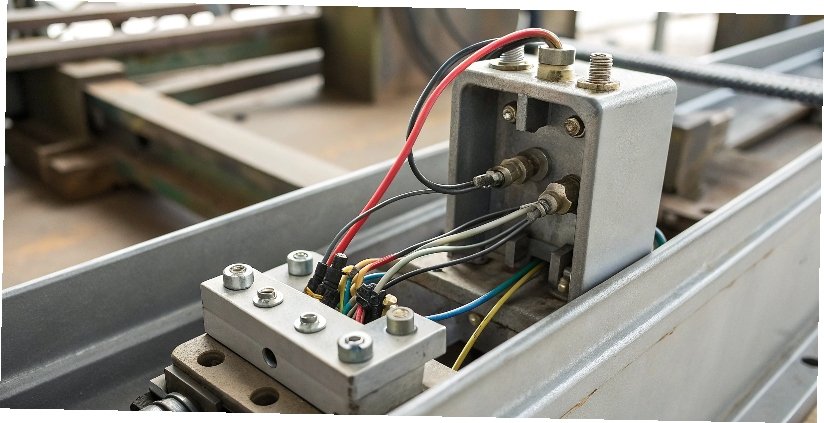
Poor linearity is often caused by mechanical issues like a damaged load cell or improper installation. Electronic causes include temperature fluctuations affecting components, electrical noise from other equipment, or outdated software. Regular maintenance prevents these issues from escalating.
Over our 18 years of manufacturing industrial scales4, we've seen nearly every possible cause of linearity failure. They almost always fall into two categories: mechanical or electronic. Understanding these helps in both prevention and diagnosis.
Mechanical Causes
The core of a scale is the load cell5, a sensor that converts force into an electrical signal. If the load cell is damaged from overloading, or if the scale's foundation is not perfectly level, the force is not distributed evenly. This creates non-linear responses. We’ve also seen issues from something as simple as debris buildup under the platform, which physically obstructs movement and throws off readings inconsistently. Regular cleaning and ensuring the scale is on a solid, level surface are basic but critical maintenance steps.
Electronic Causes
On the electronic side, problems can be more subtle. Temperature changes can affect the resistance of internal components, causing the signal to drift. Electrical noise from nearby heavy machinery can also interfere with the sensitive analog-to-digital converter. At Weigherps, this is why our quality control is so strict. Every scale undergoes comprehensive testing to ensure its mechanical structure and electronic components can withstand tough industrial environments and deliver linear, reliable performance day after day.
Conclusion
In short, scale linearity is essential for reliable measurements across all weights. Understanding and testing it ensures accuracy, compliance, and protects your bottom line from costly production errors.
-
Understanding the distinction between accuracy and linearity helps in selecting the right equipment for your needs. ↩
-
Learn the steps to perform a linearity test to maintain accuracy and reliability in your weighing processes. ↩
-
Explore the importance of using calibrated weights for accurate scale testing and maintenance. ↩
-
Learn best practices for maintaining industrial scales to ensure consistent performance. ↩
-
Gain insights into the function of load cells and their role in ensuring accurate weight measurements. ↩


Comments (0)