

Struggling to choose between high-accuracy scales? Making the wrong choice costs money and can ruin your data. The key difference is simpler than you think and vital to get right.
The main difference is readability and precision. Analytical balances are ultra-sensitive, measuring to at least 0.1 milligrams (0.0001 g) for scientific tasks. Precision balances are the industrial workhorses, typically measuring from 1 milligram (0.001 g) to 1 gram, perfect for quality control and production.
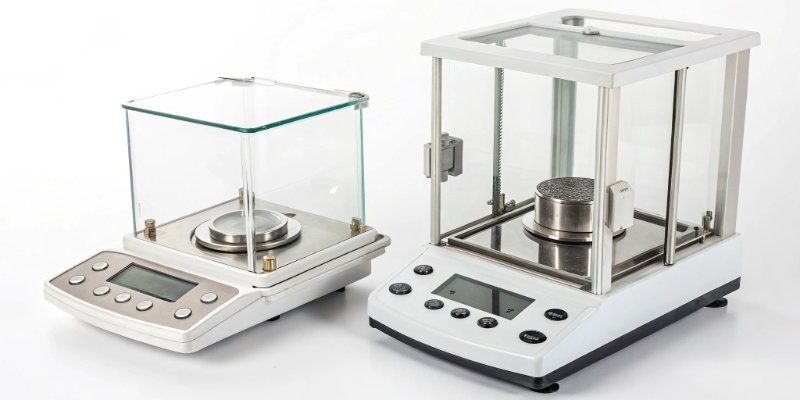
You now know the core distinction lies in how finely they can measure. But this simple difference has a big impact on where and how you use each scale. Choosing correctly isn't just about technical specs; it's about matching the tool to your specific job, whether in a lab or on a factory floor. Let's explore these differences further so you can make the most cost-effective and accurate decision for your business.
What is the difference between an analytical balance and a regular balance?
Thinking a standard "regular" scale might be good enough for your task? Using a general-purpose scale for a job that needs precision will lead to major errors and inconsistent results.
An analytical balance provides extreme precision, often 0.1 mg or better, within a protective draft shield for lab use. A "regular" balance, like a common bench scale, offers much lower readability (e.g., 1 g or more) and is built for general weighing in less controlled environments.

When we talk about a "regular balance," we're usually referring to a wide category of scales like bench scales or compact scales. In my 18 years in the weighing industry, I've seen many clients try to save money by using a simple bench scale for a task that demanded a precision balance. This almost always backfires. It leads to inconsistent product quality, failed compliance audits, and a lot of wasted material. For a software provider connecting to a weighing device, the data quality is everything. If the scale isn't accurate enough, the data fed into your system is unreliable. It’s a classic "garbage in, garbage out" situation. The data from a regular scale is simply not clean enough for quality control1 or formulation tasks where small variations matter.
Readability and Construction
The most obvious difference is in the numbers. An analytical balance gives you readings to four or five decimal places of a gram. A regular bench scale might only give you one. This is because they are built differently. The analytical balance has a highly sensitive load cell and is enclosed in a case to block air currents. A regular scale is built to be robust and handle the bumps of a busy workplace.
Application Environments
The environment dictates the scale2. Analytical balances belong in a clean, stable lab environment, often on a special anti-vibration table. Regular scales are designed for warehouses, shipping docks, and production lines. They can handle dust, moisture, and temperature changes much better.
| Feature | Analytical Balance | Regular Balance (e.g., Bench Scale) |
|---|---|---|
| Readability | 0.1 mg (0.0001 g) or better | 1 g or greater |
| Capacity | Low (e.g., up to 300 g) | Higher (e.g., up to 30 kg or more) |
| Environment | Controlled lab, free from drafts and vibrations. | Industrial, commercial, less controlled. |
| Main Use | Scientific research, chemical analysis3. | Shipping, general production, portion control. |
| Cost | High | Low |
What is the difference between an analytical balance and a platform balance?
Do you need to weigh large, heavy items but think you need lab-level accuracy? It’s a common confusion, but standard high-capacity scales lack that kind of precision for a reason.
An analytical balance is a lab instrument for measuring tiny masses with extremely high precision. A platform balance, or floor scale, is an industrial tool for weighing large, heavy objects with much lower precision. Their purposes and construction are worlds apart and they are never interchangeable.

Comparing an analytical balance to a platform balance is like comparing a surgeon's scalpel to a woodcutter's axe. Both are cutting tools, but you would never use one for the other's job. I remember a client in the chemical manufacturing business. Their process involved both types of scales every day. They used a large platform scale on the factory floor to weigh 200kg drums of their finished product for shipping and inventory. Then, in their quality control lab, they used an analytical balance to measure a 50-milligram sample taken from that same drum to verify its chemical composition. This is a perfect example of how different scales work together in a complete weighing ecosystem. One handles bulk, the other handles detail. You can’t put a drum on an analytical balance, and you can’t get a meaningful reading from a tiny sample on a platform scale.
Scale of Measurement
This is the most fundamental difference. Analytical balances measure in milligrams and grams with incredible resolution. Platform scales measure in kilograms or even tons. Their capacities are designed for completely different scales of operation.
Physical Design and Portability
An analytical balance is a delicate, tabletop instrument. A platform balance is a large, rugged plate, often installed into the floor or equipped with ramps. It's built from heavy-duty steel to withstand forklifts and heavy loads.
| Aspect | Analytical Balance | Platform Balance |
|---|---|---|
| Purpose | Measuring micro-quantities in a lab. | Weighing bulk materials, pallets, large items. |
| Capacity | ~100 g - 300 g | 100 kg - 10,000 kg+ |
| Readability | 0.0001 g | 0.05 kg (50 g) or higher |
| Location | Cleanroom, laboratory bench. | Warehouse floor, loading dock, production line. |
What are precision balances?
You know you need accurate measurements but not the extreme sensitivity of a lab balance. Overspending on an analytical balance is a waste if its precision level isn't required for your application.
Precision balances bridge the gap between standard scales and analytical balances. They offer excellent readability, typically from 1 gram down to 1 milligram (0.001 g). They are the dependable workhorses for any industry that needs reliable, repeatable measurements without the high cost of an analytical balance.

As a manufacturer of industrial scales for nearly two decades, I can tell you that precision balances4 are some of the most versatile tools we make. They are the backbone of quality and consistency in countless industries. We often work with software vendors whose systems need reliable data from the factory floor. A precision balance is the perfect device for this. It can be integrated into an IoT system5 to track material usage in a recipe, verify the weight of components before assembly, or perform statistical process control checks. The data it provides is accurate and trustworthy for process management. We recently helped a client in the food processing industry automate their recipe formulation. By connecting our precision balances to their central software, they eliminated human error and ensured every single batch was perfectly consistent.
Defining Features
Precision balances are defined by their readability6 of 0.001 g to 1 g. They have higher capacities than analytical balances7 and are more robust, designed to withstand daily use in a production or QC lab environment. Many lack a full draft shield8, though some higher-precision models have a simple glass ring.
Where They Shine
These balances are essential for tasks that require more accuracy than a regular scale can offer.
| Industry | Application for Precision Balance |
|---|---|
| Manufacturing | Quality control checks, small parts counting. |
| Food & Beverage | Recipe formulation, ingredient batching, portioning checks. |
| Pharmaceutical | Compounding, pill counting, general formulation. |
| Jewelry | Weighing gems and precious metals. |
| Chemical | Mixing paints, coatings, and other non-critical mixtures. |
What is an analytical balance?
You need to measure incredibly small masses, and every fraction of a milligram counts. A tiny error in your measurement could invalidate an entire research project or batch of product.
An analytical balance is a highly specialized laboratory instrument designed to measure mass with the highest degree of accuracy. It features a readability of 0.1 milligrams (0.0001 g) or better and is built with a draft shield to protect the fragile measurement from environmental interference.
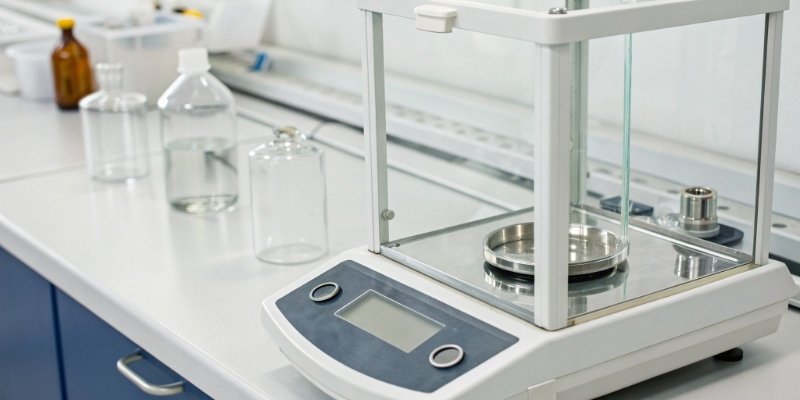
When I explain analytical balances to clients, I always emphasize that you're not just buying a scale; you're investing in a controlled measurement process. These instruments are so sensitive that a person walking by or the airflow from an HVAC system can throw off the reading. This is why they are always used inside a closed chamber, the draft shield. For our software clients, this means the data coming from an analytical balance is extremely precise and valuable. It's used for critical R&D, pharmaceutical compounding, and environmental testing. The software integrated with such a device must be equally robust and reliable, capable of capturing and storing this high-precision data without corruption. We ensure our weighing systems can communicate flawlessly with these systems because we know there is zero room for error in these applications.
The Draft Shield is Essential
The glass enclosure is not just for show. It creates a still environment around the weighing pan. Even the heat from your hand or your breath can create air currents strong enough to alter the reading on a milligram or sub-milligram level. The shield is mandatory for achieving accurate results.
Calibration and Environment
Analytical balances require frequent calibration9 to ensure their accuracy. Many modern balances have an internal, motorized calibration feature that runs automatically. They must be placed on a heavy, stable surface, like a granite anti-vibration table, in a room with a controlled temperature and minimal airflow to perform correctly.
Where They Are Indispensable
You will find analytical balances in any setting where quantitative analysis is performed. This includes university research labs, pharmaceutical quality assurance departments, forensic labs, and environmental testing agencies. Any task that involves determining the precise chemical makeup of a substance will rely on an analytical balance.
Conclusion
The main difference is precision. Choose an analytical balance for high-stakes lab research. Choose a precision balance for reliable industrial accuracy. Making the right choice ensures data integrity and saves money.
-
Find out how accurate weighing scales are essential for maintaining quality control in various industries. ↩
-
Learn how different environments determine the appropriate type of weighing scale to use. ↩
-
Understand the significance of analytical balances in conducting accurate chemical analyses. ↩
-
Learn about precision balances, their versatility, and how they bridge the gap between standard and analytical scales. ↩
-
Learn about the integration of precision balances into IoT systems for enhanced data tracking. ↩
-
Understand the importance of readability in scales and how it affects measurement accuracy. ↩
-
Explore how analytical balances provide extreme precision for scientific tasks, ensuring accurate measurements. ↩
-
Learn why a draft shield is crucial for achieving accurate measurements in analytical balances. ↩
-
Explore the importance of regular calibration for maintaining the accuracy of analytical balances. ↩



Comments (0)