
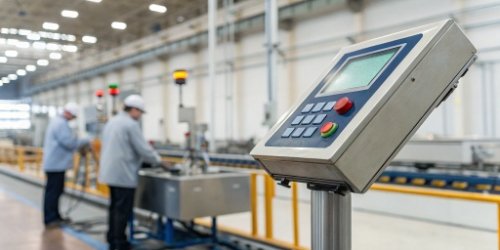
Developing software for industry is complex. A failed deployment can be costly. A programmable scale provides the perfect, low-risk testing ground for your innovative solutions.
Programmable scales are the ultimate sandbox because they merge real-world hardware with an open software environment. They allow you to test, refine, and validate your industrial applications directly on the equipment, simulating harsh conditions without risking live production. This ensures your software is robust and ready.

Having a scale as a software sandbox1 is a powerful idea. But the true value is in the specifics of how it accelerates your work. Let’s explore exactly why these scales are the ideal platforms for your software development, starting with the core benefits.
Why Are Programmable Scales Ideal Platforms for Developing Industrial Software?
Your software must work perfectly in dirty, demanding factories. Simple simulations can't replicate this chaos, risking failure. Programmable scales offer a true hardware testbed for robust development.
They are ideal because they offer a real, physical interface for your software. Instead of simulating data, you get live feedback from an industrial device. This allows for precise testing of logic, connectivity, and user interfaces in a controlled yet realistic setting, ensuring reliability from day one.
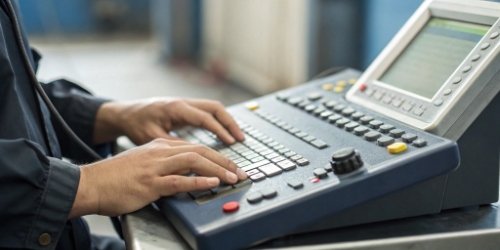
In my nearly two decades in this business, I've seen many software projects fail because they were built in a bubble. A clean office is not a factory floor.
Bridging the Gap Between Code and Reality
Programmable scales close this dangerous gap. Your code isn't just running on theoretical data; it's driving a physical device that weighs and communicates. You directly test how your software handles real weight changes, tare commands, and data protocols on actual hardware. This tangible feedback is something a pure software simulation can never offer.
A Controlled Environment for Industrial Chaos
We build our scales to be tough, and your software must be too. Programmable scales let you safely simulate the chaos of the factory.
| Feature | Traditional Method | Programmable Scale Method |
|---|---|---|
| Data Source | Simulated data sets | Live data from physical load cells |
| Function Test | Emulated API calls | Direct control of indicators & ports |
| Stress Test | Theoretical error scripts | Simulating real network drops |
This method shifts your testing from abstract to applied, significantly cutting deployment risks2.
How Do Programmable Scales Serve as Versatile Testbeds for Industrial Applications?
Testing diverse applications like logistics and batching usually requires separate hardware setups. This is inefficient and costly. A single programmable scale can easily adapt to all these scenarios.
They serve as versatile testbeds by offering customizable I/O ports, SDKs, and open APIs. This allows you to configure a single scale to emulate various industrial processes, from simple checkweighing to complex automated batching systems, making it a one-stop solution for diverse application testing.

Versatility is crucial for any purchasing manager. You need tools that solve many problems. This is where programmable scales3 truly shine for our software partners.
A Hub for Connectivity
Our scales are not closed systems. We equip them with standard interfaces like Ethernet, RS-232, and USB, plus optional digital I/O. Your software can be tested for its ability to connect to printers, barcode scanners, PLCs, or your central ERP system. This makes the scale a hub for testing an entire data workflow.
Mimicking Complex Workflows
The real power is in the programmability. You can use one device to test vastly different software applications.
| Application Scenario | Software's Main Job | How the Scale is Used |
|---|---|---|
| Logistics | Capture weight, send to PC | Simple script reads stable weight data |
| Batching | Guide operator through a recipe | Complex program controls relays, lights |
| Quality Control | Check against weight tolerances | Software uses upper/lower weight limits |
One scale empowers your team to validate software for multiple markets, maximizing your hardware ROI.
What Benefits Do Programmable Scales Offer for Innovating Industrial Software Solutions?
Innovation requires rapid testing, but hardware can be a bottleneck. This slow pace allows competitors to get ahead. Programmable scales create an agile environment to prototype ideas fast.
The main benefit is accelerated innovation. By providing an open platform, they let your developers freely test new ideas like AI-driven quality control or IoT data integration. This rapid-prototyping ability drastically shortens the development cycle, turning creative concepts into market-ready products much faster.

As a tech leader, you constantly ask, "What's next?" Your tools must enable, not hinder, your vision. A programmable scale acts as your engine for innovation.
The Freedom to Experiment
True innovation involves rapid trial and error. A programmable scale gives your R&D team the sandbox they need. They can quickly build a proof-of-concept for a new feature without requiring custom hardware for every single idea. It’s a low-cost, low-risk playground for exploring potentially high-reward concepts.
Future-Proofing Your Solutions
Testing on our scales helps you build for the factory of tomorrow.
| Innovative Tech | How You Can Test It | Your Market Edge |
|---|---|---|
| IoT & Cloud | Stream live weight data to Azure/AWS | Offer customers subscription-based data services |
| AI/ML | Use data to train predictive quality models | Sell intelligent, self-optimizing solutions |
| Automation | Control external devices (e.g., robotics) via I/O | Deliver hands-free, automated systems |
This approach lets you pioneer advanced features and deliver truly cutting-edge products to your clients.
In What Ways Can Programmable Scales Enhance the Development of Industrial Software?
Long development cycles with constant rework are frustrating and costly. Delays mean missed opportunities and budget overruns. Programmable scales can streamline every step of your development process.
They enhance development by enabling parallel hardware and software testing, reducing integration surprises. Developers get immediate, real-world feedback, which accelerates debugging. This tight loop between coding and physical testing leads to higher quality software, faster release cycles, and reduced post-launch support costs.
In my experience, the strongest partnerships are built on efficiency. Our goal is to make your development process smoother, faster, and more profitable.
Accelerating the Debugging Process
Finding a bug in industrial software can be a slow, painful process. With a programmable scale on the test bench, everything changes. When your code causes an error, you get immediate physical feedback. Did the display show the wrong unit? Did a relay fail to trigger? This direct cause-and-effect makes debugging much faster than just analyzing log files.
Enhancing the Entire Lifecycle
This improvement impacts every stage of your project.
| Stage | Traditional Challenge | Enhancement with Programmable Scale |
|---|---|---|
| Prototype | Ideas are abstract, hard to prove | Build tangible proof-of-concept quickly |
| Debugging | Real-world errors are hard to replicate | Instantly see the physical result of code |
| QA Testing | Simulators miss hardware integration4 flaws | Test against the actual target hardware |
| Deployment | On-site bugs are costly and urgent | Deploy pre-validated, reliable software |
By using the scale early, you solve problems in your lab, not at the customer's site.
Conclusion
Programmable scales are more than just hardware; they are strategic tools. They accelerate innovation, reduce risk, and empower you to build better industrial software solutions for your customers.
-
Learn about the advantages of using a software sandbox for testing industrial applications. ↩
-
Learn about the common risks associated with software deployment and how to mitigate them. ↩
-
Explore how programmable scales can enhance your software development process and reduce risks. ↩
-
Understand the challenges of hardware integration and how to address them effectively. ↩


Comments (0)