
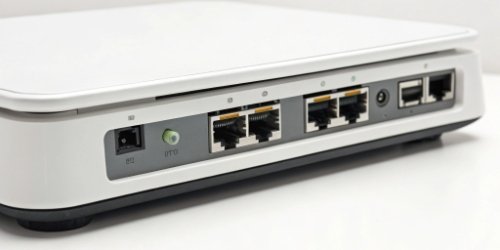
Struggling with data errors from standalone scales? This creates frustrating inventory mismatches and slows down your entire line. Connected scales sync data instantly, eliminating these costly problems for good.
Both Wi-Fi and Ethernet are essential for a modern label printing scale. Ethernet provides a highly stable, secure connection for fixed workstations. Wi-Fi offers critical flexibility, allowing scales to be moved as your workflow demands. Having both ensures optimal performance in any industrial environment.
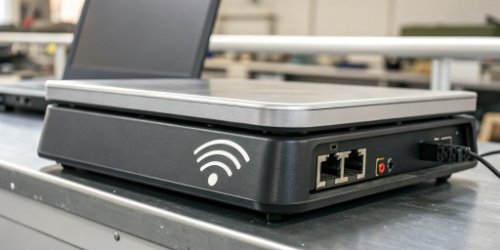
Choosing the right connectivity for your industrial scales might seem like a small technical detail. However, this decision has a huge impact on your daily operations. It affects everything from the speed of your production line to the accuracy of your inventory data. It's not just about plugging in a cable or connecting to a network. It's about building a reliable data bridge between your physical operations and your management systems. Understanding how each connection type works is the first step to creating a more efficient and error-free workflow. We will explore exactly what you need to know to make the best choice.
Why Is Network Connectivity Important for Label Printing Scales?
Are you still updating your scales with a USB drive? Manual data entry is slow, prone to human error, and simply outdated. Network connectivity automates this entire process effortlessly.
Network connectivity is vital because it turns a standalone scale into a smart, integrated part of your business system. It enables real-time data exchange for automatic price updates, inventory management, and production tracking. This powerful automation eliminates manual errors and dramatically boosts operational efficiency.
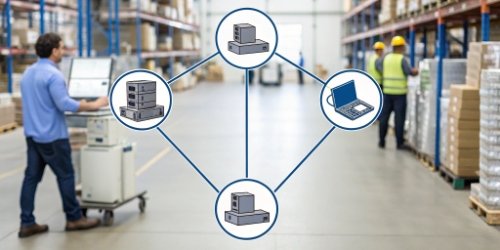
In my 19 years helping businesses with their weighing needs, I've seen the same problem repeatedly: data silos1. An unconnected scale is an island. The data it creates—weight, piece count, product ID—stays right there. To get that information into your main system, someone has to write it down or transfer it manually. This creates delays and, more importantly, a high risk of errors. A single typo can lead to incorrect shipping, flawed inventory counts, and compliance headaches. As your hardware partner, we focus on solving this core problem. We build scales designed to break down these data silos and integrate seamlessly into your workflow.
The End of Data Silos
Unconnected scales2 are a major source of operational inefficiency. Every product update, price change, or new PLU (Price Look-Up code3) requires a person to go to each scale and enter the information manually. This is not just time-consuming; it's a recipe for inconsistency. We empower our clients to leave this outdated model behind. Our network-ready scales connect directly to a central server, ensuring every device has the same, up-to-the-minute information.
Unlocking Real-Time Operations
The real power of network connectivity4 is its ability to support real-time operations. Imagine updating the price of a product across your entire factory floor with a single click. Or think about your inventory system updating itself the moment a pallet is weighed and labeled. This is what our integrated weighing solutions provide. They connect directly to your ERP or WMS, making your operations faster, more accurate, and more responsive to market changes.
Paving the Way for IoT
This connectivity is the foundation for the Industrial Internet of Things (IIoT). We design our smart label printing scale5s as multifunctional IoT devices6. They are not just for weighing; they are data collection points7 ready for a smart factory. For you as a software provider, this means our hardware is prepared to integrate with the advanced, data-driven solutions you develop for your customers.
How Do Wi-Fi and Ethernet Enhance Functionality in Label Printing Scales?
Deciding between a stable wired connection and wireless freedom can be difficult. Each has benefits and drawbacks in a busy industrial space. Combining them enhances your operations beyond what either could do alone.
Ethernet provides a stable, secure, high-speed connection ideal for stationary production lines. Wi-Fi delivers unmatched mobility and flexibility, letting you place scales wherever they are needed. Together, they enable powerful features like centralized management, remote diagnostics, and fully mobile workstations for ultimate efficiency.
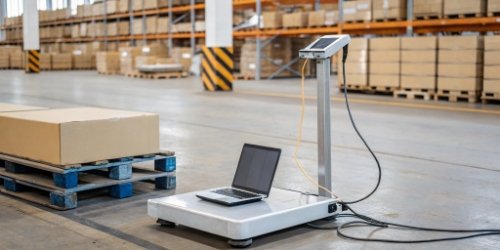
When we design our scales, we think about the real-world environments they will be used in. A busy warehouse, a fast-paced food production line, or a pharmaceutical cleanroom all have different needs. A one-size-fits-all approach to connectivity just doesn't work. As your OEM/ODM partner, we provide the hardware flexibility you need so your software solutions can shine in any scenario. The combination of Ethernet and Wi-Fi is a key part of that flexibility, allowing you to tailor the deployment for maximum stability and efficiency.
Ethernet for Unwavering Stability
For mission-critical weighing stations that cannot afford a single moment of downtime, Ethernet is the gold standard. A physical cable provides a connection that is immune to the radio frequency interference common in industrial settings.
| Feature | Benefit for Your Operation |
|---|---|
| High Speed | Instant data transfer for price lookups and label printing. |
| Low Latency | No lag between scanning an item and printing its label. |
| High Security | A closed, physical connection is much harder to intercept. |
| Reliability | Not affected by other wireless devices or machinery. |
Wi-Fi for Unmatched Flexibility
The modern workplace is not static. Your workflow might change seasonally, or you may need to set up a temporary packing station. This is where Wi-Fi is essential. It frees your scales from the constraints of cables. With Wi-Fi, you can position a scale on a mobile cart and move it directly to your inventory, instead of hauling inventory to the scale. This saves a huge amount of time and labor. Our scales support the latest Wi-Fi security protocols8, ensuring your mobile data is just as secure as your wired data.
What Are the Key Benefits of Having Multiple Connectivity Options in Label Scales?
Are you worried your new hardware will be obsolete in a few years? Relying on a single connection type limits your ability to adapt. Multiple options ensure you can grow.
Having multiple connectivity options like Wi-Fi, Ethernet, and Bluetooth is a form of future-proofing. It guarantees your scales will work with your current and future network infrastructure. It also provides critical redundancy to prevent costly downtime if one network fails.
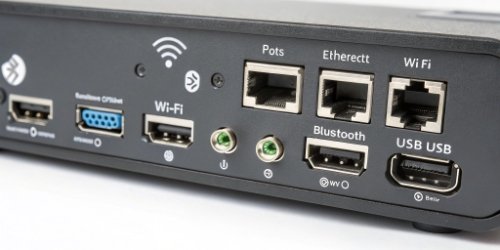
I always advise our clients to think about where their business will be in five years. Will you expand your facility? Will you adopt new software? Will you need to integrate more devices? We build our scales to support that growth. By including multiple connection types as a standard, we give you the freedom to evolve without having to replace your core weighing equipment. This long-term thinking is a key part of our vision to be your most reliable weighing expert. It's about providing value that lasts.
Future-Proofing Your Investment
Your business is dynamic, and your technology should be too. A scale with both Wi-Fi and Ethernet9 can seamlessly transition from a wired position on a production line to a mobile cart in the warehouse. As you reconfigure your layout or upgrade your network infrastructure, your scales can adapt. This flexibility protects your initial investment and lowers your total cost of ownership10 over the long run, a major concern for any purchasing manager.
Enhancing Redundancy and Reliability
What's your plan if the Wi-Fi network goes down during a critical shipping run? In many facilities, it means work grinds to a halt. However, if your scales also have an Ethernet port, your team can quickly run a cable and get back online. This built-in backup plan is not a luxury; it's a necessity for any operation where downtime is measured in lost revenue. This level of reliability is something we build into every product.
Broadening Integration Possibilities
The possibilities expand even further when you include options like Bluetooth11. This is perfect for connecting peripheral devices without a mess of wires. You can easily pair a handheld barcode scanner for faster product identification or connect to a technician's tablet for diagnostics and maintenance. For you as a software vendor, this means our hardware offers a clean, versatile platform for you to connect a whole ecosystem of smart devices.
How Do Different Network Connection Types Impact Label Scale Performance?
Is a slow network connection causing a bottleneck on your production line? The speed of data transfer can directly halt your operations. The connection type you choose directly impacts speed, reliability, and security.
Ethernet typically delivers the highest performance with its low latency and consistent speed, making it perfect for high-volume tasks. Wi-Fi performance, while excellent, can vary with signal strength and is best for mobility. The true impact depends on your data load and environmental factors.
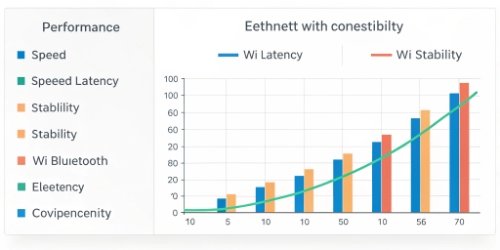
Before any product leaves our factory, our quality inspection department puts it through comprehensive testing. This includes rigorous software and network performance tests12. We simulate high-traffic environments to ensure our Ethernet ports can handle rapid data transfer and our Wi-Fi modules maintain a stable connection even in challenging conditions. We guarantee this performance with a 12-month after-sales service warranty. This commitment to quality ensures that when you partner with us, you are providing your customers with hardware that performs reliably under pressure, protecting your reputation as a quality software provider.
Speed and Latency
In high-speed production, every millisecond counts. A wired Ethernet connection offers a dedicated, physical line for data, providing consistently low latency. This means when an operator scans a product, the data lookup is instant, and the label prints immediately. Wi-Fi latency can fluctuate based on signal quality and network congestion. While often negligible, in an environment processing hundreds of items per minute, this small difference can be significant. Our scales are optimized to minimize latency on both connection types.
Security Considerations
Data security is a top concern for any connected enterprise, and it's a major focus for your clients. A wired Ethernet connection is inherently secure, as it requires physical access to intercept data. For wireless connections, strong security protocols are essential. Our scales support modern WPA2 and WPA3 Enterprise security standards, allowing them to integrate safely into the most secure corporate networks. We provide you with hardware that meets the strict security and data compliance13 requirements your customers demand.
Performance Impact Summary
| Connection Type | Speed & Latency | Security | Ideal Use Case |
|---|---|---|---|
| Ethernet | Highest speed, lowest latency | Highest (physical network) | Fixed, high-volume production lines, secure areas. |
| Wi-Fi | Good speed, variable latency | High (with WPA2/WPA3) | Mobile workstations, receiving docks, flexible layouts. |
| Bluetooth | Lower speed, short-range | Moderate | Connecting local peripherals (scanners, printers). |
Conclusion
Choosing the right network options is vital for modern weighing. Our scales offer Wi-Fi and Ethernet to ensure your operations are flexible, efficient, and ready for future growth.
-
Learn about the impact of data silos on efficiency and decision-making. ↩
-
Discover how connected scales can enhance efficiency and reduce errors. ↩
-
Gain insights into how PLU codes streamline pricing and inventory management. ↩
-
Explore the role of network connectivity in automating data processes. ↩
-
Find out the essential features that enhance productivity in your operations. ↩
-
Learn about the integration of IoT devices for smarter manufacturing. ↩
-
Discover the role of data collection points in optimizing operations. ↩
-
Understand the security measures necessary to protect sensitive data. ↩
-
Learn how these connectivity options improve performance and flexibility. ↩
-
Explore how to evaluate the long-term costs of your equipment investments. ↩
-
Discover how Bluetooth enhances connectivity and device integration. ↩
-
Learn about the testing processes that ensure reliable equipment performance. ↩
-
Explore the importance of data compliance in maintaining security. ↩



Comments (0)