
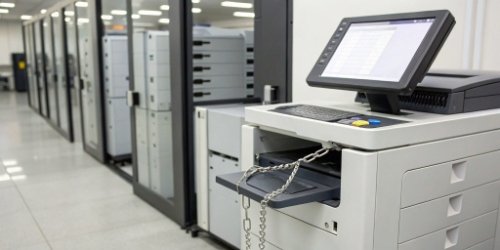
Worried about incorrect labels causing disputes or losses? Unauthorized changes can disrupt your production line. We have the solution to lock down your label formats and secure your operations.
Security features like user access controls, audit trails, and data encryption prevent unauthorized changes to label formats. These systems ensure only authorized personnel can access and modify templates, protecting data integrity, ensuring compliance, and maintaining brand consistency.

This seems straightforward enough. But what specific features actually do the work? Let's dive deeper into how these security measures1 protect your operations and give you peace of mind. As a manufacturer with 19 years of experience, I've seen how critical these details are. We will explore the different layers of protection that keep your labeling process accurate and secure.
How Do Security Features Protect Label Formats from Unauthorized Changes?
Do production errors from tampered labels frustrate you? Inaccurate information can lead to costly recalls and damage your reputation. Layered security features are the key to maintaining control and accuracy.
Security features protect label formats by creating a controlled environment. They use user authentication to verify identity, role-based permissions to limit access, and activity logs to track every single change, ensuring complete accountability.
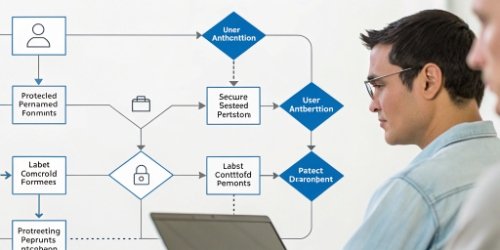
These protections form a layered defense system. It is not just one feature, but a combination of tools working together that creates a truly secure environment. From the moment a user logs in, the system is designed to control and monitor their actions. This is essential for traceability, which is a core requirement for many industries we serve. Every change is logged with a timestamp and user ID. This means if an error occurs, you can instantly trace it back to the source. It eliminates guesswork and provides a clear record for internal audits or regulatory compliance checks2. I find that this level of accountability is what truly gives our clients confidence in their systems.
Layered Defense Mechanisms
A single lock on a door is good, but multiple layers of security are better. Our systems use this philosophy. First, a user must log in with unique credentials. Then, their assigned role dictates what they can and cannot do. Finally, every action is recorded in an unchangeable audit trail. This multi-step process makes it extremely difficult for unauthorized changes to slip through the cracks. It's a comprehensive approach that we've refined over nearly two decades to protect our clients' operations.
The Importance of Traceability
Traceability isn't just a buzzword; it's a critical business function. When a label format is changed, you need to know who did it, when they did it, and what was changed. Our systems provide a complete audit log that answers these questions. This log is crucial for troubleshooting errors, ensuring quality control, and proving compliance during an inspection. It transforms accountability from a concept into a practical, automated tool.
What Measures Are in Place to Prevent Unauthorized Alterations to Label Designs?
Concerned that anyone can alter your carefully designed product labels? This inconsistency can damage your brand's reputation and lead to compliance issues. Specific measures lock down templates to prevent this.
Measures to prevent alterations include template locking, version control, and mandatory approval workflows. Locked templates cannot be changed without specific permissions, while version control tracks history. Approval workflows require manager sign-off before changes go live.
We believe in putting clear controls in place. The most effective measures are often the simplest in concept. By locking a master template, we ensure that the core design remains consistent. Any proposed changes don't overwrite the original; instead, they create a new version. This is version control3, and it's your safety net. If a new version causes problems, you can instantly revert to a previously approved one, minimizing downtime and disruption. I remember a client who faced major issues with label inconsistencies until we implemented an approval workflow. It eliminated 99% of their label-related errors4 almost overnight. Before any new or edited label format can be used in production, a supervisor or manager must digitally approve it. This adds a vital human checkpoint to the process, catching potential errors before they become costly problems.
Template Locking and Version Control
Think of a "golden" master template. This is your approved, compliant label format. We allow you to lock this template so that day-to-day users cannot alter it, accidentally or otherwise. If a change is needed for a new product run or regulation, a new version is created. The system keeps a full history of all versions. This means you have a complete, auditable record and can switch between approved versions as needed. It provides both flexibility and control.
Implementing Approval Workflows
An approval workflow is a simple but powerful tool.
- An authorized user proposes an edit to a label.
- The system automatically sends a notification to a designated manager.
- The manager reviews the changes.
- The manager either approves or rejects the change with a single click.
This process ensures that no change goes live without oversight. It’s a core feature we recommend to all clients who need to guarantee label accuracy and brand standards.
How Can Access Control Secure Label Formats Against Tampering?
Is your current system a free-for-all, where any employee can edit critical data? This leaves you vulnerable to costly mistakes and even intentional tampering. Role-based access control is the answer.
Access control secures label formats by assigning specific roles and permissions to users. For example, an operator can only print pre-approved labels, while a manager has the authority to edit formats. This granular control effectively prevents tampering.

The most fundamental principle of security is controlling who can do what. This is exactly what Role-Based Access Control (RBAC) does. We work with you to define different user roles within your organization, such as 'Operator', 'Supervisor', and 'Administrator'. Each role is then given a specific set of permissions. This is based on the principle of least privilege5, a concept we stress to all our clients. An employee should only have access to the functions and data absolutely necessary to perform their job. This dramatically reduces the risk of both accidental errors and malicious activity. An operator doesn't need the ability to change a price or nutritional information on a label, so we ensure the system prevents them from doing so. This simple restriction is one of the most powerful security features you can have.
Understanding Role-Based Access Control (RBAC)
RBAC is a method of restricting system access to authorized users. Instead of assigning permissions one by one, you assign users to roles. This makes managing permissions simple and scalable.
| User Role | Print Labels | Create New Labels | Edit Existing Labels | Approve Changes |
|---|---|---|---|---|
| Operator | ✅ | ❌ | ❌ | ❌ |
| Supervisor | ✅ | ✅ | ❌ | ❌ |
| Manager | ✅ | ✅ | ✅ | ✅ |
| Admin | ✅ | ✅ | ✅ | ✅ |
The Principle of Least Privilege
This security concept is simple: give users the minimum levels of access—or permissions—needed to perform their job functions. By restricting access, you limit the potential damage from a compromised account or an internal mistake. It is a proactive approach to security that we build into the core of our weighing solutions.
What Technologies Are Used to Safeguard Label Printing Processes from Unauthorized Modifications?
Worried about data being intercepted or altered as it travels to the printer? In an increasingly connected world, insecure connections are a major risk. Modern technology safeguards the entire process from computer to printed label.
Key technologies include data encryption like SSL/TLS to protect information sent to the printer, digital signatures to verify label authenticity, and secure network protocols that prevent unauthorized devices from connecting.

As an OEM/ODM provider, our technical department is laser-focused on integrating robust technologies to ensure the highest level of security. When your system sends label data to a weighing scale or printer, that data is vulnerable. We use data encryption6 in transit, similar to what banks use for online banking. This scrambles the information, making it unreadable to anyone who might intercept it. Furthermore, we use digital signatures7 to ensure data integrity8. Think of this as a digital tamper-evident seal on the label file. If anyone alters the file, the signature breaks, and our system will reject the print job automatically. These technologies work behind the scenes to provide a secure channel, ensuring that what you design on your screen is exactly what gets printed, every single time, without any possibility of interference.
Data Encryption in Transit
When data moves from your server to the label printer, it travels across your network. We use protocols like SSL/TLS to create an encrypted tunnel for this data. This means that even if someone were to monitor your network traffic, the label information—which could include sensitive pricing or product details—would be completely unreadable. It’s a standard we insist on for secure operations.
Digital Signatures and Checksums
A digital signature is a mathematical technique used to validate the authenticity and integrity of a message or digital document. Before sending the label format to the printer, our system can apply a unique digital signature. The receiving device then verifies this signature. If the data was changed in any way during transmission, the verification will fail, and the label will not be printed. This guarantees that the label format has not been tampered with.
Conclusion
Implementing security features like access control, audit trails, and encryption is essential for protecting your label formats, ensuring compliance, and preventing costly errors in your operations.
-
Understanding essential security measures can help you safeguard your operations effectively. ↩
-
Understanding compliance checks can help you avoid legal issues and maintain industry standards. ↩
-
Understanding version control can help you manage changes effectively and avoid errors. ↩
-
Minimizing label-related errors is crucial for operational efficiency; discover effective strategies. ↩
-
Understanding this principle can help you minimize risks associated with user permissions. ↩
-
Learning about data encryption can help you safeguard your data against unauthorized access. ↩
-
Digital signatures are vital for verifying authenticity; learn how they protect your documents. ↩
-
Exploring data integrity can help you ensure the accuracy and reliability of your information. ↩



Comments (0)