

Choosing the right lab scale feels complicated. Making the wrong choice wastes budget and ruins data. This guide breaks it down, making your decision clear and simple.
To choose the right lab scale, you must match its specifications to your specific tasks. The most important factors are the required precision (readability), the maximum weight you'll measure (capacity), your lab environment, and your budget. Aligning these ensures you get accurate, reliable results every time.

Finding the perfect balance—pun intended—can seem daunting. You're looking at a sea of technical specifications, brand names, and price points. But it doesn't have to be a headache. By breaking the decision down into a few key questions, you can confidently select a scale that not only meets your technical requirements but also represents a smart financial investment. Let's dig into the details that truly matter and save you from overspending or underperforming.
What are the key factors to consider when buying a lab balance?
Are you feeling overwhelmed by technical spec sheets? You might overspend on features you don't need or, worse, get a scale that isn’t precise enough for your work.
Focus on four key factors: the precision you need (readability), the heaviest items you'll weigh (capacity), your lab environment, and your budget. Getting the balance right between these four elements is the secret to selecting the perfect scale for your specific weighing applications.

When we help our clients, we always start with these four pillars. Thinking through them methodically prevents costly mistakes. For example, a client once nearly purchased a highly sensitive, expensive balance for a simple quality control1 check where a much more robust and affordable model would have sufficed. Let’s break down each factor so you can make an informed choice.
The Four Pillars of Scale Selection
| Factor | Description | Why It Matters |
|---|---|---|
| Capacity | The maximum weight the scale can measure. | You must choose a scale that can handle your heaviest samples, but getting one with an excessively high capacity2 can sometimes mean sacrificing precision3. |
| Readability | The smallest increment of weight the scale can display (e.g., 0.1mg, 0.01g). | This determines the precision of your measurements. Your application dictates the necessary readability4; don't pay for more than you need. |
| Environment | The conditions in your lab, including vibrations5, drafts, temperature changes6, and dust. | Sensitive balances require stable environments. Vibrations from other equipment or even air conditioning can throw off measurements. You may need a draft shield7 or an anti-vibration table. |
| Budget | Your total cost of ownership, including initial purchase price and maintenance. | International brands often carry a heavy price premium. Many of these products are made in the same factories as lesser-known brands. As an OEM manufacturer8 for 18 years, I know that you can often get the same quality and technology for a fraction of the cost. |
Should I choose an analytical balance or a precision balance?
Analytical or precision? The names are confusing. Choosing the wrong one can completely undermine the accuracy of your results and set your project back. Let's make the distinction clear.
Choose an analytical balance for high-precision tasks involving very small masses, requiring readability of 0.1mg or better. For general-purpose weighing of larger samples where readability from 1g down to 1mg (0.001g) is sufficient, a more robust and cost-effective precision balance is the ideal choice.
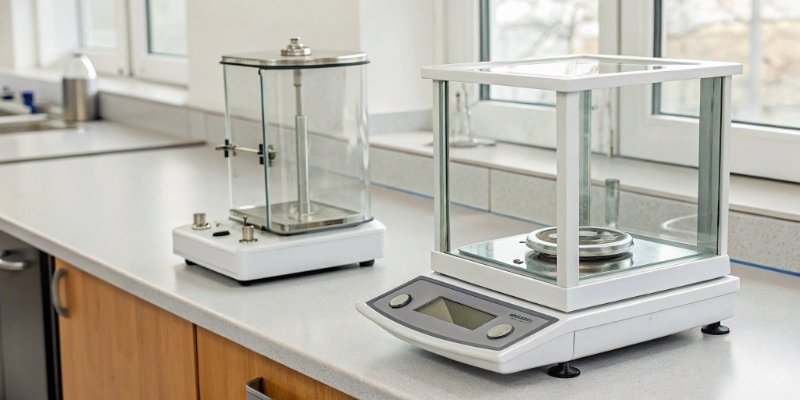
The right choice comes down entirely to your application. Think of it like choosing a vehicle. You wouldn't use a Formula 1 car (the analytical balance9) to haul supplies; you’d use a sturdy truck (the precision balance10). I remember working with a pharmaceutical R&D client who absolutely needed an analytical balance for formulating new compounds. In contrast, a client in the food industry just needed a solid precision balance for checking package weights. Using an analytical balance there would have been slow, overly sensitive, and unnecessarily expensive.
Analytical vs. Precision: A Head-to-Head Comparison
| Feature | Analytical Balance | Precision Balance |
|---|---|---|
| Readability | High: 0.1mg (0.0001g) or finer | Moderate: 1g to 1mg (0.001g) |
| Capacity | Typically lower (under 300g) | Typically higher (up to several kilograms) |
| Design | Features a draft shield to protect against air currents | Usually a top-loading open pan |
| Common Use | Chemical analysis, quantitative research, pharmaceutical formulation, density determination | Quality control, material testing, sample preparation, formulation in food and industrial settings |
| Cost | Higher | Lower |
What's the difference between readability and accuracy in a lab scale?
"Readability" and "accuracy" often sound like they mean the same thing. But mixing them up can lead to measurement errors that compromise your entire quality control process. Let's define it.
Readability is the smallest increment a scale can show you (e.g., 0.001g). Accuracy is how close that measurement is to the true, actual weight. A scale can have excellent readability but poor accuracy if it's not calibrated correctly or is of low quality.
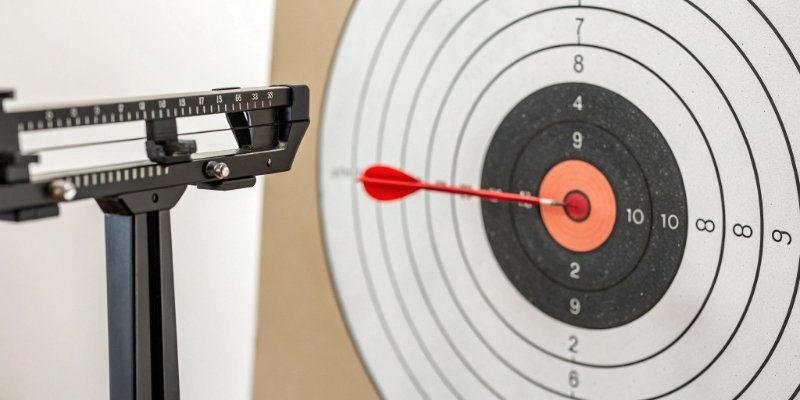
Think of it like a car's speedometer. It might display your speed down to a single MPH—that's its readability. But if the speedometer is broken and always shows you're going 5 MPH faster than you are, it's not accurate. In weighing, a scale might show a weight of 10.005g (high readability), but if the true weight is 10.050g, the scale is inaccurate. High-quality scales are engineered to be both readable and accurate. At our facility, every single scale undergoes rigorous testing to ensure its displayed weight is a true reflection of the actual weight. This is non-negotiable for reliable data.
Key Concepts Contributing to Accuracy
- Repeatability: How consistent the results are when you weigh the same object multiple times. Poor repeatability indicates a problem.
- Linearity: The scale's ability to remain accurate across its entire capacity range, from the lightest to the heaviest samples.
- Calibration: The process of adjusting the scale against a known, certified mass to ensure its output is accurate.
Do I need a scale with internal or external calibration?
Internal or external calibration? It seems like a minor technical detail. But an uncalibrated scale, no matter how expensive, gives you worthless data. Let's decide which method is best for you.
Internal calibration offers automated, hands-free convenience, making it perfect for busy labs or regulated environments needing frequent adjustments. External calibration is a manual process using certified weights. It costs less upfront and gives you more control, but it requires more user time and effort.

Your choice here balances convenience against cost and control. For a GLP/GMP compliant lab where calibrations must be documented frequently, the automation of internal calibration11 is a huge time-saver and reduces human error. The scale can even be programmed to self-calibrate if it detects a temperature change. However, I’ve seen many partners pay a massive premium for a big-brand scale just for this feature. A high-quality scale from a trusted OEM manufacturer that uses a simple external calibration12 procedure can provide identical accuracy for a much lower cost. If you only need to calibrate daily or weekly, the few minutes it takes to place a weight on the scale manually can translate into significant budget savings.
Comparing Calibration Methods
| Aspect | Internal Calibration | External Calibration |
|---|---|---|
| Process | Automatic. The scale uses an internal motor and weight to self-adjust at the push of a button or automatically. | Manual. The operator must place a certified external calibration weight on the scale pan and follow menu prompts. |
| Convenience | High. Very fast, easy, and can be done by anyone with minimal training. | Lower. Requires careful handling of certified weights and takes more time. |
| Cost | Higher initial purchase price for the scale. | Lower initial purchase price, but requires buying and recertifying external weights. |
| Best For | Regulated environments, labs with high throughput, frequent temperature changes, or multiple users. | Labs with stable environments, trained operators, and a focus on minimizing capital expenditure. |
Conclusion
Choosing the right lab scale boils down to matching your application's precision and capacity needs with your environment and budget. We can help you find that perfect, cost-effective solution.
-
This link discusses the importance of accurate lab scales in maintaining quality control standards. ↩
-
This link provides insights on selecting the right capacity for your lab scale based on your needs. ↩
-
Understanding precision is crucial; this resource explains its impact on your choice of lab scales. ↩
-
Learn about readability and its significance in achieving accurate measurements with lab scales. ↩
-
Explore the impact of vibrations on scale accuracy and how to mitigate these effects. ↩
-
Learn about the effects of temperature fluctuations on scale accuracy and reliability. ↩
-
Discover how a draft shield can enhance the accuracy of your measurements in a lab setting. ↩
-
This resource provides insights on selecting a reputable OEM manufacturer for quality lab scales. ↩
-
Find out when to use an analytical balance for high-precision tasks and its benefits. ↩
-
Explore this link to understand the distinctions and applications of analytical vs precision balances. ↩
-
Explore the advantages of internal calibration for busy labs needing consistent accuracy. ↩
-
Learn about the external calibration process and its implications for scale accuracy. ↩



Comments (0)