
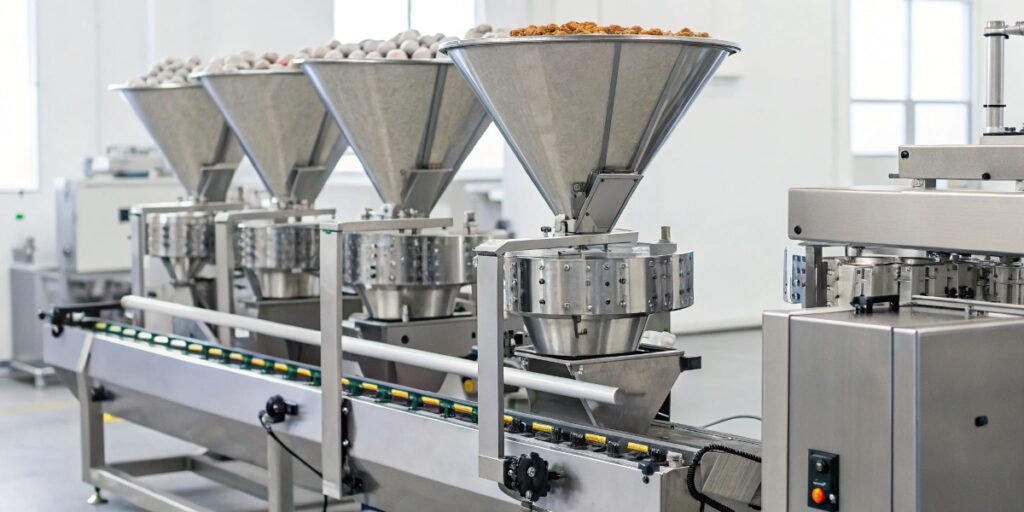
Tired of product giveaway and slow packaging lines? Inaccurate weighing costs you money. A multihead weigher provides the speed and precision to boost your efficiency and profits.
A multihead weigher, or combination weigher, uses multiple weighing heads to find the ideal combination of product weights. It calculates the group of heads that comes closest to your target weight, then discharges that precise amount for high-speed, accurate packaging.
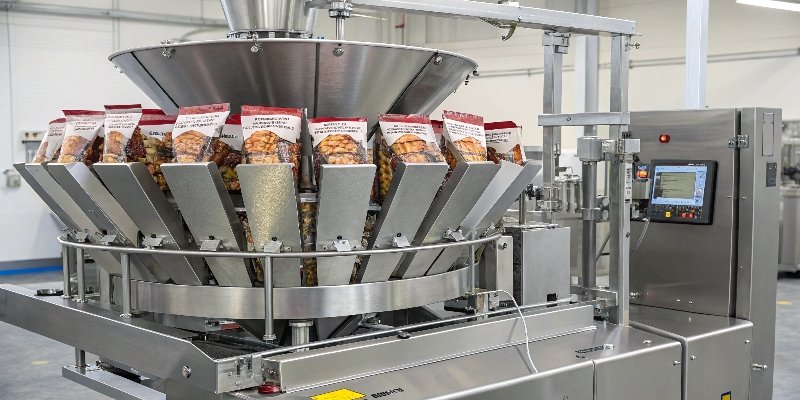
Now that you understand the basic principle, you might be wondering what makes this technology so special. I've spent 18 years in this industry, and I’ve seen firsthand how this equipment transforms production lines. The real power of a multihead weigher1 is in its features and how they bring real benefits to many industries. Let’s look closer at what it can do for your business and why it has become an essential tool for automation.
What are the key features and applications of a multihead weigher?
Do you need a single, versatile weighing solution for many different products? Using separate machines for everything is costly and very inefficient. A multihead weigher's flexibility handles many products on one machine, which saves you space and money.
Key features include high accuracy, often to ±0.5g, and incredible speed, with some models reaching 210 packs per minute. It's also versatile enough for mixing products. This makes it essential for packaging snacks, fresh produce, hardware, and pharmaceuticals on automated lines.
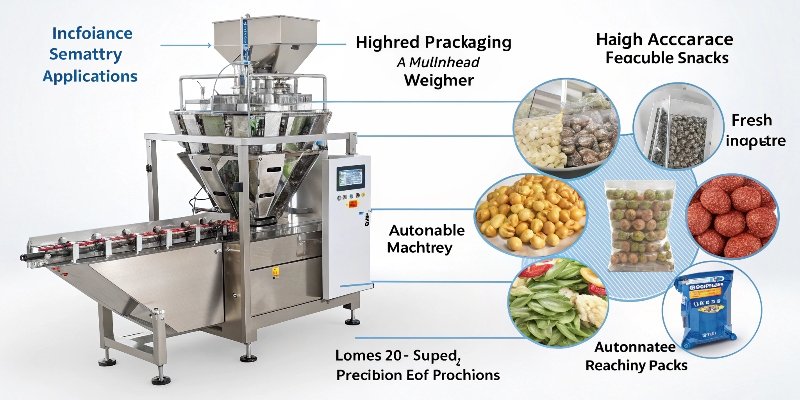
As a manufacturer, we build these machines to solve specific problems for our clients, like software vendors who need reliable hardware for their systems. The features we focus on are what make these weighers so effective.
Unpacking the Core Features
The true value comes from a few key characteristics working together. First is precision. A weigher can achieve an accuracy error of less than 0.1% of its full scale. This means for small items, the error can be under a single gram. Second is efficiency. By using multiple weighing channels in parallel, we've seen clients increase their production capacity by 300% compared to manual or semi-automatic methods. Third is flexibility. A single machine can store dozens of product "recipes." This allows you to switch from weighing potato chips to weighing screws with just a few taps on a screen. You can even use it for mixing up to eight different components into one package.
| Feature | Description | Typical Data / Benefit |
|---|---|---|
| Accuracy | Minimizes product giveaway through precise weighing. | Error rate of ≤0.1% FS, often within ±0.5-1g. |
| Efficiency | Parallel weighing across multiple heads boosts speed. | Increases production capacity by over 300%. |
| Flexibility | Handles various products and can mix ingredients. | Supports up to 8 different components in one mix. |
| Adaptability | Designed for different production environments. | IP65/IP67 waterproof designs for wet/dusty areas. |
Where It Shines: Key Applications
This technology is found everywhere. Its largest application is in the food industry for packaging things like potato chips, nuts, candy, and pasta. For these items, its speed and accuracy are perfect. It also works very well for fresh and frozen foods, such as cut vegetables, salads, or meat. We can supply machines with an IP65 waterproof rating2, so they can be washed down easily. Beyond food, it's used for pharmaceuticals to count and weigh pills and capsules. It's also great for small hardware parts like nuts, bolts, and screws. The weigher ensures every package has the correct count or weight, which is critical for quality control.
How does a multihead weigher achieve high-speed and accurate weighing?
Is achieving both speed and accuracy a constant battle on your production line? Sacrificing one for the other hurts your quality or your output. The weigher’s combination method achieves both at the same time, ending this compromise for good.
It works through a process called combination weighing. Dozens of small weigh hoppers hold portions of your product. A computer instantly calculates which hoppers combine to perfectly match the target weight. This parallel process is much faster and more accurate than weighing one large batch.
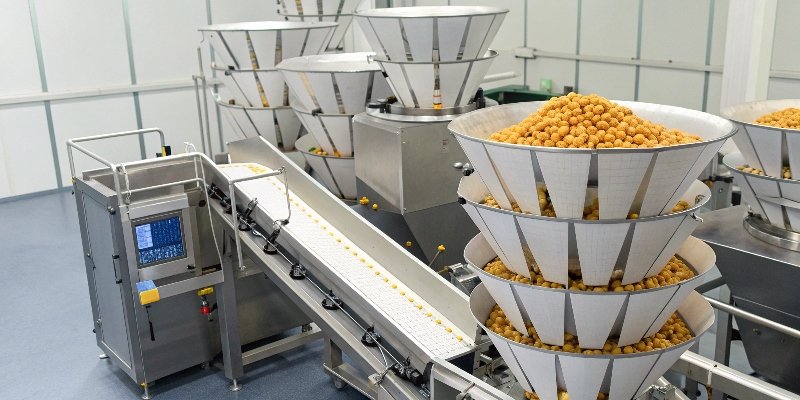
This process is the core of what makes a multihead weigher so powerful. As an engineer, seeing it in action is impressive. It's a simple idea, but the execution requires advanced technology. Let's break down exactly how it works.
The Three-Step Process to Perfection
The entire operation can be explained in three main steps.
- Material Distribution: First, the product is fed onto the top of the weigher. A central vibrating cone or a screw feeder distributes the product evenly into a series of smaller linear feeders. These feeders then gently move the product into individual weigh hoppers. On a standard 14-head machine, you have 14 of these hoppers ready to be weighed.
- Combination Calculation: Each hopper contains a high-precision sensor, called a load cell3, that measures the weight of the product inside it. The machine’s control system, which is a powerful industrial PC, reads the weight from all 14 hoppers at once. It then runs through thousands of possible combinations in a fraction of a second to find the group of hoppers that adds up closest to your target weight.
- Precise Discharge: Once the ideal combination is found, the system sends a signal to those specific hoppers. Their doors open at the exact same time, dropping the perfectly weighed portion through a funnel and into your packaging machine4 below. The entire cycle, from feeding to discharging, can happen 60 to over 200 times per minute.
The Technology Behind the Magic
This speed and precision are possible because of the advanced components inside. The load cells are incredibly sensitive, often made from aluminum alloy and based on strain gauge technology. The doors on the hoppers are controlled by fast-acting stepper motors that can open and close in less than 50 milliseconds. The control system is the brain, running complex algorithms while allowing you to store product settings for quick changeovers. It’s this combination of robust mechanics and smart software that delivers consistent results.
What types of products are best suited for weighing with a multihead weigher?
Are you worried that a new machine won't be able to handle your specific product? We know that investing in the wrong equipment is a very costly mistake. The good news is that multihead weighers are designed for a huge range of free-flowing products.
They are perfect for granular, free-flowing, and irregularly shaped items. This includes products like potato chips, nuts, candy, frozen vegetables, pasta, small hardware parts, and even fresh products like meat and salads. If it can be separated into smaller portions, it's a good candidate.
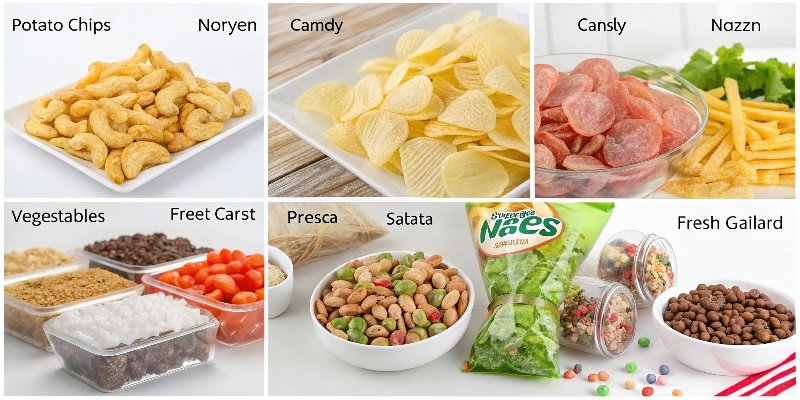
In my experience, almost any company that needs to package small, solid items can benefit from this technology. The key is understanding how the machine's features match your product's characteristics. This is a big part of how we provide targeted solutions for our clients.
From Snacks to Hardware
We can group the ideal products into a few main categories. First are dry, granular goods. This is the most common use and includes things like coffee beans, rice, snacks, cereals, and nuts. The machine can easily separate these into the hoppers for weighing. Second are fragile and irregular items, like potato chips or cookies. The gentle vibration feeding process prevents breakage. Third are fresh and frozen foods. Products like shredded cheese, salads, cut fruit, and frozen peas are handled well, especially on machines with an IP65 or IP67 waterproof rating for easy cleaning. Sticky products, like gummy candies, can also be handled with special dimpled or Teflon-coated surfaces. Finally, there's the non-food category. This includes small plastic parts, screws, nails, and other hardware where accurate count-by-weight is important.
Why It Works for Different Products
The weigher's design is what makes it so versatile. The table below shows how specific machine features solve challenges posed by different product types.
| Product Type | Key Challenge | How the Weigher Solves It |
|---|---|---|
| Fragile Items (Chips) | Breakage | Gentle vibration and controlled drop heights. |
| Sticky Items (Gummies) | Sticking to surfaces | Dimpled, patterned, or Teflon-coated hoppers and chutes. |
| Wet Items (Salads) | Cleaning and hygiene | IP65/IP67 waterproof stainless-steel construction for washdowns. |
| Mixed Items (Trail Mix) | Accurate ingredient ratio | Software that can weigh multiple components for a single drop. |
By choosing the right head configuration, materials, and software, we can tailor a machine to almost any free-flowing product. This adaptability is why it has become the industry standard for automated weighing.
What are the steps involved in setting up and operating a multihead weigher?
Are you afraid that new, advanced equipment will be complex and time-consuming to install? Production downtime is a major concern for any manager. The good news is that modern weighers are designed for a user-friendly setup and fast product changeovers.
Setup involves mechanical installation, connecting it to power and your packaging machine, and running a calibration. Operation is even simpler: you select a pre-saved product "recipe" on the touchscreen, set the target weight, and press start. The machine largely runs itself after that.
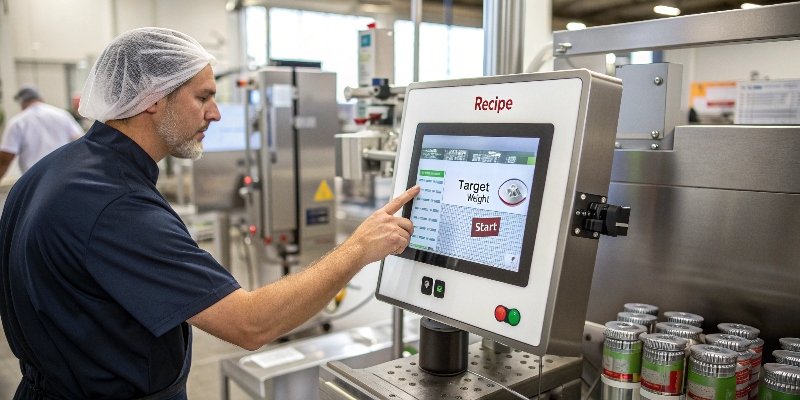
As a manufacturer providing solutions to customers worldwide, we ensure our equipment is not only powerful but also practical. We've simplified the process so your team can get up and running quickly. A smooth integration is key to a fast return on your investment.
Step 1: Installation and Integration
The first step is the physical setup. The multihead weigher is usually mounted on a platform directly above a packaging machine, like a vertical form-fill-seal (VFFS) bagger. Our technical team ensures it is installed securely. Next, we connect it to power and integrate it with your existing line. This involves connecting its control system to your packaging machine. We use standard data interfaces like RS485 or Profibus, which allows the weigher and bagger to "talk" to each other. The weigher tells the bagger when a portion is ready, and the bagger tells the weigher it's ready for the next drop. This seamless communication is critical for high-speed operation.
Step 2: Calibration and Recipe Creation
Once installed, we calibrate the load cells to ensure they are perfectly accurate. After that, we create "recipes" for each of your products. A recipe is a set of saved parameters that tells the machine how to run. This includes the target weight, the vibration intensity5 for the feeders, and the timing of the hopper doors. For example, a heavy, dense product like nuts needs less vibration than a light, bulky product like popcorn. Creating these recipes is straightforward with the modern touchscreen interface. We usually help our clients set up their first few recipes during the training process.
Step 3: Daily Operation and Maintenance
This is the easiest part. On a daily basis, your operator simply turns on the machine, selects the correct product recipe from the menu, and hits the start button. The machine automatically manages the product flow and weighing process. The operator's main job is to keep the product hopper full and monitor the system. Maintenance is also simple. For food applications, daily cleaning is important. This is why we recommend IP65-rated machines, as they can be washed down with water, making cleanup fast and easy. As part of our service, we provide full training and documentation to make sure your team feels confident from day one.
Conclusion
A multihead weigher boosts your packaging speed and accuracy. It is a versatile and essential tool for any modern automated production line, delivering a fast return on your investment.
-
Explore this link to understand the technology behind multihead weighers and their benefits for production efficiency. ↩
-
Understand the benefits of IP65 waterproof ratings for easy cleaning and maintenance in food applications. ↩
-
Discover the importance of load cells in achieving precision and accuracy in weighing. ↩
-
Explore the integration process of multihead weighers with packaging machines for seamless operation. ↩
-
Learn how adjusting vibration intensity can optimize the weighing of different product types. ↩



Comments (0)