

Struggling to know if you need an expensive balance? Choosing the wrong one wastes money and can ruin your results. Understand when high precision is the only option.
You need a high-precision balance when your work requires measuring very small quantities with extreme accuracy. This is common in laboratories, quality control for small parts, pharmaceutical formulation, and any field where tiny weight differences are critical to the outcome. It's an investment in certainty.

Investing in equipment can be a big decision for any company. As a purchasing manager or technical director, you want to make sure you get the best value. It's not just about the price. It's about getting the right tool for the job. A high-precision balance1 is a perfect example of this. It costs more for a reason. And choosing one is a clear statement about your company's commitment to quality. Let's look deeper at when this investment is not just a good idea, but necessary.
What is the use of a high precision balance?
You see these precise scales but are unsure of their real-world uses. Using a standard scale for a precision task leads to failed tests and costly errors.
High-precision balances are essential for tasks demanding extreme accuracy. Their primary uses are in pharmaceutical compounding, quality control checks for minute components, chemical formulation, and scientific research. In these areas, a tiny error in weight can have huge consequences, making precision a necessity, not a luxury.

The value of a high-precision balance comes from its ability to deliver repeatable, accurate results for very small samples. At Weigherps, I've seen them become the heart of quality control departments. The expense is justified by the technology inside. The sensors are engineered to detect changes at the milligram or even sub-milligram level. The balance also often includes internal mechanics to protect against vibrations, which would throw off a normal scale.
Key Industrial Applications
Different industries rely on this precision for different reasons. For our clients who are software vendors, their customers often operate in these high-stakes fields. Integrating their software with our precise hardware creates a powerful quality assurance system2.
| Industry | Primary Use Case | Why Precision is Critical |
|---|---|---|
| Pharmaceuticals | Formulating active ingredients (APIs). | An incorrect dose can make a drug ineffective or harmful. |
| Electronics | Weighing coatings or tiny components. | Ensures functionality and consistency of small, sensitive parts. |
| Jewelry | Measuring gemstones and precious metals. | Determines the exact value and confirms authenticity. |
| Quality Assurance | Verifying sample weights against a standard. | Catches manufacturing defects early, preventing recalls. |
Ultimately, a high-precision balance is a tool for risk management. It prevents the huge financial and reputational costs that come from inaccurate measurements in critical applications.
When should you use an analytical balance?
You have heard the term "analytical balance," but it sounds complex. Not knowing when to use one could mean you are missing the right tool for your most critical tasks.
You should use an analytical balance when you must measure mass with a very high degree of precision, typically with a readability of 0.1mg or better. They are designed for quantitative chemical analysis and are almost always used inside a draft shield to prevent measurement errors.

An analytical balance3 is a specific type of high-precision balance. Its defining feature is its sensitivity. These instruments are so sensitive that even a small air current, a change in temperature, or a spec of dust can affect the reading. This is why they always come with a transparent enclosure, called a draft shield4. You close the doors before taking a reading to create a still environment. I once visited a client's lab where they couldn't get stable readings. The problem was an air conditioning vent blowing directly over the workstation. Moving the balance solved the issue instantly.
The Importance of a Controlled Environment
Using an analytical balance means controlling the environment. The balance must be on a solid, vibration-free table. The temperature and humidity in the room should be stable. The user must also be careful, using forceps to handle samples to avoid transferring oils or moisture from their fingers.
Typical Scenarios for Analytical Balances
- Gravimetric Analysis: Determining the mass of a substance in a sample.
- Density Determination: Measuring mass to calculate the density of an object.
- Pipette Calibration: Checking if a pipette delivers the correct volume by weighing the dispensed liquid.
- Standards Preparation: Creating solutions with a precisely known concentration for calibrating other instruments.
For any task where the "true" weight is essential and theacceptable margin of error is almost zero, the analytical balance is the correct choice.
What type of balance provides high precision and sensitivity?
With so many types of balances, it's easy to get confused. Choosing the wrong one means your data is unreliable, which could impact your entire project or production line.
Analytical balances and microbalances provide the highest levels of precision and sensitivity. These instruments are specifically engineered with high-resolution electromagnetic force restoration (EMFR) sensors and protective features to measure mass accurately, often down to the sub-milligram level.

When we talk about high precision, we are talking about a specific class of weighing instruments. It's not just one type. The sensitivity of the balance is what sets it apart. This sensitivity is often called "readability" or "resolution," and it refers to the smallest change in mass the balance can detect and display. This is possible because of the advanced sensor technology inside. Unlike a simple load cell in a standard scale, these balances use a sophisticated electromagnetic force restoration5 (EMFR) mechanism. This technology is much more expensive to produce but offers incredible accuracy and stability.
Understanding Balance Tiers
The world of precision balances is tiered. As you move up the tiers, the readability gets finer, but typically the maximum capacity decreases.
Comparing High-Precision Balances
| Balance Type | Typical Readability | Typical Max Capacity | Key Feature |
|---|---|---|---|
| Precision Balance | 1g - 0.001g (1mg) | 200g - several kg | A workhorse for general lab and industrial tasks. |
| Analytical Balance | 0.1mg - 0.01mg | 100g - 300g | Always has a draft shield for high accuracy. |
| Semi-Microbalance | 0.01mg | ~50g - 100g | A step between analytical and microbalance6s. |
| Microbalance | 0.001mg (1µg) | 1g - 10g | For weighing extremely small samples with top-tier accuracy. |
As a purchasing manager, understanding these tiers is key. You don't always need a microbalance. Often, an analytical balance is perfect. The goal is to match the instrument's readability to your application's required tolerance. This ensures you pay for the precision you actually need.
When should you use an analytical balance instead of a top loading balance?
You already own a top-loading balance. Is it good enough? Using it for a high-precision task can cause hidden production errors, product failures, and wasted material.
You must use an analytical balance instead of a top-loading balance when your measurement readability needs to be 0.1mg or finer. Top-loading balances are for general weighing, while analytical balances are for applications where even the tiniest error is unacceptable.
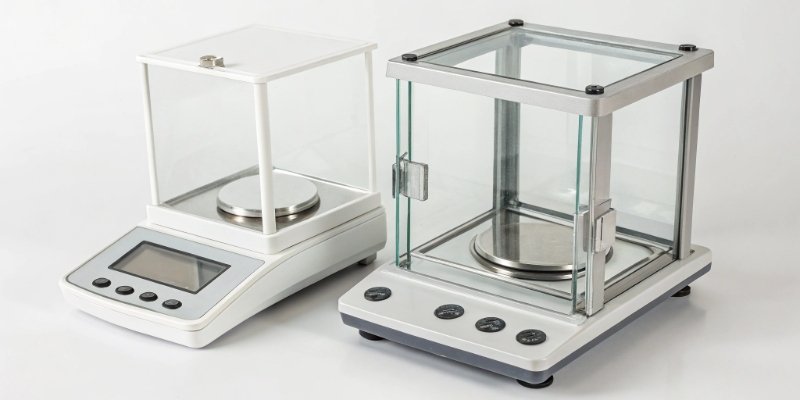
This is one of the most common questions we get at Weigherps. The choice between a top-loading balance7 and an analytical balance comes down to one thing: the required level of precision. A top-loading balance (often just called a precision balance) is robust and easy to use. It's perfect for weighing larger samples where a little variation is acceptable. I think of it as a chef's kitchen scale – great for most recipes. An analytical balance is like a pharmacist's tool, where every grain matters.
A Tale of Two Balances
The physical differences are obvious. The analytical balance has its draft shield, and the top-loading balance has an open weighing pan. But the key differences are in their performance and their intended use.
| Feature | Top-Loading Balance | Analytical Balance |
|---|---|---|
| Readability | 0.1g to 0.001g (1mg) | 0.1mg to 0.01mg |
| Environment | Less sensitive to drafts | Requires a draft-free, stable area |
| Typical Use | General weighing, batching | Quantitative analysis, formulation |
| Cost | Lower | Higher |
Making the Right Financial Decision
From a purchasing perspective, the cost difference is significant. This is where you have to think about the cost of an error8. I worked with a client in the electronics industry. They were using a top-loading balance to weigh a special coating for a small sensor. Their failure rate was high. After we analyzed their process, we found that tiny variations in the coating weight were the cause. They invested in an analytical balance. Their product failure rate dropped to nearly zero. The balance paid for itself in less than a month by eliminating waste and rework. That is the return on investment you get from using the right tool.
Conclusion
Choosing a high-precision balance depends entirely on your accuracy needs. Match the instrument's precision to your application's requirements to ensure reliable results and make a smart investment.
-
Explore the significance of high-precision balances in achieving accurate measurements in various fields. ↩
-
Discover how integrating precise hardware and software creates effective quality assurance systems. ↩
-
Get insights into the functionality and applications of analytical balances in laboratories. ↩
-
Learn how draft shields enhance measurement accuracy by minimizing environmental interference. ↩
-
Learn about the advanced technology behind high-precision balances and its benefits. ↩
-
Explore the capabilities of microbalances in measuring extremely small samples with high precision. ↩
-
Understand the applications and limitations of top-loading balances in various settings. ↩
-
Explore the financial implications of measurement errors and the importance of investing in precision. ↩



Comments (0)