
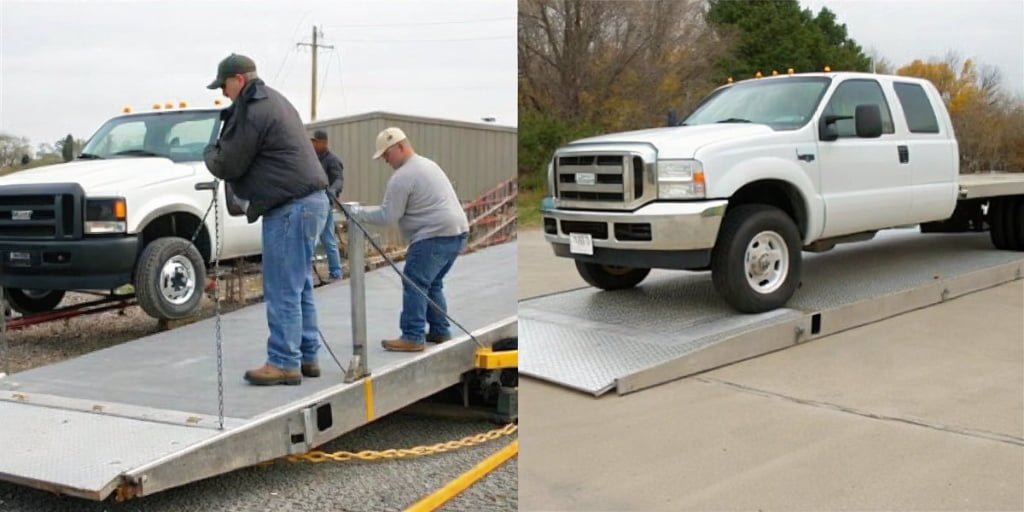
Struggling to pick the right truck scale? A wrong decision costs your company time and money. Let us help you choose the right tool for your specific job.
Choose a portable truck scale for temporary job sites, lower initial costs, and when flexibility is key. Opt for a stationary scale for permanent installations, high-traffic environments, and when you need the highest possible accuracy and durability for long-term, frequent use.

Over my 19 years in this industry, this is one of the most common questions I get from clients. The truth is, there's no single "best" answer. The right choice always comes down to your unique operational needs, your budget, and your long-term goals. I've seen businesses save thousands by choosing the right scale from the start. Let's dig into the details to find your perfect fit.
How accurate are portable truck scales?
Worried that a portable scale won't be accurate enough for your work? Inaccurate measurements can lead to overload fines, incorrect billing, and lost revenue. Let's clarify the precision you can realistically expect.
Portable truck scales are very accurate for static weighing, often with an accuracy of around 99.8% to 99.9%. However, their accuracy can be lower than stationary scales for in-motion weighing. They are excellent for compliance checks, but less so for certified legal-for-trade applications.

The accuracy of a portable scale depends heavily on how you use it. For the best results, you need a flat, level, and solid surface. An uneven or soft ground can throw off the readings. In my experience, when teams take a few extra minutes to set up the scales properly on a good surface, the results are consistently reliable. The main challenge comes when trying to weigh a truck as it moves slowly over the pads, which is where stationary scale1s have a clear advantage.
Factors Influencing Portable Scale Accuracy
Several things can affect how accurate your portable scale is. Understanding them helps you get the most out of your equipment.
| Factor | Impact on Accuracy | Best Practice |
|---|---|---|
| Ground Surface | High | Always use on a hard, level surface like concrete or asphalt. Avoid dirt or gravel. |
| Weighing Type | Medium | Static weighing (stopping the truck on the pads) provides the most accurate results. |
| Pad Placement | High | Ensure all pads are level with each other and correctly positioned under the axles. |
| Calibration | High | Regular calibration2 is key to maintaining accuracy over time. |
What is a portable weighing scale used for?
Are you unsure if a portable scale actually fits your business model? Using the wrong equipment can create bottlenecks and slow down your entire operation. Let's look at where these flexible scales really shine.
Portable scales are primarily used in temporary work sites like construction, mining, and farming. They are also perfect for mobile law enforcement checkpoints, vehicle load management in logistics, and any situation where installing a permanent scale is not practical or cost-effective.

I have many clients in the construction industry who move from site to site every few months. For them, a stationary scale is impossible. They use our portable scales to check the weight of trucks carrying materials like sand and gravel. This helps them avoid overloading fines and ensures they are getting the amount they paid for. Another common use is in agriculture, where farmers weigh their harvest directly in the field before transporting it. The main idea is to bring the scale to the truck, not the other way around.
Common Applications in Different Industries
The flexibility of portable scales3 makes them valuable tools across various sectors.
- Construction and Mining: At temporary sites, these scales are used to monitor the weight of extracted materials and ensure trucks comply with road weight limits. This prevents fines and reduces wear and tear on vehicles.
- Logistics and Shipping: Companies use them for spot-checks in warehouses or distribution centers. This helps optimize load distribution and verify shipping weights without needing a dedicated weighbridge4.
- Agriculture: Farmers can weigh produce in the field. This provides immediate data for yield management and sales, creating a more efficient harvest process.
- Waste Management: Mobile scales are used to weigh garbage trucks at collection points to track waste volumes and manage landfill capacity more effectively.
What type of weighing scale is more accurate?
Do you need the absolute highest accuracy for your operations? Choosing a less precise scale for a job that demands perfection can be a very costly mistake, especially for legal transactions.
Stationary truck scales are generally more accurate than portable ones. This is especially true for high-volume and "legal-for-trade" applications. Their permanent foundation and single, large weighbridge eliminate many variables that can affect portable scale accuracy, ensuring consistent top-tier precision.

Think of it like this: a stationary scale is built into a specially prepared concrete foundation. It's a single, solid structure that doesn't move. Portable scales are made of multiple pads that have to be set up each time. Even a small difference in the ground level under each pad can affect the final reading. For businesses that buy and sell goods based on weight, like a grain elevator or a steel mill, the superior accuracy of a stationary scale is not just a preference; it's a legal and financial necessity.
Why Stationary Scales Have an Edge in Accuracy
The design and installation of stationary scales are what give them their superior accuracy.
| Feature | Stationary Scale | Portable Scale |
|---|---|---|
| Foundation | Poured concrete, perfectly level | Relies on existing ground surface |
| Weighbridge | Single, rigid steel platform | Multiple separate weighing pads5 |
| Calibration Stability | Very high; holds calibration for longer | Can require more frequent checks |
| Legal-for-Trade | Commonly certified for commercial use | Less common; often for check-weighing only |
How do portable truck scales work?
Are you curious about the technology behind these handy portable scales? Understanding how they work can give you more confidence in your purchasing decision. I'll explain the simple but effective process.
Portable truck scales work by using a series of separate, low-profile weighing pads. Each pad contains sensors called load cells. You place one pad under each tire or axle group. The load cells measure the weight, and a central processor adds it all up for a total.

The magic is really in the load cells6 inside each pad. A load cell is a small but strong sensor that converts pressure—the weight of the truck—into a tiny electrical signal. The stronger the pressure, the stronger the signal. These signals travel from each pad, often wirelessly, to a central indicator. This indicator is the brain of the system. It collects all the individual signals from each wheel, adds them together instantly, and displays the total weight of the truck on a screen. It's a smart and efficient way to get a weight reading almost anywhere.
The Key Components and Process
The system is straightforward and built from a few core parts that work together.
- Weighing Pads: These are the flat, durable platforms that the truck's wheels rest on. They are built to be tough enough to handle heavy loads but light enough for one or two people to carry and position.
- Load Cells: Housed securely inside each pad, these are the critical sensors that do the actual measuring. At Weigherps, we use high-quality load cells to ensure our scales are both durable and reliable.
- Indicator/Processor: This is the handheld or desktop unit that displays the final weight. It receives the data from all the pads, calculates the total, and can often store data or print a receipt. Modern systems increasingly use Bluetooth to send data directly to a smartphone or tablet.
Conclusion
Choosing between portable and stationary scales is simple. It depends on your need for flexibility versus your requirement for maximum accuracy and high-volume use. Assess your priorities to choose wisely.
-
Learn why stationary scales are ideal for permanent installations and high-traffic environments. ↩
-
Find out how regular calibration maintains the accuracy of your weighing equipment. ↩
-
Discover the versatility of portable scales in different operational contexts. ↩
-
Discover the function of weighbridges in stationary scales and their impact on accuracy. ↩
-
Explore the design and function of weighing pads in portable truck scales. ↩
-
Learn about the technology behind load cells and their role in measuring weight. ↩



Comments (0)