
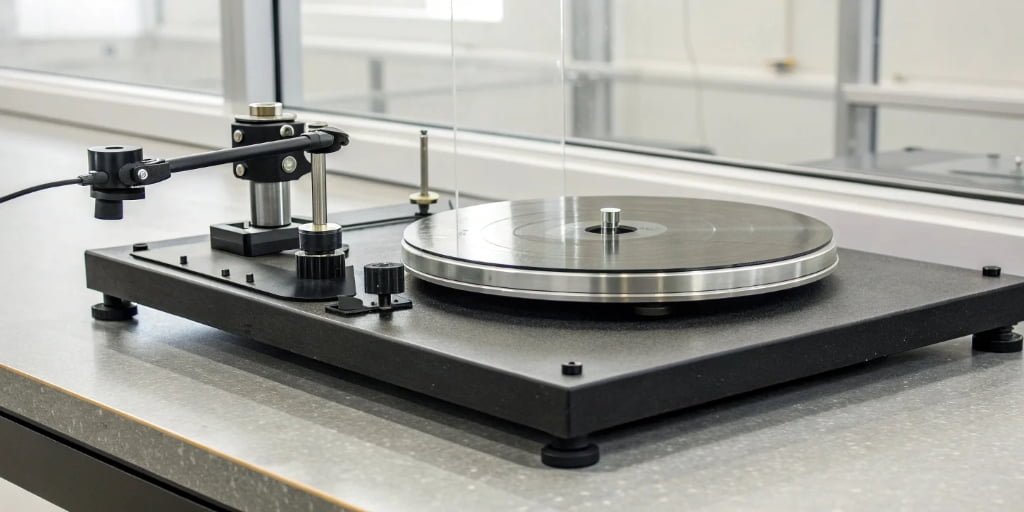
Your high-end balance gives fluctuating readings. These errors ruin tests and waste time. We'll show you why a draft shield and anti-vibration table are essential for accuracy.
High-end balances need a draft shield to block air currents and an anti-vibration table to absorb shocks. Both environmental factors cause tiny movements that create significant errors in high-precision weighing, compromising data accuracy and repeatability.

The difference between a reliable measurement and a failed one often comes down to controlling the environment. You might be surprised at how much simple air movement or a coworker walking by can affect your results. Let's break down exactly how these accessories protect your work.
What is the function of a draft shield on an analytical balance?
Ever see your balance readings drift for no reason? Even the slightest breeze from a vent or a person walking by can cause this. A draft shield is the simple, crucial barrier that stops it.
A draft shield completely encloses the weighing pan, creating a calm environment. Its main function is to block air currents from air conditioning, drafts, or even the operator's breath. This stabilization prevents reading fluctuations and ensures accurate, repeatable measurements.

Air currents might seem insignificant, but for an analytical balance measuring milligrams, they are a major source of error. The force of moving air, however small, can exert pressure on the weighing pan1, leading to unstable and incorrect readings. A draft shield2 acts as a physical barrier to create a still-air environment3 around your sample.
How a Draft Shield Works
The core principle is simple: isolation. By enclosing the weighing area, the shield prevents external air movements from interfering with the delicate measurement process4. This is especially critical when weighing very light samples, like powders or films, that can be easily disturbed.
Common Issues Solved by Draft Shields
| Problem Source | Effect on Balance | Solution |
|---|---|---|
| HVAC Vents | Constant, low-level airflow causing drift. | A fully enclosed shield blocks direct airflow. |
| People Walking By | Sudden gusts of air leading to spikes. | The shield creates a buffer against abrupt changes. |
| Operator's Breath | Minor fluctuations during close work. | Glass doors allow visibility without interference. |
Many modern draft shield2s, often made of glass or ABS plastic, also have an anti-static coating. This is vital when working with fine powders that can cling to surfaces due to static electricity, further ensuring a true weight measurement.
How do environmental vibrations affect weighing accuracy?
Your building seems perfectly still, but your balance readings jump around. Invisible vibrations from machinery, footsteps, or even traffic are disrupting your delicate sensor. Understand how these vibrations create errors and how to stop them.
Environmental vibrations cause the balance's highly sensitive internal mechanism to oscillate continuously. This prevents the sensor from stabilizing and finding a true zero point. The result is a constantly drifting reading, making it impossible to get an accurate weight, especially for small samples under 10mg.
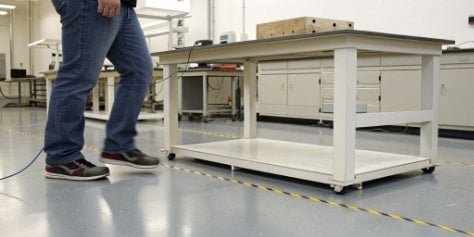
A high-precision balance5 with a resolution of 0.1mg or less is an incredibly sensitive instrument. It is designed to detect minute changes in mass. Unfortunately, this sensitivity also makes it extremely susceptible to mechanical vibrations transmitted through the floor and benchtop. The internal weighing cell cannot distinguish between the force of the sample and the force of these vibrations.
Common Sources of Vibration
These disruptions can come from sources you might not even notice:
- Foot Traffic: People walking near the workstation.
- Building Systems: HVAC units, elevators, or pumps running elsewhere in the building.
- Nearby Equipment: Centrifuges, mixers, or even a large printer operating on the same floor.
- External Sources: Heavy traffic, construction, or a nearby train line.
The Impact on Measurements
Vibrations prevent the balance from achieving equilibrium. The reading will constantly fluctuate, making it impossible to record a stable weight. According to standards like GMP and GLP6, the acceptable vibration amplitude for a 0.01mg balance is often less than 2μm. Anything more can render your results invalid. For example, a passing forklift can cause a reading to drift by more than ±0.5mg, a huge error when weighing a 5mg sample.
When is an anti-vibration table necessary for a laboratory balance?
You have tried everything, but your high-end balance is still unstable. The problem is not the balance; it is the unstable surface it is on. An anti-vibration table is the definitive solution for rock-solid stability.
An anti-vibration table is necessary whenever you use a high-precision balance (0.1mg readability or better), especially in environments with noticeable vibrations. If your lab is on an upper floor, near heavy machinery, or experiences any structural vibration, this table is not optional—it's essential for compliance and accuracy.

While a draft shield2 handles air, an anti-vibration table7 tackles ground-borne disturbances. You should consider it a mandatory piece of equipment in several key situations. The core principle is to isolate the balance from the building structure by using mass and damping materials to absorb vibrational energy8.
Key Indicators You Need One
If you answer "yes" to any of these, an anti-vibration table7 is a must:
- High Precision: Are you using a balance with a readability of 0.1mg, 0.01mg, or finer?
- Unstable Environment: Is your lab located above the ground floor, near an elevator, or close to a busy hallway or road?
- Heavy Equipment: Do you operate large equipment like pumps, centrifuges, or manufacturing machinery in the same building?
- Regulatory Compliance: Do your operations fall under GMP, GLP, or ISO standards that mandate controlled weighing conditions?
How They Provide Stability
These tables typically feature a very heavy, dense top, often made of granite. This mass is difficult to move and naturally dampens vibrations. This top is then isolated from the frame by shock-absorbing materials like rubber pads or advanced air spring systems. This combination effectively absorbs both low-frequency rumbles and high-frequency jitters, providing a perfectly still surface for your balance.
What are the best practices for setting up a high-precision scale?
You have the best equipment, but your results are still inconsistent. The problem might be your setup. Small details can make a huge difference. Follow these best practices for a perfect, error-free weighing station.
For the best setup, place your balance on a dedicated anti-vibration table in a corner of the room with minimal traffic and no air drafts. Ensure the table is perfectly level, the balance is calibrated regularly, and the draft shield doors remain closed during measurement.

Getting reliable results from a high-precision scale goes beyond just buying the right equipment. The setup of your weighing station is just as critical. A poor setup can undermine the effectiveness of even the best draft shield2 and anti-vibration table7. Following a clear checklist ensures you control every variable for maximum accuracy.
Environmental Setup
Your first step is choosing the right location. The ideal spot is on the ground floor, in a corner of the room away from doors, windows, and main walkways. This minimizes structural vibration9 and drafts. Avoid placing the balance near heat sources like radiators or equipment that radiates heat, as this can create convective air currents10 inside the draft shield2.
Equipment Setup Checklist
| Category | Best Practice | Why It Matters |
|---|---|---|
| Surface | Use a dedicated, heavy anti-vibration table7. | It absorbs floor vibrations, providing a stable base. |
| Leveling | Ensure the table and the balance itself are perfectly level. | An unlevel balance will not weigh accurately. |
| Power | Plug into a stable, dedicated power source. | Prevents electrical interference from affecting electronics. |
| Operation | Always keep draft shield2 doors closed during weighing. | Blocks last-minute air disturbances. |
| Maintenance | Calibrate the balance daily or before critical use. | It accounts for changes in temperature or pressure. |
By systematically following these steps, you create a controlled weighing environment where the only variable being measured is the mass of your sample.
Conclusion
To ensure accuracy and compliance, high-end balances require a draft shield and anti-vibration table. These tools are not optional; they are essential infrastructure for reliable, precise weighing.
-
Understanding the weighing pan's role can help you optimize your balance's performance. ↩
-
Understanding the role of a draft shield can enhance your weighing accuracy and prevent errors. ↩ ↩ ↩ ↩ ↩ ↩
-
Learn techniques to minimize air movement and enhance measurement accuracy. ↩
-
Understanding the measurement process can help you achieve more accurate results. ↩
-
Gain insights into the specifications and requirements for high-precision balances. ↩
-
Understanding these standards can help ensure compliance and improve your laboratory practices. ↩
-
Learn how an anti-vibration table can stabilize your measurements and improve data reliability. ↩ ↩ ↩ ↩
-
Understanding vibrational energy can help you create a more stable weighing environment. ↩
-
Explore how structural vibrations can disrupt measurements and how to minimize their effects. ↩
-
Learn about the impact of air movement on weighing accuracy and how to control it. ↩



Comments (0)