

Confused about whether your device measures mass or weight? This isn't just semantics; it can impact your operational accuracy. Let's clarify this fundamental weighing principle for good.
A balance definitively measures mass. Mass is the amount of matter in an object, a constant value. Weight, conversely, is the gravitational force acting on that mass and changes with location. A balance compares an unknown mass to a known mass, making it independent of gravity's pull.

So, a balance1 measures mass. That's the simple answer. But this opens up a bigger conversation. How does a balance differ from a scale, a term we use constantly in our industry? The distinction is more than just words; it’s fundamental to getting accurate results. Let's explore this difference further.
What's the fundamental difference between a balance and a scale?
Do you use the terms "balance" and "scale" as if they are the same? This common habit can lead to choosing the wrong instrument, compromising your precision and budget.
The fundamental difference is their operating principle. A balance compares an unknown mass against a known mass, making it gravity-independent. A scale, like a spring scale or most electronic scales, measures force (weight) and then often converts this reading to a mass unit for convenience.
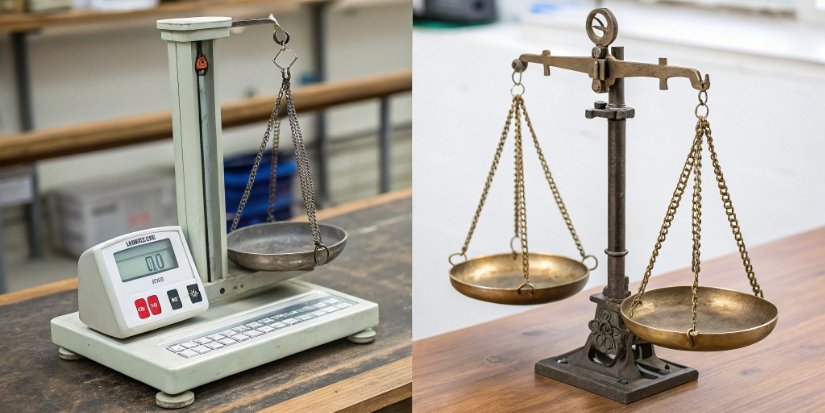
The distinction between a balance and a scale is a core concept in the weighing industry. A balance operates on a comparison principle. Imagine a classic two-pan balance. You place your object on one side and add known weights to the other until they level out. It's a direct mass-to-mass comparison, pure and simple.
A scale measures force. It measures how hard gravity is pulling an object down. A simple spring scale demonstrates this: the more an object weighs, the more it stretches the spring. Our modern industrial scales use a device called a load cell2. This transducer converts the force of weight into an electrical signal. We then process this signal and display it as a mass unit like kilograms. It's a clever process, but it originates from a weight measurement.
Key Distinctions: Balance vs. Scale
| Feature | Balance | Scale |
|---|---|---|
| Measures | Mass (directly) | Weight (force) |
| Principle | Comparison | Force Measurement |
| Gravity's Effect | Unaffected | Directly affects reading |
| Primary Unit | Mass (g, kg) | Force (N, lbf) |
| Common Use | Labs, high precision | Industrial, commercial |
How does gravity influence the measurement of weight but not mass?
Did you know your measurements could be inaccurate just by changing location? If you're measuring weight, gravity variations between cities can cause significant errors. Let's see how this works.
*Gravity's pull is not uniform across the Earth; it's slightly stronger at the poles than at the equator. Weight is mass multiplied by gravitational acceleration (W = mg). Because a balance compares one mass to another in the same gravitational field, the 'g' factor cancels out, making the measurement stable.**
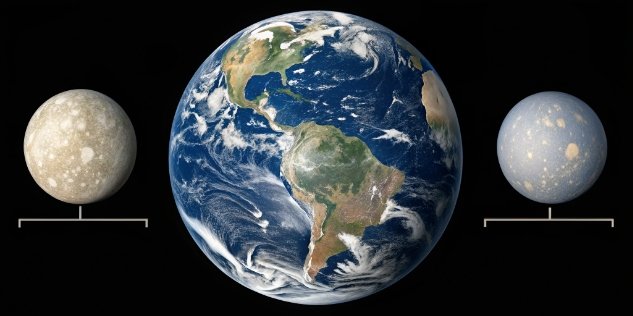
Mass is an intrinsic property of an object. It's the "amount of stuff" it contains. This value is constant, whether you are on a mountaintop or at sea level. Your mass is your mass, everywhere.
Weight is different. It's the relationship between that mass and gravity, defined by the formula: Weight = Mass × Gravitational Acceleration (g). The value of 'g' varies slightly with altitude and latitude. An object literally weighs less on Mount Everest than it does at sea level.
This is why calibration is so critical for force-measuring scales.
Gravity's Impact on Measurement
| Location | Gravitational Accel. (approx.) | Weight of a 10kg Object |
|---|---|---|
| Earth (Sea Level) | 9.81 m/s² | 98.1 Newtons (N) |
| The Moon | 1.62 m/s² | 16.2 Newtons (N) |
A force-measuring scale would show a wildly different reading on the Moon. A balance, however, would read the same. The weaker gravity affects the object and the known counterweights equally, so the comparison remains true. This is why mass is the universal standard.
Do modern electronic balances actually measure weight and convert it to mass?
Are you puzzled by how a modern "electronic balance" works? It lacks the classic pans, so it seems to break the rules. The technology inside is a clever blend of principles.
Yes, most modern high-precision devices called "electronic balances" function like scales. They use an electromagnetic force restoration (EMFR) mechanism, which measures the force (weight) required to counteract the object's mass. This force reading is then converted to a mass value by an internal microprocessor, using a pre-calibrated gravitational constant.
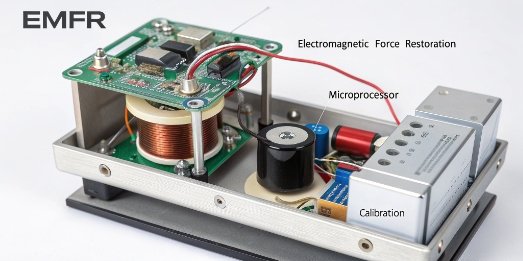
This is where terminology gets a bit tricky, but the technology is fascinating. While we call them "electronic balances" for their high precision, they operate more like a very sophisticated scale. They don't use simple load cells. Instead, they rely on a technology called Electromagnetic Force Restoration (EMFR).
Here’s a simple breakdown of the process:
- You place an object on the measurement pan.
- This action applies a downward force on a lever mechanism.
- A sensor detects this tiny movement.
- An electromagnet is then activated to generate an equal and opposite force, pushing the lever back to its original equilibrium position.
The amount of electrical current required to do this is measured with extreme precision. This current is directly proportional to the force (weight) of the object. The device's internal processor then uses this force reading and a stored, locally-calibrated value for gravity to calculate and display the object's mass. It's a brilliant fusion of principles.
If a balance measures mass, what units should be used for the result?
Are you reporting your measurement results in the correct units? Using the wrong ones can cause major confusion in data exchange and international trade, leading to preventable and costly mistakes.
The correct units for mass are based on the International System of Units (SI). The primary unit is the kilogram (kg). For smaller measurements, grams (g), milligrams (mg), or micrograms (µg) are used. Ounces and pounds are technically units of weight, though they are often used colloquially for mass.
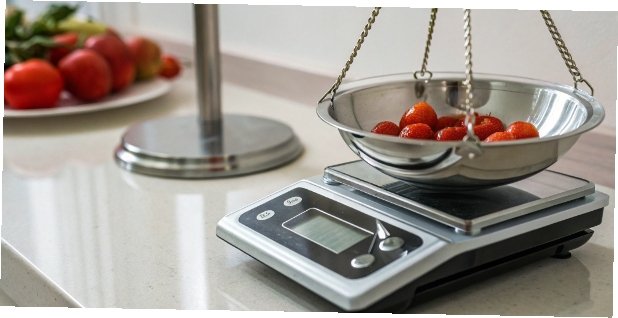
Since a balance measures mass, your results should be in mass units. For consistency in science, technology, and global trade, we use the International System of Units3 (SI). The base SI unit for mass is the kilogram (kg).
For our partners developing software, this is a crucial detail. When your application receives data from our weighing systems, it must interpret the units correctly. Assuming pounds when the device is outputting kilograms can create serious errors. We design our instruments to be flexible, but we strongly advise using SI units as the standard for all technical work. It removes any potential for ambiguity.
Common Units: Mass vs. Weight
| Unit Type | SI Units (Metric) | Imperial / US Customary Units |
|---|---|---|
| Mass | kilogram (kg), gram (g) | slug (technical, rare) |
| Weight | Newton (N) | pound-force (lbf), ounce (oz) |
While pounds (lb) and ounces (oz) are commonly used for mass in trade, they are technically units of weight. For precise technical and scientific work, kilograms and grams are the unambiguous, correct choice.
Conclusion
To summarize, a balance measures an object's intrinsic mass, while a scale measures its weight. Knowing this difference is essential for accurate, reliable, and universally understandable measurement in any industry.


[…] inside. Unlike a simple load cell in a standard scale, these balances use a sophisticated electromagnetic force restoration5 (EMFR) mechanism. This technology is much more expensive to produce but offers incredible accuracy […]
[…] For basic scales, this might be a strain gauge load cell. But for ultra-precision, we rely on Electromagnetic Force Restoration (EMFR)1 technology. An electromagnet generates a force to perfectly balance the weight on the pan. The […]