
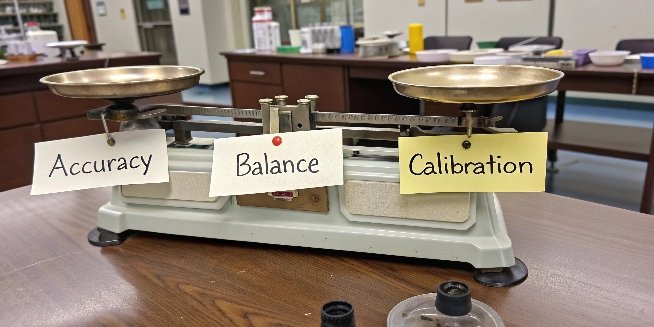
Are you confused about how different weighing scales actually work? This can make choosing the right equipment a challenge. Let's explore the three core principles behind all weighing technology.
The three fundamental principles of weighing are the lever balance, Hooke's Law, and sensor technology. While older mechanical scales use levers, modern digital scales primarily combine Hooke's Law with advanced strain gauge sensors. This combination delivers the high accuracy and reliability needed for industrial applications.
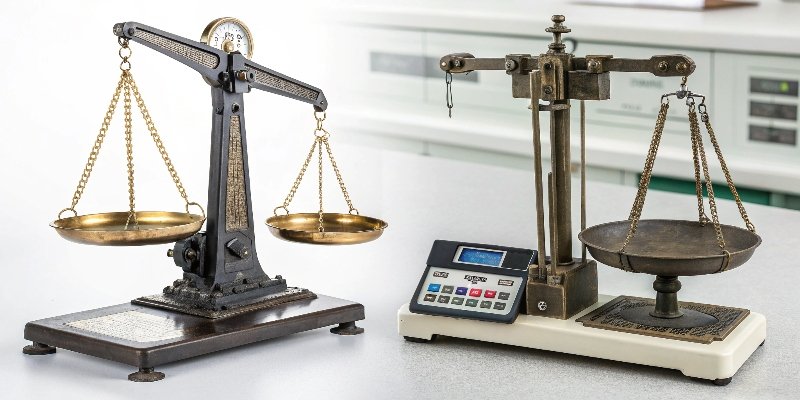
It's easy to take an accurate weight reading for granted. We place an object on a scale and a number appears instantly. But behind that simple action is a fascinating history of scientific innovation. For us as manufacturers, understanding these principles is everything. It's how we build scales that you can trust for your most critical operations. To truly appreciate the technology you rely on, it helps to understand how it evolved. Let's start with the most basic concept.
What is the principle of weighing?
The basic idea of "weighing" seems simple enough. But the real science behind it can be surprisingly diverse and complex. Let's break down the one core concept that defines weighing.
The principle of weighing is the process of measuring an object's mass. We do this by measuring the force it exerts due to gravity. This force is measured either by balancing it against a known force or by measuring the physical deformation it causes on a material.

At its heart, weighing is about measuring force. Every object with mass is pulled toward the Earth's center by gravity. This pull is the object's "weight." All scales, from the simplest to the most complex, are tools designed to measure this downward force. They then translate that force measurement into a reading of mass, like kilograms or pounds. As a global manufacturer, we understand that gravity isn't exactly the same everywhere on Earth. That's why high-precision industrial scales must be calibrated for their specific location. This ensures that the scale accurately measures mass, not just local weight. This distinction is critical in science and industry, where consistency is key.
| Feature | Mass | Weight |
|---|---|---|
| Definition | The amount of matter in an object. | The force of gravity acting on an object. |
| Unit | Kilograms (kg), Grams (g) | Newtons (N), Pounds (lb) |
| Constancy | Constant everywhere. | Varies with location (gravity). |
What is the principle used in common weighing scales?
You see old-fashioned balance scales in a museum and modern digital scales everywhere. They seem totally different. But a shared history and connected scientific principles link them together over time.
Common weighing scales use two main principles. Mechanical scales, like a traditional balance, use the lever principle to compare an unknown mass with known masses. Spring scales use Hooke's Law, where a spring's stretch is directly proportional to the applied weight.

The oldest principle is the lever balance1. It works just like a seesaw. You place an object on one side and add known weights to the other until it balances. This method is simple and visual but slow and not very precise for today's fast-paced industries. The next big step was using Hooke's Law2. This law states that the force needed to stretch or compress a spring is directly proportional to the distance of that stretch or compression. Simple bathroom scales and grocery store spring scales3 use this principle. The weight of the object stretches a spring, which moves a dial to show the weight. This was a big improvement, but springs can wear out. In my 18 years of experience, I've seen how these basic ideas paved the way for something far better.
What is the principle of the digital scale?
Digital scales provide instant, highly accurate readings. But how do they magically convert physical weight into a precise number on a screen? It's all thanks to modern sensor technology working with microprocessors.
A digital scale operates using a load cell sensor. This combines Hooke's law with electronics. Weight deforms a metal element, which changes the electrical resistance of an attached strain gauge. A circuit measures this tiny change, which a microprocessor then converts into your digital weight reading.
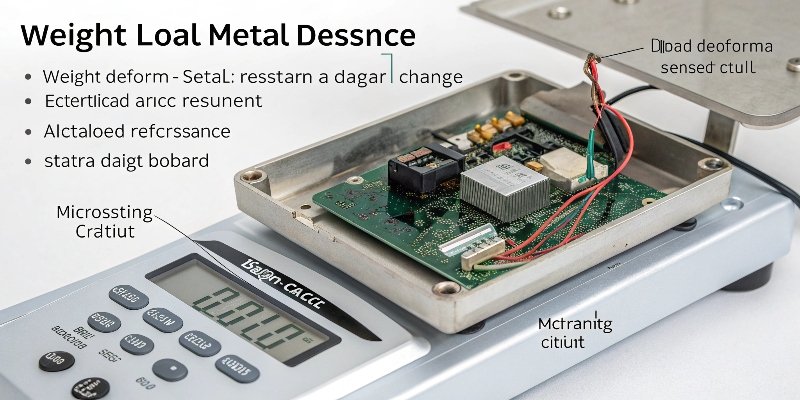
This is where our expertise at Weigherps truly comes into play. The heart of a modern industrial scale is the strain gauge load cell. When you place a load on the scale, it slightly deforms a carefully engineered piece of metal inside. A tiny sensor called a strain gauge, bonded to this metal, deforms with it. This deformation changes the strain gauge's electrical resistance. The change is incredibly small, so we use a sensitive circuit called a Wheatstone bridge4 to detect it as a tiny voltage signal. This analog signal is then amplified and converted into a digital signal that a microprocessor can read. Our R&D team works constantly to perfect this process. We develop smart algorithms that filter out vibrations and temperature changes, ensuring the final number you see is stable and exact. It's this technology that allows our IoT scales5 to send accurate data directly to your management software.
How do you calibrate a weighing scale?
Your scale seems off and gives you inconsistent readings. An uncalibrated scale can lead to costly errors in production and inventory. Let's walk through the essential process of calibration.
To calibrate a weighing scale, you first set it to zero. Next, you place a certified weight of a known mass on it. You then adjust the scale's internal settings, usually through a digital menu, until it displays the exact weight of the certified mass.

Calibration is simply the act of comparing your scale's reading to a known, true standard. Think of it as tuning an instrument. The certified weight6 is your perfect note, and you adjust the scale until it matches. For any business that relies on accurate measurements, regular calibration is not optional. Here is a basic guide:
- Prepare: Make sure the scale is on a flat, level surface, away from air drafts or vibrations. Let it warm up for a few minutes.
- Zero: With nothing on the platform, press the "Zero" or "Tare" button. The display should read "0".
- Enter Mode: Access the scale's calibration function. This is often done by pressing and holding a specific button when turning it on.
- Use Standard Weight: The scale will prompt you to place a specific calibration weight on the platform. Use only certified weights for this.
- Confirm: The scale will register the weight and finalize the adjustment.
As a manufacturer, we build our industrial scales to make this easier. Many of our models feature internal, motorized calibration. The scale can calibrate itself automatically to account for temperature shifts, ensuring it remains accurate all day long without any user intervention.
Conclusion
From simple levers to intelligent sensors, weighing principles have evolved. Understanding them helps you choose the right, reliable technology for your business, ensuring both accuracy and efficiency.
-
Explore the lever balance principle to understand its historical significance and how it laid the foundation for modern weighing technology. ↩
-
Learn about Hooke's Law and its crucial role in the functionality of various weighing scales, enhancing your understanding of measurement. ↩
-
Learn about the operation of spring scales and their application in everyday weight measurement. ↩
-
Learn about the Wheatstone bridge's function in measuring tiny changes in resistance, vital for accurate weight readings. ↩
-
Discover how IoT scales integrate technology for real-time data transmission, enhancing operational efficiency. ↩
-
Understand the significance of certified weights in calibration to maintain measurement accuracy. ↩



[…] need reliable, secure data, and our scales provide it. Modern precision scales, especially our IoT-enabled models7, don't just display a weight. They record the user ID, timestamp, material, lot number, and weight […]