
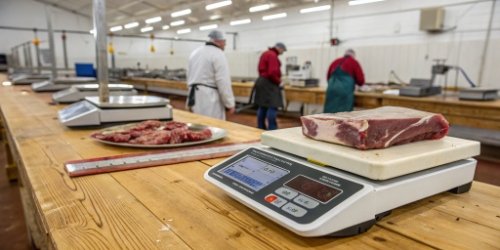
Your slaughterhouse relies on lean meat data for grading, but results are inconsistent. This creates disputes and lost profits. Understanding your tools' limits is the first step to better accuracy.
The main issue with traditional lean meat percentage instruments is their reliance on single-point measurements and empirical formulas. This method is prone to significant human error and uses outdated data models, making it too inaccurate for producers who need precise, reliable carcass grading and fair pricing.
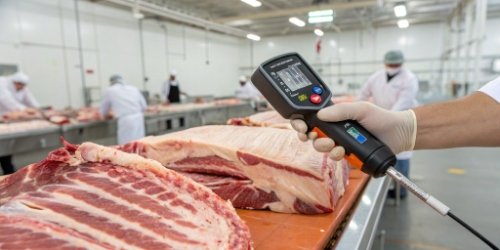
As experts in industrial weighing and measurement, we see this pattern often. A technology becomes the industry standard, but its hidden flaws create major inefficiencies. Many businesses just accept these flaws as a cost of doing business. But they don't have to. You can gain a competitive edge by understanding these problems and looking for a better way. Let's break down the principles, limitations, and real-world accuracy of these common instruments.
What Is the Principle Behind Lean Meat Percentage Measuring Instruments in Slaughterhouses?
You see the probe used, and a number pops up, but what is the device actually doing? Not knowing the principle makes it hard to trust the data or fix errors.
These instruments use a probe to measure the thickness of backfat and the loin eye muscle at a specific point. These two measurements are then plugged into a pre-programmed formula to calculate an estimated lean meat percentage for the entire carcass.
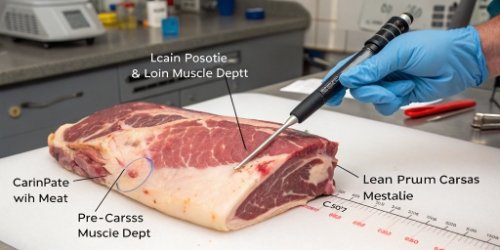
The process seems scientific, but it's more of an educated guess than a direct measurement. At our company, Weigherps, we believe that you must understand the "how" to trust the "what". These lean meat instruments are a classic example of inferring a large value from a very small sample. They operate on a simple, two-step principle: data collection and calculation.
The Core Components of the Calculation
First, an operator uses a probe, which can be a simple metal ruler or a more advanced ultrasonic device, to measure two key data points on the carcass. Second, the device's internal software applies a mathematical formula to these points. This formula is "empirical," meaning it's based on historical observations, not a universal law of physics. Researchers created it by physically dissecting a large number of carcasses in the past, correlating their backfat and loin depth to their total lean meat, and creating a best-fit model. The whole system's accuracy rests on the quality of these two steps.
| Input Variable | Description |
|---|---|
| Backfat Thickness | Measured at a specific point, often between the 3rd and 4th last ribs. |
| Loin Muscle Thickness | Measured at the same point to gauge muscle development. |
Formula f(x,y) |
An equation like Lean % = A + (B * Loin) - (C * Fat). |
| Output | Estimated Lean Meat Percentage |
This method assumes that these two small measurements can accurately predict the composition of the entire animal. This is a big assumption to make when profits are on the line.
What Are the Common Limitations of Lean Meat Percentage Measurement Devices?
You've invested in grading tools, but you still face arguments over carcass payments. The hidden flaws in these tools could be costing you both money and trust with your suppliers.
The most significant limitations are single-point measurements that fail to represent the whole animal, high dependency on operator skill, and outdated formulas that don't account for modern animal genetics or diet. These issues combine to create unreliable results.
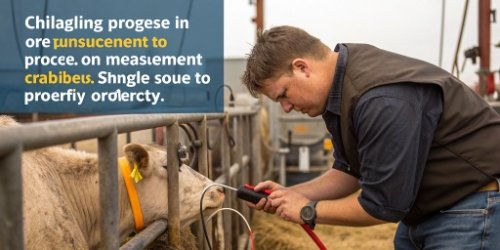
When we design a weighing system, we spend most of our time trying to eliminate variables and sources of error. These lean meat instruments, however, are full of them. For a business that needs consistency, these limitations are a serious problem. Let’s look at the three biggest issues in more detail.
1. The Problem of Single-Point Measurement
Muscle and fat are not distributed evenly across a carcass.1 Taking one measurement is like trying to determine the average weather of a country by checking the temperature in one village. An animal might have a lean back but fatty legs, or vice versa. The single-point method cannot capture this variation, leading to a grade that does not reflect the carcass's true total value.
2. The Human Factor: Operator Error
The tool is only as good as the person using it.2 For a reading to be accurate, the probe must be inserted at the exact same spot, at the exact same angle, every single time. A slight deviation—being off by a centimeter or tilting the probe—can drastically alter the fat and muscle depth readings. This "扎偏" (stabbing crookedly) phenomenon means results can vary wildly between two different operators, or even with the same operator on a busy day. This makes the data inconsistent and untrustworthy.
3. The Outdated Formula Issue
The empirical formulas used by these devices were often developed years, or even decades, ago.3 Animal breeding and nutrition science have advanced rapidly. Today's pigs or cattle are genetically different from their ancestors; they grow faster and have different muscle-to-fat ratios. An old formula based on the animal population from 20 years ago cannot be accurate for today's animals. The model is fundamentally broken.
How Accurate Are Lean Meat Measuring Tools, and What Challenges Do They Present?
You depend on accurate data for fair pricing, but can you really trust the numbers your tools provide? Inaccuracy is not just a technical problem; it is a direct financial loss.
The accuracy is very questionable, with error rates often reaching several percentage points. The main challenges are ensuring consistent operator use, performing regular validations, and updating the underlying formulas—tasks that are difficult and rarely performed correctly in a busy processing environment.
In our field of industrial scales, a few grams of error can be a big deal. In meat processing, a few percentage points of error can mean thousands of dollars in lost revenue or overpayment per day. An error margin of 3-5% is not uncommon with these tools.4 On a 100 kg carcass, a 5% error is a 5 kg difference in saleable lean meat. This level of uncertainty presents serious challenges for any business wanting to optimize its operations.
The core challenges are not easily solved, as they are built into the technology and the process itself.
| Challenge | Description | Consequence | Our Recommended Approach |
|---|---|---|---|
| Inconsistent Technique | Operators place the probe at slightly different locations or angles. | Wildly variable readings and unfair grading. | Implement rigorous, ongoing training, use jigs or guides for placement, and conduct regular spot-checks. |
| Instrument Calibration | The instrument's internal settings can drift, or ultrasonic probes can degrade. | Systematic error where all measurements are consistently wrong. | Calibrate daily against a known physical standard. This is non-negotiable for any serious measurement tool. |
| Outdated Formulas | The animal population has changed since the formula was created. | All estimations are biased, consistently over or under-valuing carcasses. | This is the hardest part. It requires periodically dissecting carcasses to create new formulas, which is costly and complex. |
| Biological Variation | No two animals are identical. A formula is just an average. | Even a perfect measurement on a "standard" animal is wrong for an outlier. | Recognize the limits and explore technologies that measure the whole object, not just one point. |
What Are the Pros and Cons of Using Lean Meat Percentage Instruments in Meat Processing?
These tools are common in the industry, but is sticking with them the right choice for your business? Continuing with the status quo could mean leaving potential profit and efficiency on the table.
The primary benefit is that these instruments are fast, cheap, and provide a basic standard for trading. The major drawbacks are their inherent inaccuracy, high dependence on operator skill, and their nature as a technological dead end that prevents true process optimization.

Every business decision is a trade-off. As weighing system experts, we always advise clients to look beyond the initial price and consider the total cost of ownership, including the cost of inaccuracy. Here is a straightforward breakdown of using traditional lean meat probes.
The Advantages: Speed and Simplicity
There is a reason these tools became popular. They are much faster than the alternative of physically separating lean and fat. On a fast-moving processing line, speed is critical. The initial investment for a probe is also much lower than for advanced imaging systems like MRI or DEXA. Finally, because they are so common, the "lean percentage" number they produce acts as a common language for buying and selling, even if the number itself is flawed.
The Disadvantages: Inaccuracy and Risk
The cons, however, are significant for a modern, data-driven business. The financial risk from inaccurate grading is huge.5 You could be overpaying for lower-quality carcasses or undervaluing premium ones, hurting both your bottom line and your supplier relationships. The operational inconsistency makes it impossible to gather reliable data for process improvement.6 You can't improve what you can't measure accurately. Finally, this technology offers no path forward. It doesn't integrate with modern IoT systems or provide the rich data needed for analytics-driven decisions.
| Pros | Cons |
|---|---|
| Fast to use on the processing line | Prone to significant financial error |
| Low initial equipment purchase cost | Highly dependent on operator training and mood |
| Simple for workers to operate | The core formulas become outdated and inaccurate |
| Creates a basic industry standard | Provides no detailed data for process improvement |
For companies focused on precision, these cons quickly outweigh the pros, pushing them to find better solutions.
Conclusion
Traditional lean meat measurement tools are fast but flawed. For true accuracy, fair pricing, and long-term profit, businesses should explore more advanced and reliable measurement technologies.
-
"Carcass and Meat Quality Characteristics and Changes of Lean and ...", https://pmc.ncbi.nlm.nih.gov/articles/PMC12345986/. This source explains the biological variation in muscle and fat distribution across animal carcasses and its impact on single-point measurement accuracy. Evidence role: mechanism; source type: research. Supports: Muscle and fat distribution across a carcass is uneven, affecting single-point measurement accuracy.. Scope note: The source may focus on specific species and not generalize across all livestock. ↩
-
"Anthropometric measurement error and the assessment of ...", https://pubmed.ncbi.nlm.nih.gov/10655963/. This source highlights the role of operator skill in the accuracy of lean meat measurement tools. Evidence role: expert_consensus; source type: education. Supports: Operator skill significantly impacts the accuracy of lean meat measurement tools.. Scope note: The source may not quantify the extent of operator error in specific scenarios. ↩
-
"The Impact of Modifications in the Testing Method for Determining ...", https://pmc.ncbi.nlm.nih.gov/articles/PMC11987893/. This source discusses the historical development of empirical formulas in carcass grading and their limitations in modern contexts. Evidence role: historical_context; source type: encyclopedia. Supports: Empirical formulas in lean meat percentage devices were developed years ago and may not reflect modern animal genetics.. Scope note: The source may not specify the exact timeline for all formulas used in the industry. ↩
-
"II. Statistical analysis of error attributable to sex, genotype, and weight", https://pubmed.ncbi.nlm.nih.gov/7607996/. This source provides evidence of typical error margins in lean meat percentage measurement tools. Evidence role: statistic; source type: research. Supports: Error margins of 3-5% are common in lean meat percentage measurement tools.. Scope note: The margin may not apply universally across all tools or species. ↩
-
"[PDF] Economics of Increased Beef Grader Accuracy by Maro A. Ibarburu ...", https://farmdoc.illinois.edu/assets/meetings/nccc134/conf_2007/pdf/confp03-07.pdf. This source discusses the economic impact of grading inaccuracies in meat processing. Evidence role: case_reference; source type: research. Supports: Inaccurate grading poses significant financial risks in meat processing.. Scope note: The source may focus on specific case studies and not provide a general overview. ↩
-
"The implementation of grading systems for beef carcass value ...", https://pmc.ncbi.nlm.nih.gov/articles/PMC11018705/. This source explains how operational inconsistencies in measurement tools hinder reliable data collection for process optimization. Evidence role: mechanism; source type: education. Supports: Operational inconsistencies in lean meat measurement tools prevent reliable data collection for process improvement.. Scope note: The source may focus on specific operational scenarios and not generalize across all industries. ↩



Comments (0)