
Are you losing money from incomplete product packages? A few missing grams seem insignificant, but inaccurate shipments erode profits and customer trust. Getting your weighing process right is the first step to protecting your bottom line.
No, a standard industrial scale often cannot reliably detect a missing item that weighs only a few grams. Its advertised accuracy is typically measured in a perfect lab setting, not in a real-world factory. Workshop vibrations and other interferences can significantly reduce its effective accuracy.
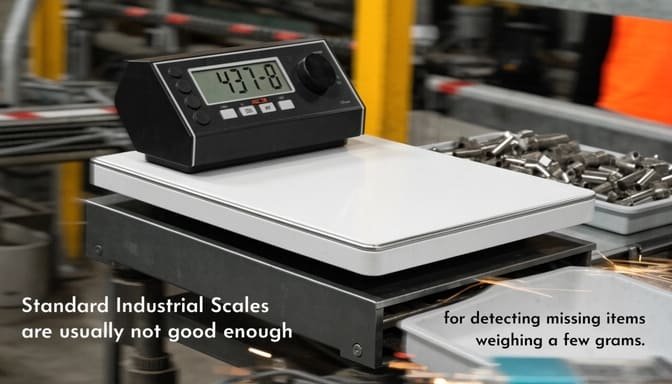
This disconnect between the specifications on a datasheet and actual performance on the factory floor is something I see all the time. As a manufacturer of industrial scales for nearly two decades, I've visited countless production facilities. A client often tells me, "My scale is rated for 10-gram accuracy, but it can't tell me when a small component is missing from a kit." They are right to be frustrated. The problem isn't usually the scale itself, but that it's the wrong tool for such a precise job in a challenging environment. Understanding this difference is the key to solving the problem and ensuring every package you ship is complete.
How accurate are typical industrial scales in identifying single missing components based on weight?
Are you trusting a scale's spec sheet to guarantee complete products? That advertised accuracy can vanish amid workshop vibrations and air currents. This uncertainty in your quality control process can cost you dearly in returned products and a damaged reputation.
A typical industrial scale is not accurate enough to reliably identify a single missing lightweight component. The "division" or "readability" you see on the specifications is not the same as real-world accuracy. Environmental factors like machinery vibrations, drafts from ventilation systems, and temperature changes dramatically reduce its practical performance.
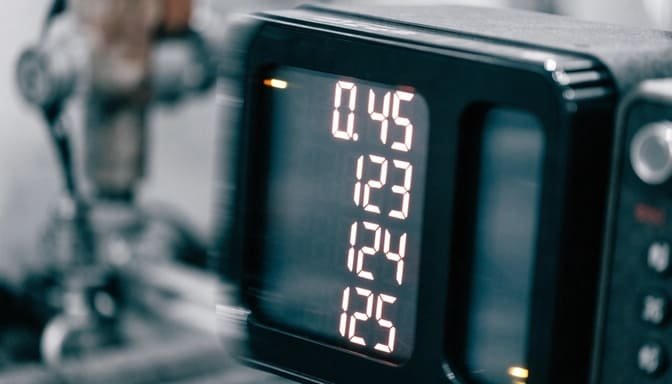
Let me break down why the scale on your factory floor doesn't perform like it does in the lab. The advertised division value, let's say 10 grams, is a metric called readability—it's the smallest increment the scale can display. However, this is often confused with accuracy, which is how close the measurement is to the true weight. In a controlled laboratory, these might be very close. But your factory floor is not a lab. I once had a client in the automotive parts industry who couldn't understand why their Class III scale, with a 10g division, failed to flag kits missing a single 15g bolt. We discovered the heavy stamping machine on the other side of the facility created constant, low-level vibrations. These vibrations are forces, and the scale's sensitive load cell interprets them as small, fluctuating changes in weight, making it impossible to get a stable, repeatable reading for a tiny component.
Here are the main culprits that degrade a scale's accuracy:
| Environmental Factor | How It Affects the Scale | Real-World Example |
|---|---|---|
| Vibrations | Interferes with the load cell's ability to settle, causing fluctuating readings. | A nearby conveyor belt, a forklift driving past, or heavy machinery operating in the building. |
| Air Currents | Drafts from HVAC systems, open doors, or even foot traffic can apply pressure to the scale platform, skewing results. | An air duct blowing directly onto a scale used for weighing powders. |
| Temperature Changes | Cause the metal components inside the load cell to expand or contract, leading to measurement drift. | A scale near a loading dock door where temperatures change between morning and afternoon shifts. |
| Electrical Interference | Radio Frequency Interference (RFI) from other equipment can disrupt the electrical signal from the load cell to the indicator. | High-power motors or variable-frequency drives operating near the weighing station. |
These factors stack up, meaning a scale rated for 10g division in a lab might have a real-world repeatability of 30g, 50g, or even worse. For detecting a missing part, this level of uncertainty is unacceptable.
Is it possible for an industrial scale to pinpoint small discrepancies in weight due to missing items?
Are you frustrated that your standard scales can't catch small but costly packaging errors? These minor mistakes add up, eroding your profits and damaging your reputation. Pinpointing these tiny discrepancies requires a more advanced and targeted approach.
Yes, it is possible, but not with a standard industrial platform scale. Pinpointing small weight differences requires a high-precision system, such as an inline checkweigher, specifically designed for this task. These systems use superior load cells and advanced software to filter out environmental noise.

To achieve the level of precision needed to detect a missing screw or leaflet, you have to move beyond a general-purpose scale. The solution lies in a system engineered for the task. At Weigherps, this is exactly what we specialize in. We had a client in the pharmaceutical industry who needed to ensure every bottle of pills contained a small cotton ball, which only weighed a couple of grams. Their standard bench scale was useless for this. We designed a solution that integrated a high-precision checkweigher right into their packaging line. This system uses a technology called electromagnetic force restoration (MFR) or specialized strain gauge load cells1 that are far more sensitive and stable than those in standard scales. More importantly, it's paired with intelligent software. This software uses algorithms that create a "digital filter" to cancel out the background noise from factory vibrations. It learns the normal rhythm of the production line and isolates the true weight of the product from these disruptive forces. This allows the system to reliably and repeatedly detect the tiny weight difference of a missing cotton ball, automatically rejecting any defective packages without slowing down production.
Can standard industrial weighing systems reliably identify shortages of small, lightweight pieces?
Are you still seeing incomplete product kits slip past your quality control, even with scales in place? Relying on standard systems to check for small parts is a gamble, and your brand's reputation for quality and consistency is what's at stake.
No, standard industrial weighing systems are not reliable for identifying shortages of small, lightweight pieces. Their resolution is often too low, and their performance is too easily compromised by typical factory floor conditions to be trusted for such a critical quality control task.
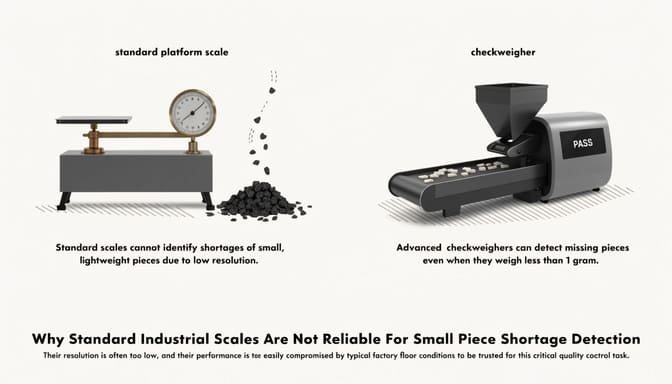
The fundamental issue is that a standard industrial scale and a high-precision checkweigher are designed for different jobs. A standard scale is built for bulk measurement where a small margin of error is acceptable. A checkweigher is an instrument of verification, built for speed and precision to confirm every single package meets a precise specification.2 For any potential client in the software or smart device industry, I always emphasize that the hardware must match the sophistication of their quality goals. You wouldn't run advanced diagnostic software on an outdated computer, and the same logic applies here. You can't achieve high-level quality assurance with low-resolution weighing hardware. Many modern checkweighing systems can be seamlessly integrated with metal detectors and data management systems like MES or ERP, transforming them from simple scales into critical data points for your entire smart manufacturing operation.
Here’s a direct comparison between the two:
| Feature | Standard Industrial Scale | High-Precision Checkweigher |
|---|---|---|
| Primary Purpose | General bulk weighing (e.g., pallets, large boxes). | In-motion verification of individual products. |
| Typical Resolution | Lower (e.g., 10g, 20g, or more). | Higher (e.g., 0.1g or even 0.01g). |
| Sensitivity to Environment | Highly vulnerable to vibrations, drafts, and temperature. | Designed with dampening and software filters to resist these factors. |
| Software & Integration | Basic weighing functions with limited data output. | Advanced data logging, analytics, and integration with production line controls. |
| Reliability for Small Parts | Low and inconsistent. | High and repeatable. |
This is why, as part of our process at Weigherps, we don't just sell a scale. We analyze your production environment and your specific quality control needs to provide a targeted and cost-effective weighing solution that actually works in the real world.
Conclusion
Standard scales are not suitable for detecting small missing items in a factory setting. For true accuracy and reliable quality control, you need a customized, high-precision weighing system engineered for your specific production environment.
-
"Strain Gauge Load Cells", https://www.mt.com/my/en/home/products/Industrial_Weighing_Solutions/load-cell-and-weigh-module/strain-gauge-beam-load-cells.html. Engineering references describe electromagnetic force restoration balances and strain-gauge load cells as established transducer technologies for precision weighing, supporting the article’s statement that high-precision weighing systems may use these sensing methods. Evidence role: definition; source type: paper. Supports: High-precision weighing systems can use electromagnetic force restoration or specialized strain-gauge load-cell technologies.. Scope note: The source would establish the technologies and their precision applications, not verify the performance of any specific checkweigher model. ↩
-
"Check weigher", https://en.wikipedia.org/wiki/Check_weigher. Checkweigher references describe automatic checkweighing as in-motion verification of products against preset weight limits on production lines, supporting the characterization of checkweighers as verification instruments for individual packages. Evidence role: definition; source type: encyclopedia. Supports: A checkweigher is a verification instrument used to confirm that individual packages meet specified weight limits.. Scope note: The source supports the general function; speed and precision vary by application, product characteristics, and equipment design. ↩



Comments (0)