
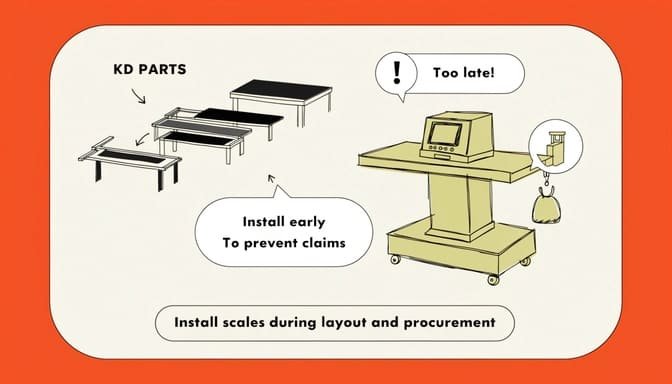
Tired of costly KD part claims? The dispute seems unwinnable, draining your profits. A simple placement change for your scale can stop these losses for good.
To prevent excessive claims on Knock-Down (KD) parts, install the industrial scale at the final packing station. This captures the definitive weight record just before shipment, providing irrefutable evidence against shortage disputes and shifting control from the quality department to the point of dispatch.

You might think your current quality checks are enough, but the real financial leaks happen after that1. The key isn't just if you weigh, but when you weigh. As a manufacturer with 19 years of experience, I've seen countless companies struggle with this. Let's explore how a strategic shift can protect your bottom line.
How can industrial scales be strategically placed to minimize disputes over KD part claims?
Facing endless disputes over KD part shortages? These claims can damage trust and your budget. Placing scales at key exit points provides the hard data needed to end these arguments.
Strategically place industrial scales at the final packing station, right before sealing the box. This creates a time-stamped weight record for each shipment, serving as your ultimate proof of contents and quantity and effectively minimizing the grounds for any future claims or disputes from clients.
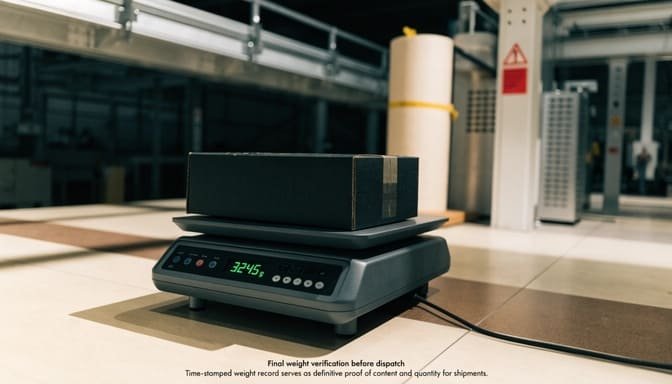
For years, I've seen clients treat weighing as a simple quality control (QC) function. However, to truly solve shortage claims, you must see weighing as the cornerstone of shipment control. The traditional process of weighing components in the QC department is a good first step, but it leaves a massive gap where errors can happen. Parts can be misplaced, dropped, or simply forgotten between the QC check and the final packing station.2 When a claim arrives, your QC record proves what was inspected, not what was shipped. This subtle difference is where disputes are born and where your profits are lost. By moving the scale, you change the entire dynamic.
From Quality Control to Shipment Control
The most strategic placement for a scale is at the point where the box is sealed. My insight has always been that you need undeniable evidence from the last possible moment you have control over the package. That moment is right before the tape goes on. When an operator packs a box of KD parts and places it on a scale at their station, they are no longer just a packer; they are the final checkpoint. The weight recorded becomes the single source of truth.3 If a customer claims a shortage, you don't have to argue. You simply provide the timestamped weight record of that sealed box. This shifts the burden of proof and ends the debate before it can even begin.
Creating an Indisputable Digital Record
For a software vendor, the hardware is only half the solution. As a purchasing manager or technical director, you know that data is power. This is where modern IoT scales become essential4. Our scales at Weigherps are designed for easy integration. They don't just show a number on a screen; they communicate directly with your Warehouse Management System (WMS) or Enterprise Resource Planning (ERP) software5. This integration creates a digital, unalterable record tied directly to the shipping order. Imagine your packing team scans an order, the system pulls the expected weight, and the scale confirms the actual weight in real-time. That data is logged automatically. This directly addresses your concerns about software compatibility and provides the high security and robust data you require. It's a seamless bridge between the physical and digital aspects of your operation.
What is the best point in the process for using an industrial scale to control KD component losses?
Are missing KD components slowly bleeding your business dry? These small losses add up to a big problem. The solution is pinpointing the single most effective control point in your workflow.
The absolute best point to use an industrial scale is during the final packing and sealing process. Weighing the complete, ready-to-ship package of KD components confirms that everything is accounted for at the very last moment, providing the strongest possible control against losses before it leaves your facility.
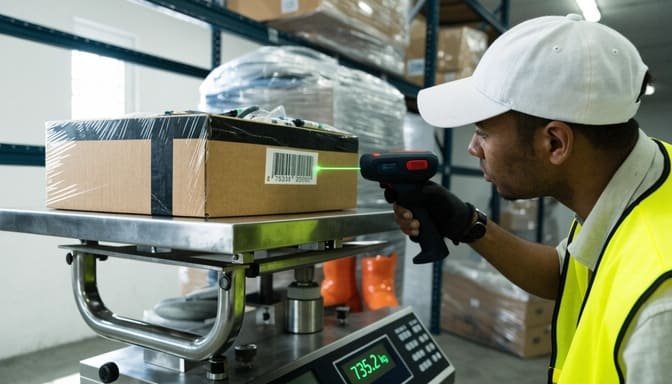
As someone who lives and breathes industrial weighing, I can tell you that control is everything. Losing control of your components, even for a few steps in the process, invites risk. The insight I've shared with countless partners is that the final outbound weight is the only piece of evidence that can fully protect you in a dispute. It's not about adding more work; it’s about making one particular step—the final weigh-in—as powerful as possible. This single action provides a clear pass/fail checkpoint that prevents financial loss and protects your relationship with your clients.
The Final Checkpoint: Your Last Line of Defense
Think of the final packing station as your last line of defense against financial loss from shortage claims. Everything that happens before this point—receiving, kitting, quality inspection—is internal preparation. But the moment that box is sealed and weighed, it becomes an official record of what you are sending to the customer. A client of mine, a major electronics brand, was plagued by claims for missing cables and accessories in their smart device kits. Their QC process was flawless, but claims persisted. We implemented our IoT scales at each packing station. The final weight of every box was recorded against the order number. Claims dropped by over 95% in three months6 because they finally had irrefutable proof of shipment content. This is the power of final-moment verification.
Comparing Different Weighing Points
To make the best decision, it helps to see the options laid out clearly. As a technical director or purchasing manager, you need to justify your investments with clear logic. Here is a simple breakdown of the most common weighing points in a workflow and why the final packing station provides the most control for preventing KD part claims.
| Weighing Point | Pros | Cons |
|---|---|---|
| Incoming Goods | Verifies supplier quantities upon arrival. | Does not account for or prevent internal losses post-receiving. |
| Production Kitting | Ensures individual kits are complete before assembly. | Parts can still be lost or forgotten between kitting and final packing. |
| Quality Control Dept. | Acts as a standard quality gate for components. | A gap exists between QC approval and final shipment; errors can occur here. |
| Final Packing Station | Creates an undeniable, timestamped record of the sealed, shipped package. | Requires a well-integrated workflow at the packing station. |
This table clearly shows that while other weigh points have their place, only weighing at the final packing station directly addresses the problem of outbound shortage claims.
Where should an industrial scale be implemented to catch shortages in KD parts before shipment?
Shipping orders you believe are complete, only to face shortage claims? This uncertainty is risky and expensive. Implementing a scale at the right spot can catch these errors before they ever leave.
To catch shortages in KD parts effectively, the industrial scale must be implemented at the packing workbench, right where the final box is filled and sealed. This placement ensures an immediate weight check against the expected weight, flagging any discrepancies for correction before dispatch.
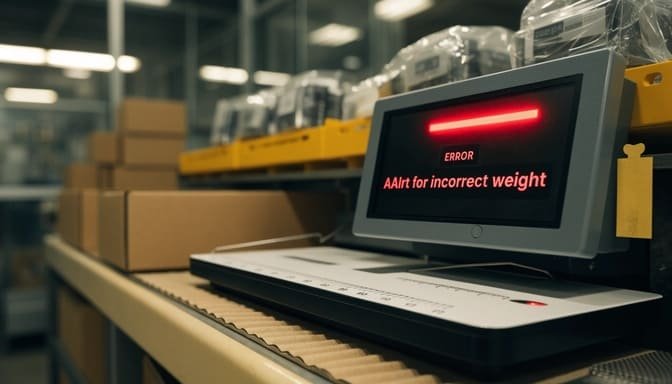
Over my 19 years in this industry, I've realized that the most effective systems don't just record data—they actively prevent errors from happening. For a software provider, this concept is second nature. You build systems with validation rules and error checks. The same logic should apply to your physical shipments. By placing a smart scale at the packing station, you're not just weighing; you're creating an active verification gate that forces correctness.
Turning Weighing into an Active Verification Tool
This is where hardware meets intelligent software. As a software services company, this is where our solutions can create immense value for you. An industrial scale from Weigherps can be integrated into your systems. Here’s how it works: your software knows a specific order of KD parts should weigh, for example, 15.2 kg. The scale is set with this target weight, including a small tolerance. The packer fills the box and places it on the scale. If the weight is 15.2 kg, the system shows a green light and allows a shipping label to be printed. But if the weight is 14.9 kg, the system flags the error with a red light and blocks the label printing process7. The package cannot proceed until the missing part is added and the weight is correct. This simple, automated check turns a passive process into an active, error-proof one.
The Role of IoT and System Integration
For your role as a Technical Director or Purchasing Manager, the ease of integration is paramount. You're concerned about compatibility and want to avoid complex, siloed systems. We understand this completely. That’s why our R&D team at Weigherps focuses on creating IoT-enabled scales with flexible integration capabilities, like APIs and SDKs. This means your technical team can easily connect our scales to your existing software, whether it’s a custom-built platform or a standard WMS. You can build the weight-verification logic directly into the software your team already uses. This empowers you to leverage technology you're familiar with to revolutionize your physical shipping process. We don't just sell you a scale; we provide you with a tool and the professional support to make it a seamless part of your ecosystem, ensuring a clear and quick return on your investment.
Conclusion
To stop KD part claims, move your scales to the packing station. Recording the final weight is the only evidence that matters, protecting your profits and your reputation.
-
"Reduced Shipping Errors in Food Distribution ... - AgEcon Search", https://ageconsearch.umn.edu/record/355587/files/ARS-NE-73.pdf. Research on warehouse and order-fulfillment errors documents that picking, packing, and shipping mistakes can create direct costs through returns, claims, rework, and customer-service handling. Evidence role: general_support; source type: paper. Supports: Financial losses can occur after quality checks through fulfillment and shipment errors.. Scope note: Such evidence would support the general cost mechanism, not quantify losses for KD-part manufacturers specifically. ↩
-
"Why Warehouse Picking Errors Happen", https://xorosoft.com/warehouse-picking-errors/. Warehouse-management literature identifies handling, picking, and packing errors as common sources of inventory and shipment discrepancies during internal material movement. Evidence role: general_support; source type: paper. Supports: Parts can be lost or omitted during handling between quality control and final packing.. Scope note: This would support the plausibility of post-QC errors, not prove that they occurred in the specific KD-parts operations discussed in the article. ↩
-
"Traceability Software: 8 Proven, Essential Features - KnarrTek", https://knarrtek.com/traceability-software/. Traceability and audit-trail guidance supports linking operational records to a unique order or shipment identifier so that later review can identify the recorded status of that shipment at a defined time. Evidence role: mechanism; source type: institution. Supports: A recorded final weight tied to a shipment can serve as the authoritative operational record for that shipment.. Scope note: This supports the value of a controlled record, but 'single source of truth' is an operational design choice rather than a universal standard. ↩
-
"Research on Impact of IoT on Warehouse Management - PMC", https://pmc.ncbi.nlm.nih.gov/articles/PMC9967450/. Research on Industrial Internet of Things applications in logistics and manufacturing supports that connected sensors can automate data capture and integrate physical-process data into enterprise systems. Evidence role: expert_consensus; source type: paper. Supports: IoT-enabled scales can be important for automated shipment-weight recording and system integration.. Scope note: This supports the general usefulness of IoT-enabled weighing, not that IoT scales are essential in all plants or dispute scenarios. ↩
-
"Manufacturing Data Integration | How to Connect MES ...", https://blog.minitab.com/en/blog/manufacturing-data-integration-how-to-connect-mes-erp-and-shop-floor-data. Enterprise-integration literature supports that shop-floor devices and sensors can exchange operational data with WMS or ERP systems through industrial communication protocols, middleware, or APIs. Evidence role: mechanism; source type: research. Supports: Industrial scales can be integrated with WMS or ERP software to transmit weighing data.. Scope note: The evidence would support technical feasibility in general, not compatibility of any specific Weigherps scale with a buyer’s software environment. ↩
-
"A Weighing Algorithm for Checking Missing Components in ...", https://journals.sagepub.com/doi/10.5772/59022. A verifiable case study or audited internal report would be needed to substantiate the reported 95% reduction in shortage claims after installing packing-station scales. Evidence role: case_reference; source type: other. Supports: A major electronics brand reduced missing-cable and accessory claims by over 95% within three months after implementing IoT scales at packing stations.. Scope note: Neutral public sources may support the general effectiveness of checkweighing, but they cannot verify this specific percentage without access to the cited company’s data. ↩
-
"Underweight Package Causes on Production Lines - InspeX", https://inspexmetaldetection.com/checkweighers/underweight-package-causes/. Sources on checkweighers and packaging-line controls support that weight verification can be integrated with automated accept/reject logic to prevent nonconforming packages from proceeding. Evidence role: mechanism; source type: research. Supports: A weighing system can be configured to stop a shipment step, such as label printing, when the package weight is outside tolerance.. Scope note: This supports the mechanism of automated blocking or rejection, but the exact label-printing lockout depends on the software and workflow implementation. ↩



Comments (0)