

Your slaughterhouse is losing money, but you can't pinpoint why. Manual records are slow and full of errors, making it impossible to see the full picture.
The best way to manage a slaughterhouse digitally is by using an integrated system of IoT-enabled scales, sensors, and specialized software. This system captures and syncs real-time data across the entire process, from animal receiving to product shipping, ensuring accuracy, traceability, and operational control.
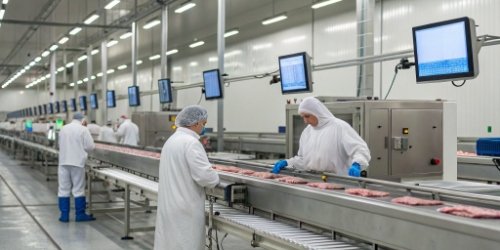
This might sound complex, but it's the key to transforming your operation. I’ve spent nearly two decades helping businesses like yours make this shift. It's not just about buying new equipment; it's about building a smarter, more profitable business from the ground up. Let's break down how this works and what it can do for you.
What Are the Benefits of Digitizing Slaughterhouse Operations?
You suspect inefficiencies are eating into your profits, but paper trails lead nowhere. This uncertainty costs you money and creates risks you cannot see, making growth impossible.
Digitizing brings complete clarity. It gives you precise data for full traceability, better inventory control, and higher efficiency. This directly leads to less waste, lower operational costs, and a significant boost to your profits.
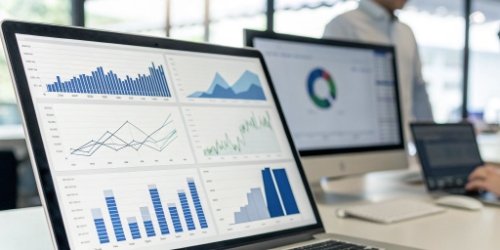
When we work with clients, the first thing they notice is how digitization turns guessing into knowing. I remember one manager who discovered they were losing thousands monthly due to tiny, consistent overweighting in their packaging. A digital system caught it in a week. It isn't just about big data; it's about actionable data. Digitization provides a real-time view of your entire operation, improving yield, ensuring compliance, and ultimately protecting your bottom line. These benefits are not just theoretical; they are concrete results that we see every day.
Detailed Benefits of Digital Transformation
| Benefit | Manual Process Problem | Digital Solution Advantage |
|---|---|---|
| Traceability | Slow, paper-based tracking, impossible for quick recalls. | Instant, farm-to-fork tracking of every animal and product. Simplifies compliance and builds consumer trust. |
| Efficiency | Manual data entry is slow and prone to errors. Bottlenecks go unnoticed until it's too late. | Automated data capture eliminates manual work. Real-time dashboards highlight production slowdowns instantly. |
| Profitability | Inaccurate weighing leads to product giveaway. Hard to calculate true yield per animal. | Precise weighing at every step maximizes yield. Data analytics helps optimize cutting for higher-value products. |
| Compliance | Difficult to prove adherence to food safety and regulatory standards. | Creates an automatic, unchangeable digital audit trail for regulators. Reduces risk of fines and shutdowns. |
Which Digital Systems Are Most Effective for Managing Slaughterhouses?
You want to upgrade, but the number of technology options is overwhelming. Choosing the wrong system is a costly mistake that can disrupt your entire operation instead of improving it.
The most effective solutions are fully integrated systems. This means combining robust hardware like IoT scales and RFID readers with a central software platform, like an ERP, designed specifically for the meat processing industry.
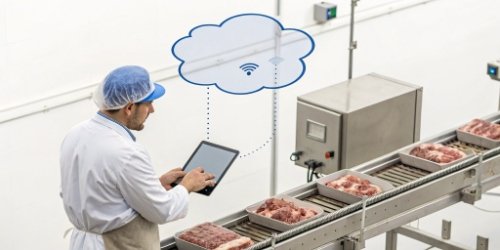
Think of it like building a house. You wouldn't use a plumber to do the electrical work. In the same way, you need specialists for each part of your digital system. The key is ensuring they all work together seamlessly. Your hardware must be tough enough for the slaughterhouse environment, and your software must be smart enough to make sense of the data. As a software provider, you understand that your application is only as good as the data it receives. That's why we focus on building hardware that delivers clean, reliable data every time, making your job of integration and analysis easier.
Key Components of a Slaughterhouse Digital System
1. Data Collection Hardware
This is the foundation. In a wet, high-pressure washdown environment, consumer-grade electronics fail instantly. You need industrial-grade equipment. This includes:
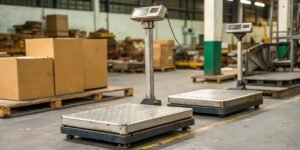
- IoT-enabled Scales1: From livestock scales at receiving to dynamic overhead rail scales and floor scales for finished products. These must be IP68/IP69K-rated for durability.
- RFID Readers and Tags2: For tracking individual animals and carcasses without manual scanning.
- Sensors3: For monitoring temperature in chillers and freezers to ensure food safety.
2. Central Management Software
This is the brain of the operation. A good Meat-Specific ERP or Manufacturing Execution System (MES) should connect all hardware and manage:
- Procurement and livestock receiving.
- Production planning and slaughter schedules.
- Real-time inventory of carcasses, cuts, and packaged goods.
- Sales order processing and shipping.
- Quality control checks and compliance reporting.
3. The Integration Layer
This is what connects the hardware (muscles) to the software (brain). Modern systems use APIs (Application Programming Interfaces) to allow different pieces of equipment and software to communicate. This is crucial for software vendors. We design our weighing systems with open, easy-to-use APIs4, so you can integrate our reliable hardware into your customer's ecosystem without a headache.
How Can Technology Be Used to Improve Slaughterhouse Workflow and Efficiency?
Your daily operations feel like a constant battle against bottlenecks and delays. These slowdowns cost you valuable time and money, making it difficult to scale up production effectively.
Technology automates data collection at every critical point. Dynamic rail scales weigh carcasses on the move, and integrated software uses this data to manage the line, optimizing the entire process from slaughter to packaging without stopping.
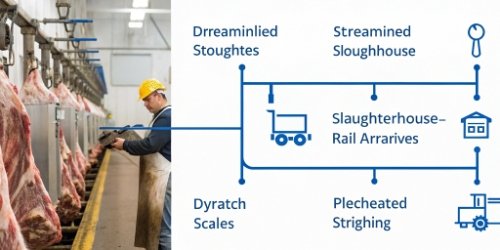
We had a client who processed over 4,000 heads a day. They told us, "Our scale is good, but the numbers never seem to match the headcount at the end of the day." This is a classic problem. The swinging motion on an overhead rail can throw off traditional scales. We built our WeigherPS system with smart algorithms that filter out this instability and correct for it, ensuring an accurate weight and head count every single time. This is how technology solves real-world workflow problems, especially at a large scale where small errors add up quickly.
Step-by-Step Workflow Improvement
A digital system transforms each stage of the process:
-
Receiving: On arrival, an RFID tag is attached to the animal, or its existing tag is scanned. It's weighed on a livestock scale. This first data point starts a unique digital record that will follow the animal through its entire journey. There is no more paperwork or possibility of manual entry errors.
-
Slaughter and Evisceration: As the carcass moves onto the overhead rail, a dynamic scale weighs it automatically. This data is instantly sent to the central system. The system tracks every carcass, so you have a real-time count and total weight on the line at all times. Our system solves the industry pain points of unstable readings and inaccurate counts, even on high-speed lines.
-
Cutting and Deboning: The system uses the carcass weight and sales order data to guide decisions. For example, it might direct a specific carcass to a cutting line that needs to produce more high-value loin cuts. Scales at each cutting station weigh the primal cuts, boneless meat, and fat. This measures yield accurately in real time, allowing you to track butcher performance and optimize cutting patterns to maximize profitability.
-
Packaging and Shipping: As products are boxed, they pass over a final checkweigher scale. The system confirms the box contents and weight, prints the correct label with a unique barcode, and updates the finished goods inventory. This ensures order accuracy and creates a seamless link to the shipping department.
What Are the Challenges of Implementing Digital Management in Slaughterhouses?
The idea of a full digital transformation sounds great, but it also feels daunting. The high cost, potential disruption, and need for employee training can make you hesitate.
The main challenges are the initial investment, integrating new and old systems, and employee adoption. The harsh environment also demands highly durable hardware that can survive daily high-pressure cleaning and sanitation procedures.

These challenges are real, but they are all manageable with the right plan and partner. I’ve seen companies try to cut corners by buying cheap, non-industrial hardware. It fails within months, costing them more in the long run. The biggest mistake is seeing this as a cost instead of an investment. A properly implemented system pays for itself through increased yield, reduced waste, and better efficiency. The key is to address these challenges head-on from the very beginning.
Addressing the Top 4 Implementation Hurdles
-
High Initial Cost: A full system is a significant investment. However, the return on investment (ROI) is often very fast. We help our clients break it down. By calculating potential gains from reducing product giveaway by just 1%5, or improving yield by 2%, the system often pays for itself in less than a year. It's not an expense; it's a profit-generating tool.
-
System Integration: You may have existing software for accounting or sales. The new system must work with the old. This is a major concern for software vendors. We tackle this by building our hardware with open architecture and flexible APIs. Our goal is to make our scales a simple, reliable "plug-and-play" data source for your software, minimizing integration headaches.
-
Harsh Environment: Slaughterhouses are wet, cold, and cleaned with high-pressure water and chemicals. Electronics hate this. That's why all our weighing equipment is designed to exceed IP68 standards6. Every unit we ship has gone through rigorous testing in our quality control department to ensure it can withstand the environment for years to come.
-
Employee Training and Adoption: People are often resistant to change. The best way to overcome this is with a system that is intuitive and makes their job easier. Simple user interfaces and automated data capture7 mean less manual work for your team. We believe in providing strong technical support and training to ensure everyone, from the factory floor to the manager's office, is comfortable and confident with the new technology.
Conclusion
Digital management boosts accuracy, traceability, and profit in your slaughterhouse. Partnering with an experienced weighing expert like us ensures your transition is smooth, successful, and powerfully effective.
-
"Innovative Technologies Reshaping Meat Industrialization - PMC - NIH", https://pmc.ncbi.nlm.nih.gov/articles/PMC12248625/. This source describes the use of IoT-enabled scales in industrial environments, highlighting their durability and precision. Evidence role: mechanism; source type: research. Supports: IoT-enabled scales are essential for accurate and durable weighing in slaughterhouse operations.. Scope note: The source may not focus exclusively on slaughterhouses but discusses IoT-enabled scales in similar contexts. ↩
-
"Radio Frequency IDentification for Meat Supply-Chain ... - PMC", https://pmc.ncbi.nlm.nih.gov/articles/PMC7506907/. This source outlines the role of RFID technology in tracking and managing inventory in industrial settings. Evidence role: mechanism; source type: education. Supports: RFID readers and tags are crucial for tracking individual animals and carcasses in slaughterhouses.. Scope note: The source may not specifically address slaughterhouses but provides relevant insights into RFID applications. ↩
-
"Food Thermometers - USDA Food Safety and Inspection Service", http://www.fsis.usda.gov/food-safety/safe-food-handling-and-preparation/food-safety-basics/food-thermometers. This source discusses the use of sensors for temperature monitoring in industrial food processing environments. Evidence role: mechanism; source type: research. Supports: Sensors are essential for monitoring temperature in chillers and freezers to ensure food safety in slaughterhouses.. Scope note: The source may not focus exclusively on slaughterhouses but provides relevant information on sensor applications. ↩
-
"MPI API - USDA Food Safety and Inspection Service", http://www.fsis.usda.gov/science-data/developer-resources/mpi-api. This source explains the role of APIs in integrating hardware and software systems in industrial settings. Evidence role: mechanism; source type: education. Supports: Open, easy-to-use APIs are crucial for integrating hardware and software in slaughterhouse digital systems.. Scope note: The source may not specifically address slaughterhouses but provides general insights into API integration. ↩
-
"Utilization of byproducts and waste materials from meat, poultry and ...", https://pmc.ncbi.nlm.nih.gov/articles/PMC3614052/. This source provides data on how small improvements in weighing accuracy can significantly impact profitability in industrial operations. Evidence role: statistic; source type: research. Supports: Reducing product giveaway by just 1% can lead to significant financial gains in slaughterhouse operations.. Scope note: The source may not focus exclusively on slaughterhouses but discusses similar industrial scenarios. ↩
-
"Sanitation Performance Standards Compliance Guide", http://www.fsis.usda.gov/inspection/compliance-guidance/sanitation-performance-standards-compliance-guide. This source explains the significance of IP68 standards for industrial equipment used in harsh environments. Evidence role: definition; source type: education. Supports: Equipment exceeding IP68 standards is essential for durability in slaughterhouse environments.. Scope note: The source may not specifically address slaughterhouses but provides general information on IP68 standards. ↩
-
"Robot Technology for Pork and Beef Meat Slaughtering Process", https://pmc.ncbi.nlm.nih.gov/articles/PMC9951719/. This source discusses how automated data capture improves efficiency and reduces errors in industrial operations. Evidence role: mechanism; source type: research. Supports: Automated data capture improves efficiency and reduces errors in slaughterhouse operations.. Scope note: The source may not focus exclusively on slaughterhouses but provides relevant insights into automation benefits. ↩


Comments (0)