

Inaccurate test equipment can ruin your projects and lead to faulty products. I understand that this uncertainty wastes time and erodes trust. Proper metrology skills ensure every measurement is precise, reliable, and trustworthy.
We use metrology skills by following a strict process. This includes preparing the equipment, choosing the right calibration method, handling data carefully, and creating detailed reports. This ensures every piece of test equipment is accurate and reliable for your needs, giving you total confidence in your results.

It all sounds straightforward on the surface, but the details make all the difference between a simple check and a scientifically valid calibration. For anyone in the software field integrating with hardware, understanding this process is key to ensuring your applications perform flawlessly. Let me walk you through how we apply these principles. This will show you why our equipment is so dependable and how it provides the stable foundation your software requires.
What is the role of metrology in ensuring accurate equipment calibration?
Calibration without understanding metrology is just guesswork. This can lead to inconsistent results and unreliable data for your systems. Metrology provides the scientific foundation for calibration, ensuring repeatable accuracy and building trust.
Metrology is the science of measurement. Its role in calibration is to provide the framework of standards, methods, and traceability. It turns a simple check into a scientifically valid process, guaranteeing that measurements are accurate, consistent, and accepted globally.

Metrology is what gives calibration its meaning and authority. Without it, you are just comparing one unknown against another. I've seen companies spend thousands on developing software only to have it fail during testing because the hardware it relied on was "checked" but not properly calibrated. They couldn't trust their data. The true role of metrology is to build that trust on a solid, scientific footing.
The Foundation of Confidence
At its core, metrology establishes a common language for measurement that everyone can agree on. It ensures that a kilogram in our factory is the same kilogram in your lab. This is achieved by adhering to internationally recognized standards, like those outlined in ISO/IEC 170251. It provides a set of rules and best practices that remove ambiguity. For you, as a software provider, this means the data your applications receive from our hardware is not just a number; it is a verifiable fact, backed by a global system of standards.
Beyond Simple Adjustments
A common mistake is thinking calibration is just about tweaking a device until it shows the "right" number. Metrology teaches us that it's about understanding and quantifying the instrument's error and its measurement uncertainty. It answers the question, "How confident are we in this measurement?" We analyze the entire measurement process to identify all potential sources of error and calculate their combined effect. This gives us a clear picture of the instrument's performance, which is far more valuable than a simple pass/fail check. This detailed analysis ensures our equipment provides the stable, predictable performance your software needs to operate reliably.
What are the fundamental steps of a calibration process based on metrology principles?
A disorganized calibration process creates chaos. This leads to inconsistent outcomes and leaves you with no records to fall back on. A structured, step-by-step process based on metrology ensures perfect, repeatable results every time.
The process begins with careful preparation, including checking the environment and selecting a high-precision standard. We then perform the calibration, meticulously record all data, analyze the results to determine errors, and issue a formal calibration certificate.

Following a defined procedure is non-negotiable in our line of work. I remember early in my career, a junior technician rushed a calibration and forgot to log the ambient room temperature. The instrument was sensitive to temperature changes, which meant the entire calibration was invalid. We had to redo hours of work. That day taught me a valuable lesson: every single step in the process matters. It’s this attention to detail that ensures the quality and reliability you count on.
Step 1: Preparation is Key
Before we even touch a standard, we prepare. This involves a visual inspection of the equipment under test to ensure there's no damage. Then, we verify the environmental conditions. Is the temperature stable? Is the humidity within the required range? These factors can significantly impact measurements. Finally, we select the appropriate standard. This standard must be more accurate than the device being calibrated, typically by a factor of four or more. For example, to calibrate a high-precision industrial scale, we use a set of certified standard weights whose mass is known with extremely low uncertainty.
Step 2: Execution and Meticulous Data Collection
With everything prepared, a trained technician performs the calibration according to a specific, validated procedure. This isn’t a task for just anyone; it requires skill and focus to avoid introducing human error. During this phase, we record everything: the readings from the device, the values of the standards used, the environmental conditions, the date, and the technician's name. This raw data is the foundation of the entire calibration. We take multiple readings to assess the repeatability of the instrument, ensuring the measurements are not just accurate once, but consistently.
Step 3: Analysis and Reporting
Once we have the data, we move to the analysis phase. We calculate the instrument's error by comparing its readings to the known values of our standards. We also perform a measurement uncertainty analysis to quantify our confidence in those results. Finally, we determine if the equipment meets the required specifications. All of this information is compiled into a detailed calibration report or certificate. This document is your proof that the equipment has been calibrated properly and that its measurements are reliable and traceable.
Which metrology skills are most critical for calibrating precision test instruments?
Anyone can follow a manual, but real skill is needed for precision. Without it, hidden errors can creep into measurements from your most sensitive instruments. Mastering specific metrology skills is what separates a technician from an expert.
The most critical skills are understanding measurement uncertainty, selecting the right calibration standards, and mastering specific calibration methods. Equally important is the ability to analyze data and interpret the results correctly to ensure true accuracy.

When we hire a new technician for our quality control department, we don't just look for someone who can follow steps. We look for someone who understands why each step is important. The ability to think critically about the measurement process is what truly ensures quality. It's about more than just getting a number; it’s about understanding the quality of that number. These deeper skills are what allow us to build equipment that integrates seamlessly with sophisticated software systems, providing data that is not just accurate, but also trustworthy.
Deep Dive into Measurement Uncertainty
One of the most vital but often misunderstood skills is the ability to calculate and interpret measurement uncertainty. It’s not just about acknowledging that a measurement might be slightly off. It’s about scientifically quantifying the doubt that exists in any measurement. An expert metrologist can identify all potential sources of error—from environmental factors to instrument limitations to operator influence—and combine them into a single, statistically sound uncertainty budget. This skill is crucial because it gives a complete picture of an instrument’s performance.
Mastery of Calibration Methods
There is no one-size-fits-all method for calibration. A skilled professional must know which technique to apply based on the instrument and the required accuracy. Choosing the wrong method can be inefficient or, worse, produce inaccurate results.
| Method | Best For | Example |
|---|---|---|
| Direct Comparison | Simple, linear instruments | Using a standard weight to calibrate a digital scale. |
| Indirect Comparison | When direct measurement is not possible | Using a certified sample material to test a spectrometer. |
| Calibration Curve | Instruments with a non-linear response | Calibrating a pressure sensor across its entire range. |
Knowing when to use a simple comparison versus developing a full calibration curve is a key skill that ensures both accuracy and cost-effectiveness.
How do you establish and maintain metrological traceability for calibrated equipment?
A calibration certificate is almost useless without traceability. It means your measurements cannot be proven against international standards. We build an unbroken chain of comparisons right back to the primary, global standard.
We establish traceability through an unbroken chain of calibrations. Each piece of our equipment is calibrated by a standard that is, in turn, calibrated by an even higher standard. This chain links all the way back to a national or international standard.
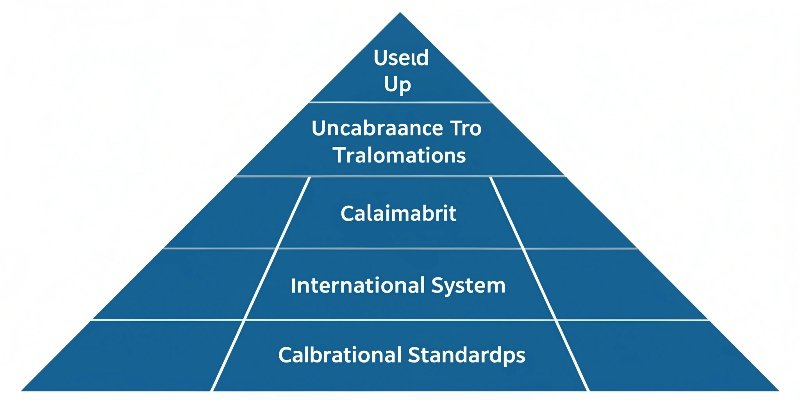
Traceability is the cornerstone of measurement confidence. It’s the single most important concept that ensures a measurement made in our facility in China is equivalent to a measurement made in a lab in Europe or North America. For our clients, particularly those in software who rely on consistent hardware inputs, this guarantee is everything. It ensures that their systems will behave predictably, no matter where our equipment is deployed.
Building the Unbroken Chain
Traceability is often visualized as a pyramid. At the very top are the international standards, like the definition of the kilogram, maintained by organizations like the International Bureau of Weights and Measures (BIPM). Below that are the national standards maintained by National Metrology Institutes (NMIs). Our highest-level reference standards are calibrated directly against these national standards. We then use our reference standards to calibrate our working standards, which are the tools we use daily in our production and quality labs. This creates an unbroken chain of comparisons. Every calibration we perform comes with documentation that proves its link back to the international standard.
Maintaining the Chain for the Long Term
Establishing this chain is only half the battle; maintaining it is an ongoing commitment. At Weigherps, this is a core part of our quality management system2. Every standard we own is on a strict recalibration schedule. We don't wait for things to go wrong. We proactively send our standards to accredited laboratories to ensure their values remain accurate and their own traceability3 is intact. All calibration records are meticulously maintained, creating a complete history for every piece of critical equipment. This rigorous process is our promise to you that every product we ship meets the highest standards of accuracy and reliability, providing a stable and trustworthy partner for your software solutions.
Conclusion
In short, metrology is the science behind trustworthy measurements. Using a structured process, critical skills, and ensuring full traceability are how we guarantee that every piece of equipment is accurate and reliable.
-
This link offers comprehensive information on ISO/IEC 17025 standards, essential for calibration labs. ↩
-
Explore the role of a quality management system in ensuring consistent calibration quality. ↩
-
Explore the concept of traceability to understand how it ensures measurement accuracy across different standards. ↩



[…] international standards (like ISO 170254) and uses traceable weights (like […]