

Struggling with complex slaughterhouse costs? Inaccurate numbers can seriously hurt your bottom line. We provide a clear framework for precise cost tracking to boost your company's financial health.
Calculating slaughterhouse costs requires a combined approach. Use the "variety method" for different livestock, the "step-by-step method" for each production stage, and the "value allocation method" to distribute costs across various final products. This ensures accuracy and compliance with financial standards.
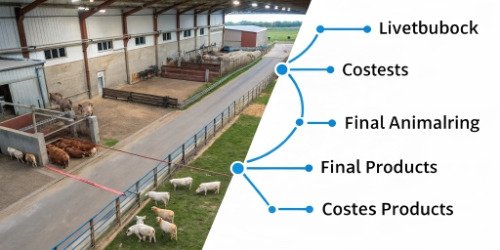
Getting the high-level concept is one thing, but making it work in practice is another. The reality of a slaughterhouse is that production is continuous, the process is complex, and the product forms are incredibly diverse. Let's break down the logic and steps so you can apply this to your own operations. This is how you turn raw numbers into smart decisions that move your business forward.
What Is the Logical Framework for Financial Cost Accounting in Slaughterhouse Operations?
Is your current accounting framework a jumbled mess? This confusion makes it hard to see your true costs and profitability. This can lead to very risky business choices.
The logical framework should follow your production flow. It starts with raw material costs, like live animals, and adds costs at each stage—slaughter, chilling, and cutting. It ends by allocating these total costs to the diverse final products, from prime cuts to by-products.
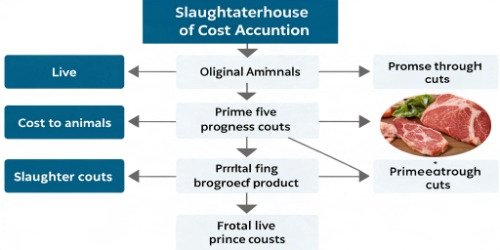
To get this right, you have to think like your product. The entire cost accounting framework should mirror the physical journey of the animal through your facility. It's a journey from a single input to many outputs. This is the core challenge. I remember visiting a client's facility years ago. They were convinced they were losing money on their by-products and were close to just disposing of them. After we helped them implement a proper cost allocation system, they realized those by-products were actually quite profitable. Their old system was just dumping costs unfairly onto low-value items. A good logical framework captures data at each critical point. It's not just about accounting. It's about creating a digital copy of your production process for a clear financial analysis.
Your framework must distinguish between:
- Direct Costs: These are costs you can trace directly to a product, like the purchase price of the animal and the wages of the butchers on the cutting line.
- Indirect Costs (Overhead): These are costs necessary for production but not tied to a single item, like factory rent, electricity for coolers, and administrative salaries.
The framework must track and accumulate these costs from start to finish.
How Can Standard Cost Accounting Be Applied to Measure Slaughterhouse Expenses?
Are your actual costs constantly surprising you at the end of the month? Unpredictable expenses make budgeting nearly impossible. This uncertainty slowly eats away at your profit margins.
Standard cost accounting sets a predetermined, or "standard," cost for each production unit or process. You then compare these standards to your actual costs to identify variances. This helps pinpoint inefficiencies in labor, material use, or overhead for targeted improvements.

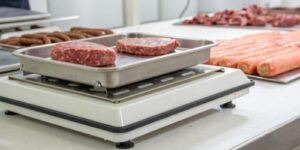
Let’s make this practical. You can set a standard for almost any step. For example, deboning a pork shoulder. You can set a standard time for a skilled worker to complete the task and a standard yield for the amount of meat expected. We work with clients to help them establish these benchmarks. Then, our weighing systems can provide the actual data in real-time. A scale at a deboning station can record the starting weight, the final weight of the valuable meat, and timestamp the process. Your software can then compare this actual data against your standard. If a variance appears, you know exactly where to look. Maybe a new employee needs more training, or a batch of raw material is of lower quality. This transforms accounting from a backward-looking report into a forward-looking management tool.
| Metric | Standard Cost | Actual Cost | Variance |
|---|---|---|---|
| Labor Time per Unit | 10 minutes | 12 minutes | -2 minutes (Unfavorable) |
| Material Yield | 85% | 82% | -3% (Unfavorable) |
| Overhead per Unit | $0.50 | $0.50 | $0.00 (On Target) |
This simple comparison gives you immediate, actionable insights to control your expenses.
How Do Specific Accounting Methods Handle Slaughterhouse Complexity?
Do generic accounting methods fail to capture your slaughterhouse's unique reality? Applying the wrong model gives you misleading data. You need a solution that is tailored to your specific industry.
A combined approach is best. The "variety method" separates costs by animal type. The "step-by-step method" tracks costs through each processing stage. Finally, the "value allocation method" intelligently distributes these costs among the final products based on market value.
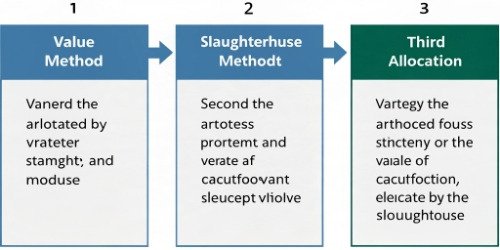
This combination is the secret sauce. Our WeigherPS system is built on this logic because it's the only way to get a true financial picture in this industry. Let's break down each method.
The Variety Method
This is your starting point. It’s not right to mix the costs of a premium-grade animal with a standard-grade one. This method treats each "variety" (like pigs vs. cattle, or organic vs. conventional) as a separate cost pool. It ensures costs are tracked accurately from the very beginning for each distinct product line.
The Step-by-Step Method
Your production line has clear stages: slaughter, chilling, carcass breaking, deboning, and packaging. This method calculates the cost of the work-in-progress product at the end of each step. For example, you know the exact cost of a fully chilled carcass before it even hits the cutting room. This helps you find cost bottlenecks and analyze the efficiency of each department.
The Value Allocation Method
This is the most critical part. One pig creates many different products with vastly different market prices. This method allocates the total accumulated production cost based on the relative sales value of each final product. High-value cuts like tenderloin carry a larger share of the cost than lower-value items like trim or bones. This ensures you can determine the true profitability of every single item you sell.
What Are the Key Steps in Financial Cost Estimation for Slaughterhouses?
Feeling overwhelmed by where to even start with cost estimation? Without a clear process, you might miss key expenses. This can lead to very inaccurate financial projections for your business.
The key steps are: 1) Calculate raw material cost per animal. 2) Track direct labor and utility costs per process. 3) Allocate factory overhead. 4) Use the "step-by-step" method to accumulate costs. 5) Use the "value allocation" method to assign final costs.
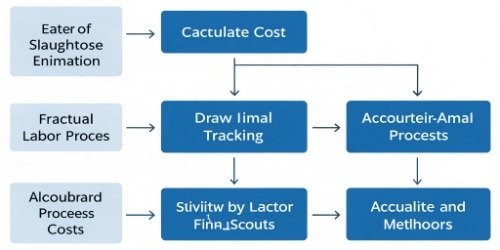
Think of this as a recipe. If you follow the steps in order, you will get a reliable result every time. For many of our clients, the "aha" moment comes when they automate this process. Manually tracking this is a nightmare, but a well-integrated system makes it seamless. Our IoT-enabled scales and software are designed to capture the necessary data at each step, feeding it directly into your accounting system. This removes human error and provides managers with real-time financial data. It moves cost accounting from a quarterly headache to a daily strategic advantage. Here is a more detailed breakdown of that process:
| Step | Action | Details and Examples |
|---|---|---|
| 1. Raw Material Costing | Track all costs to acquire the live animal. | This includes the purchase price, transportation fees, and any initial feed or holding costs before processing. |
| 2. Direct Cost Collection | Measure direct labor and direct machine costs. | Track worker hours for the kill floor, cutting line, and packaging. Meter electricity usage for key areas. |
| 3. Overhead Allocation | Pool and assign indirect costs.1 | Group costs like rent, insurance, and administrative salaries. Allocate them to production based on a logical driver, like labor hours or machine time. |
| 4. Process Costing | Accumulate costs at each production stage. | As a carcass moves from slaughter to chilling to cutting, add the costs from each step to its total value. |
| 5. Final Product Costing | Distribute the total cost to final products. | Use the "value allocation" method to assign the fully accumulated cost to each cut of meat and by-product based on its market value. |
Conclusion
Accurate slaughterhouse accounting is achievable. Using a combined variety, step-by-step, and value allocation method gives you the financial clarity needed to drive profitability and operational efficiency in your business.
-
"Indirect Costs Allocation - CFO Division - University of Florida", https://cfo.ufl.edu/directive-hub/indirect-costs-allocation/. The source describes pooling and assigning indirect costs as a method for distributing overhead expenses across production processes, ensuring accurate cost allocation. Evidence role: mechanism; source type: education. Supports: Pooling and assigning indirect costs ensures accurate overhead allocation in production accounting.. ↩


Comments (0)