
Struggling to guide your food industry clients on certification? Their complex equipment needs for compliance can be confusing, directly impacting your software integration. You need to provide clear answers.
While not all certifications have a strict mandate, they are very important. Key standards like BRCGS and ISO 22000 view metal detectors and checkweighers as best practices. Including them is a significant advantage during an audit and is fundamental to a robust food safety plan.

As a software provider, your clients in the food sector look to you for more than just code. They see you as a partner in their technological advancement. When they are working toward a food safety certification, they need to make sure every part of their operation is compliant, from processing to packaging. Understanding their equipment needs, like metal detectors and checkweighers, allows you to provide better integration and more valuable advice. This knowledge helps you build stronger, more trusted relationships with your clients, making your solutions an essential part of their success.
Are Metal Detectors and Checkweighers Required for Food Safety System Certification?
Worried your client might fail their audit? Navigating certification requirements is complex, and a mistake in equipment advice could lead to non-compliance and damage your professional relationship.
The answer depends on a risk assessment within the company's HACCP plan. Standards like BRCGS require metal detection unless a risk assessment proves it's unnecessary. Checkweighers ensure compliance with weight regulations and are considered a vital quality control tool.

Let's dive deeper into this. I've been in the industrial weighing business for nearly two decades, and I've seen how these certifications work firsthand. The core of most modern food safety standards is Hazard Analysis and Critical Control Points (HACCP). [2, 14] This is a system where a food producer must identify potential hazards—be they biological, chemical, or physical—and then set up control points to manage them. [5, 12] A stray piece of metal is a classic physical hazard. [5] Therefore, a metal detector becomes a logical Critical Control Point (CCP). [12] An auditor will want to see how your client is preventing metal contamination. If they don't have a metal detector, they need a very good, documented reason why, such as using more advanced X-ray inspection. [16] Checkweighers play a different but equally important role in quality and compliance. They ensure every package meets the labeled weight, which is often a legal requirement. [3, 4]
What Equipment is Necessary for Food Companies to Achieve Safety System Certification?
Feeling overwhelmed by the equipment your clients need? Suggesting the wrong tools can lead to wasted investment for them and a loss of credibility for you.
Essential equipment is determined by the company's specific risk analysis. However, for most producers, this includes foreign body detectors (like metal detectors or X-ray systems) and in-line checkweighers. These tools address physical contamination risks and ensure product weight consistency, which are cornerstones of food safety.
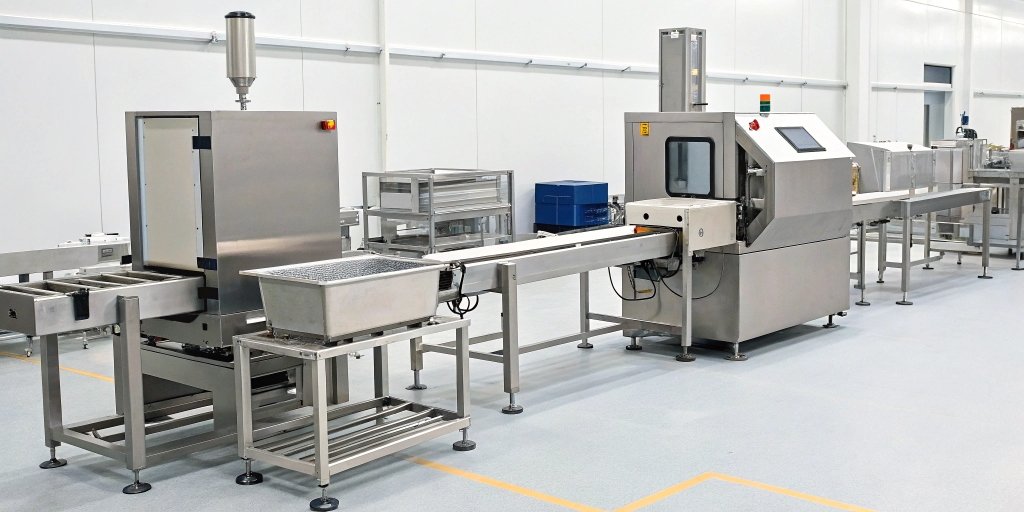
From my experience, a food company's journey to certification starts with its own internal analysis. They have to map out their entire process and ask, "What could go wrong here?" Let's take a bakery for example. A piece of a metal sieve could break off and fall into the dough. This is a potential hazard. The HACCP plan would then identify this risk and establish a CCP. [2, 21] The most direct way to control this risk is to pass the final, packaged product through a metal detector before it's shipped. Standards like the BRCGS are very specific about this. Clause 4.10.3.1 mentions that the system must have an automatic rejection device to remove contaminated products from the line.1 [15] Similarly, checkweighing ensures that the customer gets what they paid for and that the company complies with weights and measures laws. [4] It also acts as a process control tool; a series of underweight packages can signal a problem with the filling machine. [3] So, when you're talking to a client, the conversation should be about managing risk and ensuring consistency.
Do Food Safety Certifications Require the Use of Metal Detection and Weighing Machines?
Are you unsure if you should push your client to invest in this equipment? Giving hesitant advice can make you seem uninformed, weakening your position as an expert partner.
While not always explicitly mandatory, their use is strongly implied and often necessary to pass an audit. Global standards like SQF and BRCGS benchmarked by the GFSI have specific clauses for controlling physical contaminants and verifying product integrity, making this equipment fundamental for compliance.

Let's break down what the major certifications say. These standards are all built on the idea of preventing problems before they happen. They are not just a checklist of machines to buy. However, to meet their requirements, certain equipment becomes almost essential. I remember a client, a meat processor, preparing for an SQF audit. The SQF code is very clear: "Metal detectors or other physical contaminant detection technologies shall be routinely monitored, validated and verified for operational effectiveness." [6, 11] This means not only must you have the equipment, but you also have to prove it's working correctly all the time. [11] For checkweighers, the link comes through quality control and legal compliance. While a standard like ISO 22000 focuses broadly on managing food safety, it requires controlling processes to ensure the final product is safe and meets specifications. [20, 25] Consistent weight is a key specification. Below is a simple table showing how different standards approach this.
| Certification | Metal Detection Requirement | Checkweighing Role |
|---|---|---|
| BRCGS | Required unless a risk assessment justifies its absence. Specific rules on testing and rejection procedures. [15, 17] | Supports quality control and legal compliance with weights and measures regulations. |
| SQF | Required based on risk assessment. The system must be validated, verified, and records kept. [6, 11] | Verifies net content claims and ensures process control, contributing to quality plans. |
| ISO 22000 | Not explicitly named, but required as part of hazard control for physical hazards identified in the HACCP analysis. [23, 25] | Falls under operational control to ensure product conformity and meet customer needs. |
| HACCP | Not a certification itself, but a system. Metal detection is a common CCP for physical hazards. [12, 14] | Used to monitor a CCP if weight is critical for safety (e.g., proper cooking amount). |
As you can see, while the language varies, the expectation is clear. You need a system to control physical contaminants and ensure product consistency. For most food producers, that system includes a metal detector and a checkweigher.
How Can Food Producers Meet Equipment Standards for Food Safety Certifications?
Your clients are lost in technical specs and audit rules. You want to help them succeed, but how do you guide them to choose and implement the right equipment effectively?
Producers should select equipment based on a risk assessment. They must ensure the machines are validated, routinely tested with certified standards, and integrated with a system that can automatically reject non-conforming products. Proper documentation of all these procedures is essential for an audit.

After we help a client install a new weighing or detection system, the work isn't over. That's really just the beginning. To truly meet certification standards, they need to follow a lifecycle approach. First, the equipment must be suitable for the product and environment. For example, a wet environment needs a machine with a high waterproof rating. Second, it must be installed and calibrated correctly. This is part of the validation process—proving the machine is capable of doing its job. [15] Third, it must be verified and monitored continuously. This means routine checks. For a metal detector, an operator might pass test pieces of different metal types (ferrous, non-ferrous, stainless steel) through it at the start of a shift2 to ensure it’s working. [15, 21] This procedure, and its results, must be documented. [6] Finally, there needs to be a clear, tested procedure for what happens when a problem is found, such as a product rejection. [6, 15] My team and I always emphasize that the goal is to build a reliable system that protects consumers and the brand.
Conclusion
In short, while not universally mandatory, metal detectors and checkweighers are essential for robust food safety. They are key to passing major audits and demonstrating a true commitment to quality.
-
"BRCGS 4.10.3.2 Metal Detection Rejects Internal Auditor ...", https://www.ifsqn.com/forum/index.php/topic/45255-brcgs-41032-metal-detection-rejects-internal-auditor-interpretation-disagreement/. The BRCGS Food Safety Standard clause on metal detection and X-ray equipment specifies rejection or segregation of contaminated product, supporting the claim about automatic rejection requirements in relevant line configurations. Evidence role: case_reference; source type: institution. Supports: BRCGS requires appropriate rejection or segregation systems for detected contaminated products under its foreign-body detection requirements.. Scope note: The citation should verify the exact clause number and wording in the applicable BRCGS issue, because clause numbering and exceptions can change between editions. ↩
-
"Metal Detector Test Pieces - Calibration - Food Processing", https://malloysupply.com/product-category/calibration-test-pieces/. Food safety certification guidance and metal-detection control procedures commonly require routine challenge testing with ferrous, non-ferrous, and stainless-steel test pieces, supporting the described verification practice. Evidence role: mechanism; source type: institution. Supports: Routine metal detector verification often uses ferrous, non-ferrous, and stainless-steel test pieces.. Scope note: The exact test frequency, test-piece size, and placement are site- and standard-specific, so the citation supports the practice generally rather than a universal start-of-shift rule. ↩



Comments (0)