
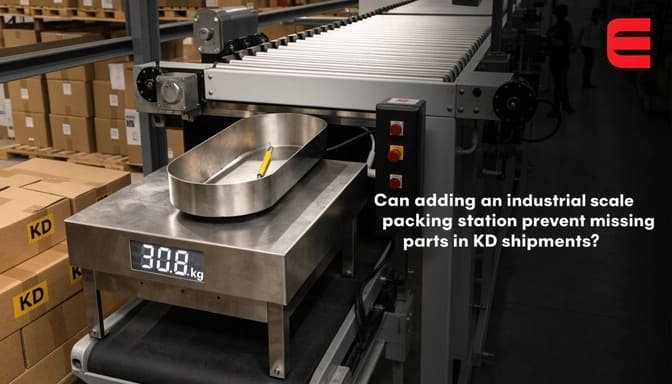
Frustrated by missing parts in your overseas KD shipments? The cost isn't the part, but the line stoppage and air freight to fix it. A simple industrial scale at the packing station is your most effective defense, preventing these expensive disruptions.
Yes, absolutely. Placing an industrial scale at the final packing station is a highly effective way to prevent missing parts in Knock-Down (KD) shipments. By weighing each packed kit, you can immediately verify if its weight matches the pre-determined standard for a complete kit. Any deviation signals a missing or extra component, allowing for immediate correction.
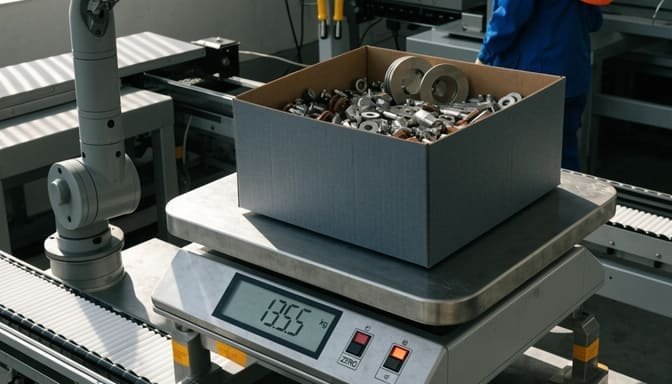
I’ll never forget the call from our assembly plant in Mexico. A single missing bracket, a part worth less than a dollar, had brought our entire assembly line to a halt. The cost of that mistake wasn't a dollar. It was the two weeks of production we lost waiting for the replacement part to be air-freighted, a cost that ran into tens of thousands. That experience taught me a hard lesson: the most expensive mistake is the one you don't catch before it leaves your facility. This is why we must now explore how a simple, proven technology—the industrial scale—can act as the ultimate gatekeeper for your global operations.
How effective is an industrial scale in ensuring complete shipments for KD assembly lines abroad?
Struggling with inconsistent shipments causing chaos at your overseas plant? Imagine having a guard that checks every single box for completeness before it ships. An industrial scale is that guard, ensuring accuracy and saving you from costly overseas errors.
An industrial scale is extremely effective because it provides an objective, data-based check for every single kit. It replaces unreliable manual checks with a simple, repeatable process: if the weight is correct, the kit is complete. This method catches errors before they are shipped, drastically reducing the chances of an incomplete kit reaching the assembly line abroad.
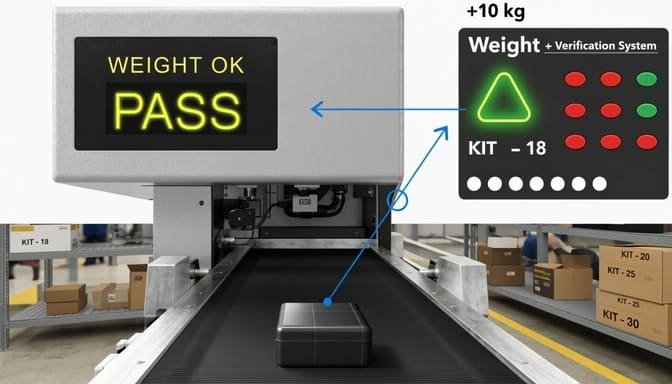
In my 19 years of experience, I've seen that human error is the biggest variable in packing1. A packer might be distracted, tired, or new to the job. Relying on visual checks or manual counting is a recipe for occasional, but very expensive, failures.2 An industrial scale eliminates this guesswork. It's a simple system of record. We establish a "golden weight" for each KD kit, including all parts, packaging, and instructional materials. The scale at the final packing station Before it is sealed is programmed with this target weight plus an acceptable tolerance.3
Here's how it transforms the process:
- Immediate Feedback: If a packed box is underweight, the system flags it instantly. This means a part is missing. If it's overweight, it could mean a duplicate part was added, which can also cause issues.
- Process Control: This is more than just a check; it's a process control tool. Consistent underweight alerts for a specific kit can signal a problem upstream, perhaps in the bill of materials or the part-kitting process itself.
- Cost-Benefit Analysis: As I learned the hard way, catching the error at the packing station means a ten-minute rework. Letting it slip through to the overseas plant means a two-week stopping line and exorbitant air freight charges. The return on investment for the scale is realized the very first time it catches an error.
| Scenario | Without Industrial Scale (Manual Check) | With Industrial Scale (Weight Check) |
|---|---|---|
| Error Detection | Relies on human attention; prone to error. | Objective, data-driven; highly reliable. |
| Correction Cost | Extremely high (air freight, line stoppage). | Low (rework at packing station). |
| Production Impact | Major assembly line shutdowns. | Minimal; a few minutes of delay at packing. |
| Data & Insights | None. Errors are anecdotal. | Provides data for process improvement. |
What role can a packing station scale play in avoiding missing components in overseas KD deliveries?
Tired of blame games when parts go missing? A packing station scale doesn't just catch errors; it creates a clear point of accountability. It's a simple tool that proves a package was complete when it left your control.
A packing station scale serves as the final quality control checkpoint. Its primary role is to validate the completeness of a kit before it enters the logistics chain. By confirming the package weight matches the expected weight, it acts as a preventative tool, ensuring every component required for assembly is present.

Think of the scale as your last line of defense. Before we implemented checkweighing, a missing component in an overseas shipment would trigger a lengthy and frustrating investigation. The warehouse would blame the packing team, the packing team would blame the parts-kitting department, and no one had any real proof. The industrial scale changes this dynamic completely. Its role is not just to weigh, but to verify and document.
For a software vendor like our clients, who live in a world of data and precision, this is a concept that resonates. You wouldn't ship code without running it through a final validation check. The scale does the same for physical products. Its key roles include:
- Error Prevention: The most crucial role. It stops underfilled kits from ever leaving the plant.
- Accountability: The weight data, often logged automatically against a work order or serial number, provides a concrete record that the kit was packed correctly.4 This ends the internal blame game and provides a clear audit trail5.
- Process Simplification: For the packing operator, it's a simple pass/fail test. There's no need to manually count dozens of small parts. They just need to see the green light on the scale's indicator, which improves their speed and reduces mental fatigue.
- Building Trust: When your overseas partner knows you have a rigorous verification process, it builds confidence and strengthens the relationship. They know the shipments they receive will be complete and ready for assembly.
Is using an industrial scale the best solution to address missing parts in KD shipments to international assembly lines?
Considering complex vision systems or RFID to solve missing parts? Those are powerful, but an industrial scale is often the faster, cheaper, and more reliable first step. It solves the core problem with unmatched simplicity and ROI.
For preventing missing parts in KD shipments, an industrial scale is arguably the most cost-effective and reliable solution available. While more complex systems like computer vision exist, a weighing system provides the best balance of accuracy, speed, implementation cost, and ease of use for this specific problem.

As a manufacturer of scales, I'm biased, but my opinion comes from seeing what works in the real world. I've had clients, particularly in the tech space, who are drawn to high-tech solutions like vision systems or RFID. These technologies are fantastic for certain applications, but for ensuring kit completeness, they often introduce unnecessary complexity and cost.
A vision system, for example, needs to be programmed to recognize every single part. If a part changes slightly, the system needs reprogramming. Lighting conditions can affect its accuracy.6 RFID requires tagging every single component, which can be prohibitively expensive and labor-intensive for low-cost parts.
Let's break down why an industrial scale is often the superior choice for this task:
Simplicity and Reliability
An industrial scale operates on a fundamental principle: mass. It doesn't care about the shape, color, or orientation of a part. It only cares if the total weight is correct. This makes it incredibly robust and easy to set up. You define a target weight and a tolerance, and the system is ready to go.
Cost-Effectiveness
The return on investment is unmatched. The cost of a single production line stoppage overseas due to a missing part can be hundreds of times the cost of the industrial scale that would have prevented it. For a Purchasing Manager or Technical Director, this is a straightforward calculation. The minimal upfront investment provides immediate and substantial risk mitigation.
Ease of Integration
Modern industrial scales are designed to fit into existing workflows. As a software vendor client would appreciate, our scales can connect directly with PLC and ERP systems. This allows for automated data logging, so every weighment is recorded, providing a digital paper trail and enabling deeper analysis of production accuracy.
In summary, while other technologies have their place, the industrial scale remains the gold standard for preventing missing parts in KD shipments due to its simplicity, reliability, and unparalleled cost-effectiveness. It directly addresses the most critical failure point with a solution that is both practical and powerful.
Conclusion
To prevent catastrophic line stoppages, an industrial scale at the packing station is not just an option; it's essential. It turns a potentially devastating overseas problem into a minor, ten-minute fix at home.
-
"Human Factors", https://www.faasafety.gov/files/gslac/courses/content/258/1097/AMT_Handbook_Addendum_Human_Factors.pdf. Human-factors research on manual inspection and repetitive industrial tasks documents attention lapses, fatigue, and variability in human performance, supporting the claim that manual packing checks are vulnerable to human error. Evidence role: expert_consensus; source type: paper. Supports: Human error is a major source of variability in manual packing and checking processes.. Scope note: This would support human error as an important variable, not necessarily prove it is the single biggest variable in every packing operation. ↩
-
"Visual Inspection Reliability for Precision Manufactured Parts", https://pubmed.ncbi.nlm.nih.gov/26342002/. Studies of visual inspection reliability show that manual inspection can miss defects or counting errors, supporting the claim that visual or manual checks may fail intermittently in production settings. Evidence role: expert_consensus; source type: paper. Supports: Visual checks and manual counting can fail occasionally in industrial packing or inspection processes.. Scope note: The source would establish fallibility of manual checks generally; the expense of failures must be supported separately by downtime or logistics-cost evidence. ↩
-
"2023 NIST Handbook 44.pdf", https://www.nist.gov/system/files/documents/2022/11/30/2023%20NIST%20Handbook%2044.pdf. Legal metrology standards for automatic catchweighing instruments describe comparison of measured mass against preset limits or tolerances, supporting the practice of using target weights with acceptance ranges. Evidence role: definition; source type: institution. Supports: Packing-station scales can be configured to compare measured weight with a target weight and acceptable tolerance.. Scope note: The standard supports the weighing-control concept, not the specific tolerance values appropriate for a given KD kit. ↩
-
"Metrological Traceability: Frequently Asked Questions and ...", https://www.nist.gov/metrology/metrological-traceability. Manufacturing traceability references describe linking production measurements to work orders, batches, or serial numbers as a way to document process history, supporting the audit-record function of logged weight data. Evidence role: general_support; source type: government. Supports: Automatically logged weight data linked to a work order or serial number can provide a record of packing verification.. Scope note: The source would support traceability practices generally; it would not verify that any particular scale installation logs data correctly. ↩
-
"Guidance on the requirements for Documented Information ...", https://www.iso.org/iso/documented_information.pdf. Quality management standards emphasize retention of documented information as evidence that processes were performed as planned, supporting the claim that logged packing-weight records can form an audit trail. Evidence role: expert_consensus; source type: institution. Supports: Logged weighing records can contribute to an audit trail for packing verification.. Scope note: This supports the audit-trail concept; adequacy depends on record integrity, calibration, and data-retention controls. ↩
-
"Colour and illumination in computer vision - PMC - NIH", https://pmc.ncbi.nlm.nih.gov/articles/PMC6015817/. Computer-vision research notes that image-recognition performance can be sensitive to illumination changes, supporting the claim that lighting conditions may affect vision-system accuracy. Evidence role: mechanism; source type: paper. Supports: Lighting conditions can affect the accuracy of computer vision systems used for inspection.. Scope note: The degree of sensitivity varies by camera, algorithm, lighting control, and application design. ↩



Comments (0)