
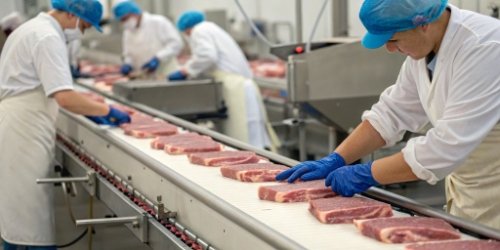
Labeling errors lead to costly recalls and fines. This damages your reputation and profits. A streamlined process is the key to stopping these mistakes before they happen.
The best way is to integrate the process. Weigh the portion, print the unique label, and apply it immediately. This 'weigh-print-apply' sequence prevents mix-ups between different products or batches, ensuring that the right label always goes on the right package.
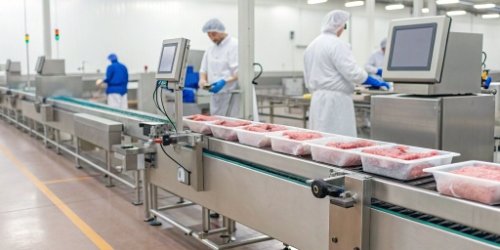
I remember visiting a client's meat processing1 facility a few years ago. They had a real problem with labeling errors2. When I walked onto their production floor, I saw the issue immediately. Workers were cutting and weighing portions at one station, placing them in trays. Then, they would walk these trays over to another table where a pile of pre-printed labels was waiting. The chance for a simple mix-up was huge. An employee could easily grab the wrong label for a tray, especially during a busy shift. This experience taught me a valuable lesson. It is not just about having good equipment; it is about the process. Let's break down the methods that fix this common but costly problem.
What Methods Prevent Labeling Mistakes in Meat Portioning Lines?
Do you have staff trying to match labels to packages? This manual process is slow and full of risk. Simple method changes can drastically improve your labeling accuracy.
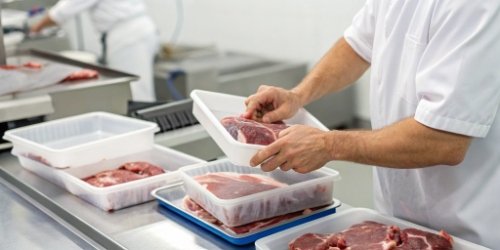
The most effective methods involve minimizing the time and steps between weighing and labeling. Use one-piece flow, where each portion is weighed and labeled individually before the next one begins. Clear procedures and well-trained staff are also critical for consistency.
The core idea here, based on my
insight from many factory floors, is simple. The moment a package and its corresponding label are separated, you create an opportunity for error. The solution is to never let them be separated. This is what we call a "one-piece flow3" or a "weigh-print-apply4" method.
The Problem with Batching
Many facilities use batching to try and be efficient. They'll weigh 50 packages of chicken thighs, then go print 50 labels. The problem is that now someone has to accurately match those 50 labels to the 50 packages, each with a slightly different weight and price. It only takes one distraction for a mistake to happen.
The Power of One-Piece Flow
The one-piece flow method fixes this. One package goes on the scale. The scale captures the weight and sends it to the printer. The printer produces a single, unique label. The operator applies it immediately. The task is complete. Then, the next package is processed. This systematic approach removes the guesswork entirely.
| Method | Error Risk | Speed | Process Complexity |
|---|---|---|---|
| Batch Processing | High | Seems fast, but rework is slow | High (matching is difficult) |
| One-Piece Flow | Very Low | Consistent and predictable | Low (simple, repeatable steps) |
How Can Technology Help Reduce Labeling Errors in Meat Processing?
Relying on human eyesight for accuracy is a gamble. One tired employee or a simple typo can cause a major recall. Technology offers a reliable and consistent solution.
Technology connects your scales directly to your printers and central database. This integration ensures the weight data is transferred automatically, without errors. Software can also verify that the product information, like the cut of meat or use-by date, matches the item being weighed.
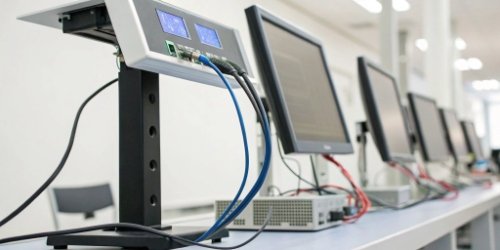
Technology acts as the bridge that makes the one-piece flow method flawless. As an industrial scale manufacturer, we have seen how powerful this connection can be. For clients like software vendors, this integration concept is very familiar. Your expertise is in software, and ours is in the hardware that captures the critical data. When we connect them, we create a foolproof system.
Centralized Data Management
Instead of an operator manually typing product codes or prices, the system pulls this information directly from a central database. When you want to weigh beef sirloin, you select it on the terminal. The system knows the product name, price per kilogram, and shelf-life information. This removes the risk of an operator typing "sirloin" as "sirloin" or entering the wrong price.
Smart Scale Integration
Our modern IoT scales do more than just weigh. They have communication ports and APIs. This allows them to talk directly to your software systems and the label printer. The data flows seamlessly, eliminating manual steps.
Here is how the data moves in an integrated setup:
| Step | Action | Data Transferred | Result |
|---|---|---|---|
| 1 | Operator places meat on scale. | Product selected from menu. | Scale knows product is beef. |
| 2 | Scale captures weight. | Exact weight (e.g., 0.542 kg). | Data sent to the system. |
| 3 | System calculates price. | Price per kg * 0.542 kg. | Correct price is generated. |
| 4 | System commands printer. | All data (name, weight, price, date). | Correct label is printed instantly. |
This process is fast, efficient, and removes the points where human errors typically occur.
What Steps Ensure Accurate Labeling in Meat Portioning Operations?
You might have good equipment, but errors are still happening. This can be frustrating for you and your team. A clear, step-by-step process is often the missing piece.
To ensure accuracy, you must implement a strict Standard Operating Procedure (SOP). This includes daily equipment calibration, clear workstation setup, single-portion processing, and immediate label application. A final verification scan before packing provides an extra layer of security.
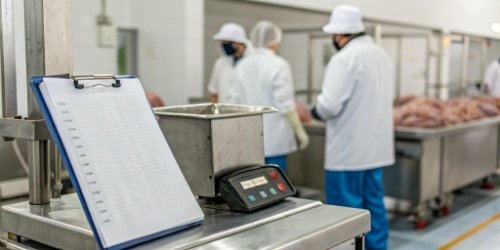
Having the right process is just as important as having the right technology. I work with clients to build these procedures because reliable hardware needs a reliable workflow to be effective. A strong SOP makes your operation consistent, no matter who is working on the line. It turns a complex task into a series of simple, repeatable actions that are easy to train and monitor.
Pre-Operation Checks
The day must start correctly. Before any production begins, your team should follow a checklist. This includes turning on all equipment, confirming the scales are calibrated with certified weights, and ensuring the label printers are loaded with the correct label stock. It also means verifying that the correct product database is loaded for the day's production run.
The In-Process Workflow
This is where you enforce the one-piece flow. Your SOP should clearly state the exact steps for the operator to follow.
| Step | Procedure | Purpose |
|---|---|---|
| 1. Select Product | Operator selects the active product from the scale's interface. | To load the correct price and data. |
| 2. Weigh Portion | Place a single, packaged portion onto the scale. | To capture the accurate weight. |
| 3. Print & Apply | The system prints one label. Apply it immediately to the package. | To prevent any mix-ups. |
| 4. Verify (Optional) | Use a barcode scanner to scan the newly applied label. | To confirm the data is correct in the system. |
| 5. Place in Bin | Place the finished product in the "completed" bin. | To separate it from unfinished work. |
This structured workflow leaves no room for improvisation or shortcuts that lead to errors.
How Do Automated Solutions Minimize Labeling Errors in Meat Portioning?
Manual labor is slow, expensive, and prone to mistakes. As your production demand grows, it becomes impossible to maintain accuracy. Automation offers a scalable, nearly error-proof solution.
Automated solutions, like in-line checkweighers with integrated label printer-applicators, physically eliminate the chance for human error. The system automatically weighs a moving package, calculates the price, prints the correct label, and applies it, all without manual help.
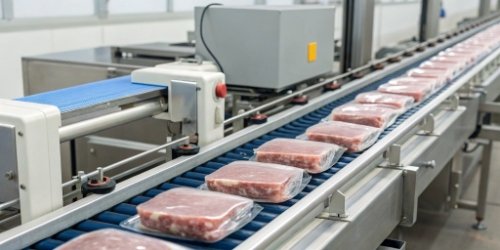
For high-volume producers, automation is not a luxury; it is a necessity. It represents the ultimate form of the "weigh-print-apply" principle. In my 19 years of experience, I have helped many clients make the leap from manual processing to full automation. The return on investment is not just in labor savings, but more importantly, in perfect quality control and the elimination of costly labeling recalls.
The Role of the Checkweigher
A dynamic checkweigher5 is the heart of the automated line. It weighs packages as they move along a conveyor belt at high speed. It can also be programmed with weight tolerances. If a package of chicken breasts is supposed to be between 450g and 550g, the checkweigher can automatically reject any package that is underweight or overweight using a pneumatic pusher. This ensures product consistency before it even gets to labeling.
The Fully Integrated Line
After passing the checkweigher, the package continues to the integrated labeler. The weight data from the checkweigher is sent instantly to the label printer. The printer generates the label with the exact weight and price, and a mechanical arm or air jet applies it perfectly to the package. This entire process can happen at speeds of over 100 packages per minute with virtually zero error.
| Factor | Manual System | Semi-Automated | Fully Automated |
|---|---|---|---|
| Accuracy | Low | High | Extremely High |
| Speed | Slow | Medium | Very Fast |
| Labor Cost | High | Medium | Low |
| Initial Investment | Low | Medium | High |
| Consistency | Low | High | Perfect |
Conclusion
To eliminate labeling errors, you must bridge the gap between weighing and labeling. Whether through process changes or automation, an integrated weigh-print-apply system is your most reliable path forward.
-
Exploring best practices can help you ensure compliance and accuracy in meat labeling. ↩
-
Understanding the consequences of labeling errors can help you implement better practices and avoid costly mistakes. ↩
-
Discovering the advantages of one-piece flow can lead to significant improvements in your labeling process. ↩
-
Learning about this method can help you implement effective labeling strategies to minimize errors. ↩
-
Understanding the function of a checkweigher can help you maintain product consistency and accuracy. ↩



Comments (0)