

Struggling with slow, manual reports? This old data leads to bad decisions. Creating a fast, accurate daily operating report is crucial, and we can show you the modern way.
To create a daily slaughterhouse report, you must track key metrics: purchasing, slaughter volume, cutting volume, sales, and gross profit. The best method uses an automated system, like ours at Weigherps, to pull real-time data from scales into a visual dashboard for instant insights.
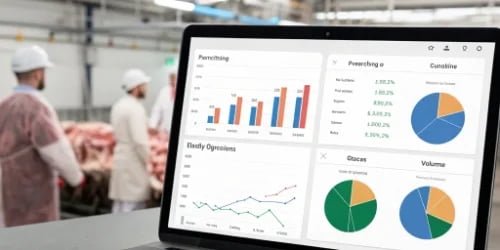
Having a good report is more than just collecting numbers. It is about understanding what those numbers mean for your business right now. An old report is just a history lesson. A real-time report is a guide for your next decision. You need data that is fresh and easy to understand. This is the only way to stay ahead and make smart choices that grow your business. Let's look at what makes a report truly useful.
What Are the Essential Components of a Daily Operating Report for a Slaughterhouse?
Is your report missing key numbers and feeling incomplete? This makes you question its value and your ability to manage effectively. Here's what every great report must include.
Essential components include procurement data (livestock source, weight, cost), production metrics (slaughter/cutting counts, yield), inventory levels, sales figures (by product, customer), and financial summaries like gross profit. These elements provide a full operational overview and a clear picture of your business.
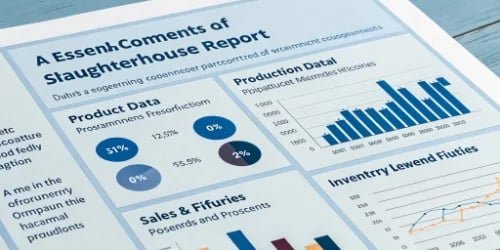
A powerful report breaks your operation down into clear sections. At Weigherps, we help our clients focus on four main areas. Each area has key metrics that you need to track every single day. If one number is off, you can spot it immediately. This structure helps you find problems before they become expensive. For a report to be useful, it must tell a complete story from when the livestock arrives until the final product ships.
Key Report Sections
| Component Category | Key Metrics to Track | Why It's Important |
|---|---|---|
| Procurement | Supplier, Live Weight, Cost per Head/kg, Arrival Time | Tracks incoming costs and supplier performance.1 |
| Production | Slaughter Count, Carcass Weight, Yield %, Cut Volume | Measures efficiency, throughput, and product conversion. |
| Inventory | Finished Goods (by cut), Cold Storage Levels | Prevents spoilage, manages stock, and informs production.2 |
| Sales & Finance | Sales Volume, Revenue, Gross Profit, Top Customers | Shows financial health and identifies sales trends.3 |
How Can Slaughterhouses Efficiently Compile Data for Daily Operating Reports?
Are you spending hours chasing data from different departments? It's a frustrating job, and mistakes are easy to make. You can streamline this whole process and get your data instantly.
Efficient data compilation relies on automation. You should connect smart scales and IoT devices directly to a central system. This eliminates manual entry, reduces errors, and ensures data is collected in real-time from the receiving dock to the shipping floor, creating a single source of truth.

I remember the old way of doing things. Managers walked around with clipboards, writing down weights. Then, someone in the office would spend the next day typing it all into a spreadsheet. The final report was often two days late. By then, the opportunity to fix a problem was gone.
With a modern system, the process is completely different.
- The Old Way: It involved paper, manual data entry, and a lot of wasted time. Data from Monday might not be ready until Wednesday. The chance for human error was huge, and a simple typo could throw off the entire report. This method is slow, expensive, and unreliable.
- The New Way: Our Weigherps IoT scales are placed at every key point. They are at receiving, along the processing line, and at final packing. Each time a product is weighed, the data goes straight to a central dashboard. As soon as the last truck leaves for the day, your daily report is ready in minutes, not days. This gives you a complete and accurate picture of your business instantly.4
What Tools and Templates Are Best for Creating Slaughterhouse Operating Reports?
Are you still stuck using old spreadsheets? They can feel clunky and they never show you what is happening right now. There are much better tools that can change how you see your business.
The best tools are integrated software platforms, not standalone templates. You should look for systems, like ours at Weigherps, that combine hardware like IoT scales with software like visual dashboards. These give you real-time, custom reports that are much better than static Excel or paper templates.
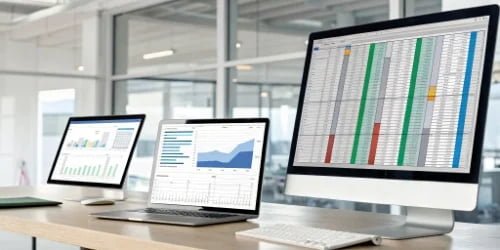
Choosing the right tool is a big decision. A simple paper template is cheap but very limited. A spreadsheet is more flexible, but it still requires manual work and can't provide live data. The best solution connects directly to your operations to give you information as it happens. This way, you are not just looking at history, but you are managing the present. Let's compare the options so you can see the difference for yourself.
Comparing Reporting Tools
| Tool | Speed | Accuracy | Real-Time Data | Customization |
|---|---|---|---|---|
| Paper Forms | Very Slow | Low | No | Very Low |
| Excel Spreadsheets | Slow | Medium | No | Medium |
| Integrated IoT System | Instant | High | Yes | High |
An integrated system with IoT scales is the clear winner for any modern slaughterhouse.5 It gives you the speed and accuracy you need to make good decisions.
How Does a Daily Operating Report Help Improve Slaughterhouse Efficiency and Performance?
Do you feel like you are managing your business blind? Making big decisions without current data is very risky. A good daily report gives you the clear vision you need.
A daily report transforms management by providing timely, accurate data. This lets you spot inefficiencies, manage yields, optimize inventory, control costs, and make strategic decisions quickly. It shifts you from reacting to problems to proactively improving your operation.

A daily report is more than a list of numbers; it's a tool for action. I visited a client who had just installed our system. His new daily report showed that one processing line had a 3% lower yield every Tuesday. It turned out to be a machine that needed maintenance. They fixed it immediately and saved thousands of dollars each month. That is the power of daily data.
See Problems Fast
With a daily report, a sudden drop in yield or a slowdown in production is obvious. You can investigate and solve the issue on the same day, not a week later.
Improve Your Yield
You can compare the weight of incoming livestock to the weight of the final cut products every day.6 This helps you track yield precisely and find ways to reduce waste and increase profit.
Manage Sales Better
The report shows you which products are selling fastest and which customers are buying the most.7 You can use this information to adjust pricing, manage promotions, and focus your sales efforts.
Conclusion
Stop using slow, manual reporting methods. An automated daily report gives you the real-time data you need to boost efficiency, cut costs, and increase profits in your slaughterhouse.
- "[PDF] Essential Procurement Performance Metrics to Track Regularly", https://govlab.hks.harvard.edu/wp-content/uploads/2025/04/Essential-Proc-Performance-Metrics_vF.pdf. This source explains how tracking procurement metrics like costs and supplier performance aids in operational efficiency. Evidence role: mechanism; source type: research. Supports: Tracking procurement metrics helps monitor costs and evaluate supplier performance effectively.. ↩
- "Smart Inventory Management System of Food-Processing-and", https://www.sciencedirect.com/science/article/pii/S1877050913001816/pdf?md5=d1542a21a36236330b63da1e95ea627b&pid=1-s2.0-S1877050913001816-main.pdf. This source discusses how inventory tracking prevents spoilage and supports production planning in industries like food processing. Evidence role: mechanism; source type: research. Supports: Inventory tracking prevents spoilage, manages stock, and informs production planning.. Scope note: The support is contextual to industries where inventory management is critical. ↩
- "Comprehensive financial health assessment using Advanced ... - PMC", https://pmc.ncbi.nlm.nih.gov/articles/PMC11637307/. This source explains how financial summaries in reports provide insights into business health and sales trends. Evidence role: mechanism; source type: education. Supports: Financial summaries in reports help assess business health and identify sales trends.. ↩
- "4 capabilities of a real-time business | MIT Sloan", https://mitsloan.mit.edu/ideas-made-to-matter/4-capabilities-a-real-time-business. This source highlights how real-time data systems provide comprehensive and accurate operational insights. Evidence role: general_support; source type: research. Supports: Real-time data systems provide a complete and accurate picture of business operations instantly.. Scope note: The support is contextual to systems capable of real-time data integration. ↩
- "Opportunities for Regulatory Authorities to Assess Animal-Based ...", https://pmc.ncbi.nlm.nih.gov/articles/PMC10571985/. This source evaluates the advantages of integrated IoT systems in improving operational efficiency and data accuracy in industries like slaughterhouses. Evidence role: expert_consensus; source type: research. Supports: Integrated IoT systems are highly effective for modern slaughterhouses in terms of speed and accuracy.. Scope note: The support is contextual to industries where IoT systems are applicable. ↩
- "The Importance of the Slaughterhouse in Surveilling Animal ... - PMC", https://pmc.ncbi.nlm.nih.gov/articles/PMC9959654/. This source explains how tracking yield metrics, such as weight comparisons, helps optimize production efficiency in slaughterhouses. Evidence role: mechanism; source type: research. Supports: Comparing the weight of incoming livestock to final products helps track yield and optimize efficiency.. Scope note: The support is specific to industries where yield tracking is a critical metric. ↩
- "5 key reasons why data analytics is important to business", https://lpsonline.sas.upenn.edu/features/5-key-reasons-why-data-analytics-important-business. This source discusses how sales data in operational reports can identify trends and inform strategic decisions. Evidence role: mechanism; source type: education. Supports: Sales data in reports helps identify fast-selling products and key customers for strategic planning.. ↩



Comments (0)