
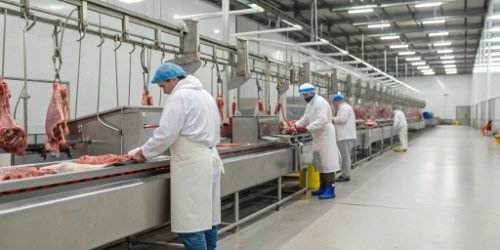
Managing a contract slaughtering service is complex, leading to errors and lost revenue. A modern, automated system is the only way to streamline operations and ensure profitability.
To successfully operate a contract slaughtering service, you must integrate technology for client management, slaughtering plans, automated weighing, and billing. This digital approach reduces manual work, minimizes errors, improves accuracy, and increases overall efficiency and client satisfaction in your slaughterhouse.

Running a contract slaughtering service can be a huge part of a slaughterhouse's income. But I have seen many businesses get tangled up in the complexity. Manual paperwork, scheduling conflicts, and billing mistakes create chaos and hurt the bottom line. It feels like you are working harder but not getting ahead. The answer is not more people, but better processes. You need a system that simplifies everything from the client's first request to the final payment. Let's look at how you can build a service that is smooth, efficient, and profitable by breaking down the key areas you need to focus on.
What Are the Key Steps to Set Up a Contract Slaughtering Service in a Slaughterhouse?
Starting a contract service from scratch can feel overwhelming. Miss one important step, and you could face legal trouble or major operational headaches down the road.
The key steps are getting your legal permits, setting up the facility, defining your service offerings, creating clear client agreements, and implementing a digital management system. A solid software foundation is crucial for managing everything effectively from the very first day.

Setting up this service properly is about building a strong foundation. In my 19 years of helping businesses with weighing solutions, I’ve seen that a good start prevents future problems. You need to think about it in logical stages. First, handle the paperwork and get your facility ready. Then, decide exactly what you will offer and how you'll manage it. The final, and most important, step is choosing the right technology to tie it all together. A system that automates tasks doesn't just save time, it builds a professional and reliable service that clients will trust.
Laying the Foundation
Before you accept a single animal, you must have all your legal and physical structures in place. This includes getting the necessary licenses and permits from local and national authorities. Your facility must also meet all health and safety standards.1 This is non-negotiable. At Weigherps, we ensure all our equipment meets international standards like CE because we know compliance is key. The same principle applies here. Your physical layout should be optimized for a smooth flow from animal receival to final product dispatch to prevent any bottlenecks.
Defining Your Service Tiers
Not all clients have the same needs.2 You should define different service options. For example, you can offer "sequential slaughter," "batch slaughter," or even "random-order slaughter" for special requests. Each mode serves a different purpose and can be priced accordingly. Being flexible allows you to serve a wider market. A good management system will allow you to easily manage these different slaughter plans and associate them with the right clients. This upfront definition makes scheduling and billing much clearer later on.
Implementing Technology
Trying to run a modern contract slaughtering service with pen and paper is a recipe for failure.3 You need a centralized digital system from day one. This system should connect everything: client information, scheduling, weighing, and billing. This is how you move from a manual process to an automated one.
| Aspect | Manual Process | Automated System |
|---|---|---|
| Scheduling | Phone calls, emails, spreadsheets | Online client portal, real-time calendar |
| Weighing | Manual recording, risk of errors | IoT scales, data sent automatically |
| Billing | Manual calculation, prone to disputes | Automatic fee calculation, instant invoices |
| Record Keeping | Physical files, hard to search | Digital records, fully auditable |
How Can Slaughterhouses Manage Client Agreements for Contract Slaughtering Services?
Juggling different client contracts on paper is messy and inefficient. This confusion often leads to billing disputes, which can damage client relationships and your reputation.
Use a centralized digital system to manage every client's profile, service terms, and specific pricing. This creates clear communication, ensures transparent billing, and helps you track each client's unique needs and service history with complete accuracy.

In our experience, most client problems come from poor communication and unclear agreements. A simple misunderstanding about pricing or services can turn into a major issue. We solved this for our clients by building systems that make everything transparent. When a client can see their history, their rates, and their requests all in one place, trust is built. A digital platform for managing agreements isn't just about efficiency; it's about creating a professional and trustworthy relationship with your clients. It shows you are organized and that you value their business, which is a powerful way to keep them coming back.
Standardizing Agreements
Your first step is to create a standard contract template. This document should clearly outline your services, fees, liability, and payment terms. Having a standard template ensures you are consistent and fair with all clients. But you also need flexibility. Your system should allow you to customize specific terms for individual clients, like special pricing for high-volume partners. Once signed, this digital agreement becomes the single source of truth for that client relationship, eliminating any "he said, she said" arguments.
Digital Client Portals
Empower your clients by giving them direct access to their information. A secure online portal, which could even be a mobile app like a WeChat Mini Program, is a game-changer.4 Here, clients can submit their slaughtering plans, view their service history, and check their invoices. I remember one of our partners who implemented this; their phone calls for simple questions dropped by 80%. It frees up your staff from administrative tasks and gives your clients the control and transparency they want.
Automated Record Keeping
The beauty of an integrated system is how it connects actions to agreements. When an animal is weighed on an IoT-enabled scale, that data is instantly captured and linked to the client's account. The system then automatically applies the pre-agreed rates from their digital contract to calculate the service fee. There is no manual data entry, so there is no risk of human error. The process is seamless and completely auditable. This automated record-keeping ensures every invoice is accurate, justifiable, and sent out on time.
What Business Strategies Ensure Efficiency in Operating Contract Slaughtering Services?
Your slaughterhouse is busy, but are you truly profitable? Many businesses find that hidden inefficiencies are silently eating away at their bottom line every single day.
Focus on strategies that automate and optimize your core processes. Use IoT scales for automatic data capture, streamline scheduling with an online platform, and offer flexible slaughtering modes. These actions reduce labor costs, minimize errors, and maximize plant throughput.
As a manufacturer, we are obsessed with efficiency. Every wasted step or material costs money. The same is true for a service business like contract slaughtering. The goal of our company is to help our customers leverage technology to grow their profits, and this starts with optimizing day-to-day work. The most successful slaughterhouses I have worked with are the ones that treat their operation like a modern factory. They analyze their workflow, identify bottlenecks, and use technology to fix them. A smart system doesn't just make work easier; it makes your entire business more powerful and profitable.
Optimizing Slaughter Modes
Offering different ways to process animals allows you to maximize your facility's use. Every slaughterhouse we partner with has different client demands. This is why our systems support various modes. This flexibility means you can schedule jobs in the most efficient way possible, grouping similar tasks and minimizing downtime.
| Slaughter Mode | Best For | Key Benefit |
|---|---|---|
| Sequential Slaughter | Clients with specific carcass tracking needs | Guaranteed 1-to-1 tracking for premium services. |
| Batch Slaughter | High-volume, standardized processing | Maximizes throughput and operational speed. |
| Random-Order Slaughter | Urgent or special client requests | Offers flexibility and premium customer service. |
| Self-Procured | Clients who bring their own livestock | Simplifies intake and tracking for third parties. |
The Power of Automation
Automation is the core of an efficient operation. When weighing information from scales is automatically sent to your management system, you eliminate the single biggest source of errors: manual data entry. This automated data flow continues through the entire process. The system can automatically generate weighing slips , which clients can print themselves, and then create the final settlement bill without anyone on your team lifting a finger. This saves hundreds of hours of administrative work and ensures billing is always 100% accurate based on real-time data.
Enhancing Client Loyalty
Efficiency also creates opportunities to add value for your clients.5 With a digital system tracking all transactions, it’s easy to implement a loyalty program. You can automatically award points for volume or frequency, which can be redeemed for discounts. This is a simple but powerful strategy to encourage repeat business. It shows you appreciate your clients and gives them a real incentive to stick with you instead of trying a competitor. It’s a win-win situation that builds long-term business growth.
What Legal and Operational Guidelines Are Crucial for Running a Contract Slaughtering Service?
Ignoring regulations is not an option in this industry. A single compliance failure can result in heavy fines, legal action, and could even shut down your entire operation.
Crucial guidelines include strict adherence to food safety standards like HACCP, full traceability, accurate record-keeping for audits, and proper staff training. A high-quality management system helps enforce and document these guidelines automatically, making compliance a part of your daily routine.

At Weigherps, quality assurance is built into our DNA. Every single product we ship undergoes a comprehensive battery of tests by our quality inspection department. We bring this same mindset to the operational systems we design. For a slaughterhouse, safety and compliance are your license to operate. You cannot treat them as an afterthought. The best approach is to build these rules directly into your operational workflow. Technology is the perfect tool for this. It can enforce procedures, create an unchangeable record, and make sure that nothing gets missed, protecting your business, your clients, and the public.
Traceability is Non-Negotiable
In the event of a food safety issue, you must be able to trace every product from start to finish. A fully integrated system provides this end-to-end traceability.6 From the moment an animal is received and tagged, its journey is tracked digitally. The system links the live animal to the carcass, the final cuts, and the client who owns them. This creates a detailed digital paper trail. If a recall is ever necessary, you can quickly and accurately identify all affected products, minimizing risk and demonstrating responsible management to regulators.
Automating Compliance Documentation
Audits are a fact of life in this industry.7 An automated system makes preparing for them stress-free. All the necessary documents—weighing receipts, processing records, settlement statements, and traceability logs—are generated and stored digitally by the system. They are organized, easily searchable, and ready for inspection at a moment's notice. Because the data is captured automatically from certified equipment, its integrity is high. This level of organization and accuracy shows auditors that you are in full control of your operations.
Quality Control Integration
Just as our own QC department tests every scale, your system should enforce your own quality checkpoints. You can program required checks into the workflow. For example, the system can require a supervisor to digitally sign off on a sanitation check before a processing line can be activated. Or it can flag a carcass that falls outside of a certain weight or temperature range for inspection. By integrating QC into the digital workflow, you ensure that your standards are met every single time, without fail. This is how you build a reputation for consistent, high-quality service.
Conclusion
Ultimately, running a successful contract slaughtering service requires smart technology. It helps you manage clients, optimize work, and ensure compliance, reducing costs and boosting profits for a true win-win.
-
"Inspection Guidance for Animal Slaughtering and Processing ...", http://www.osha.gov/laws-regs/standardinterpretations/2024-10-15. This source details the health and safety standards required for slaughterhouse operations, including facility design and equipment compliance. Evidence role: definition; source type: government. Supports: Your facility must also meet all health and safety standards.. Scope note: The source may focus on general standards and not specific regional requirements. ↩
-
"[PDF] USDA AMS LPGMN Cattle Contracts Library - Explanatory Notes", https://www.ams.usda.gov/sites/default/files/media/CCL_ExplanatoryNotes.pdf. This source discusses the varying needs of clients in the meat processing industry and the importance of tailored service offerings. Evidence role: expert_consensus; source type: research. Supports: Not all clients have the same needs.. Scope note: The source may not address all possible client needs in contract slaughtering. ↩
-
"Disruption in the meat industry: new technologies in nonmeat ... - PMC", https://pmc.ncbi.nlm.nih.gov/articles/PMC9901393/. This source explains the inefficiencies and risks of manual processes in modern slaughterhouse operations. Evidence role: general_support; source type: research. Supports: Trying to run a modern contract slaughtering service with pen and paper is a recipe for failure.. Scope note: The source may not specifically address contract slaughtering services. ↩
-
"Abattoir - Slaughterhouse Management SaaS", https://abattoir.app/. This source discusses the advantages of secure online portals and mobile apps for client management in the meat processing industry. Evidence role: mechanism; source type: research. Supports: A secure online portal, which could even be a mobile app like a WeChat Mini Program, is a game-changer.. Scope note: The source may not specifically address WeChat Mini Programs. ↩
-
"Feeding and Processing Affect Meat Quality and Sensory Evaluation", https://pmc.ncbi.nlm.nih.gov/articles/PMC12609881/. This source explains how operational efficiency in slaughterhouses can lead to enhanced client value through better service and cost savings. Evidence role: mechanism; source type: research. Supports: Efficiency also creates opportunities to add value for your clients.. Scope note: The source may not provide specific examples of added value in contract slaughtering services. ↩
-
"Recent advancements in meat traceability, authenticity verification ...", https://pmc.ncbi.nlm.nih.gov/articles/PMC11788888/. This source describes how integrated systems enable end-to-end traceability in meat processing operations. Evidence role: mechanism; source type: research. Supports: A fully integrated system provides this end-to-end traceability.. Scope note: The source may not address all aspects of traceability in contract slaughtering services. ↩
-
"[PDF] Audit Programs for Livestock, Meat, Poultry, and Egg Industries", https://www.ams.usda.gov/sites/default/files/media/Process%20Verified%20Facsheet%20-%20FINAL.pdf. This source discusses the role of audits in ensuring compliance and operational integrity in the meat processing industry. Evidence role: historical_context; source type: government. Supports: Audits are a fact of life in this industry.. Scope note: The source may not provide specific examples of audit processes in contract slaughtering. ↩


Comments (0)