

Manual grading is subjective and creates bottlenecks. These inconsistencies can lead to disputes and lost profits, making it hard to guarantee quality and price accurately for your clients.
Visual sensors are set to revolutionize slaughterhouse grading. They use cameras and AI to objectively analyze carcass traits like conformation and fat. This provides consistent, traceable, and efficient grading, making it a future mainstream solution as costs decrease and technology matures.
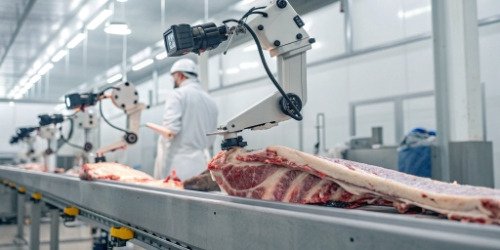
The promise of this technology is huge for the meat processing industry. As a manufacturer of industrial weighing equipment for 19 years, I've seen how automation can transform a production line. Visual sensing is the next big step in that transformation. But you might be wondering how it actually works and what specific advantages it can bring to your software solutions. Let's dive deeper and explore how this technology can benefit you and your clients.
How Can Visual Sensors Enhance Meat Grading Processes in Slaughterhouses?
Your clients struggle to improve the accuracy and speed of their grading processes. Outdated methods mean missed opportunities for optimization, higher labor costs, and a ceiling on efficiency.
Visual sensors enhance grading by automating data capture. Cameras collect high-resolution images, and AI analyzes key metrics like fat thickness and muscle area. This replaces subjective judgment with objective, repeatable data, integrating with the production line for real-time results.

From our experience, we know that true enhancement comes from combining smart hardware with intelligent software. The process is straightforward but powerful. A high-speed camera, mounted on the processing line, captures an image of each carcass. This image is then instantly sent to a computer running an AI algorithm. The software analyzes the image for critical grading parameters like backfat distribution, muscle conformation, and even color or texture. This happens in seconds. For a software provider like you, the real opportunity is integration. This data can be fed directly into your clients' Enterprise Resource Planning (ERP) or factory management systems. It moves grading from a standalone manual task to a connected, digital data point in the production workflow.
| Feature | Manual Grading | Visual Sensor Grading |
|---|---|---|
| Speed | 1-2 minutes per carcass | 5-10 seconds per carcass |
| Objectivity | Subject to fatigue, bias | Consistent, rule-based |
| Data | Handwritten notes | Digital record with image |
| Integration | Difficult, requires manual entry | Seamless via APIs |
What Are the Benefits of Using Visual Sensing Technology for Slaughterhouse Grading?
Proving the return on investment for new technology is always a challenge. Without clear, measurable benefits, you and your clients risk spending money on a system that doesn't deliver results.
The key benefits are objectivity, efficiency, and traceability. It eliminates human inconsistency, provides instant grading to accelerate the line, and creates a permanent digital record with images for every carcass. This data also enables better process control, boosting overall profitability.
The advantages of this technology are not just theoretical; they translate into real-world value. I've seen clients transform their operations by focusing on these core benefits. For your software business, offering a solution that delivers these results makes for an easy sale.
Unmatched Objectivity
Humans get tired. Their judgment can change from the beginning of a shift to the end.1 An AI model, however, applies the exact same criteria to the first carcass as it does to the thousandth. This objectivity means that a grade-A carcass is always a grade-A carcass, period. This consistency is the foundation for fair pricing and building trust with both suppliers and buyers.
Radical Efficiency
In most plants, manual grading is a bottleneck. Visual sensors turn it into an accelerator. Grading happens in real-time as the carcass moves down the line.2 There's no need to stop or slow down. This increased throughput means more product processed per day without adding more labor. The system pays for itself through improved operational efficiency.
Complete Traceability
Every grading action generates a digital file containing the grade, all supporting data, and the source image.3 This creates a perfect audit trail. If a customer disputes a grade, you can instantly pull up the record and show them the proof. This level of traceability is becoming essential for food safety compliance and brand protection.
How Will Visual Sensor Technology Evolve in Slaughterhouse Meat Classification?
Investing in technology feels risky if it might become obsolete in a few years. You need to be confident that you are backing a lasting solution, not just a temporary trend.
The technology will evolve toward greater accuracy, lower costs, and deeper integration. Expect more sophisticated AI models that predict quality traits like tenderness. Integration with IoT systems will provide comprehensive data from farm to fork, making grading a key part of a larger smart-factory ecosystem.
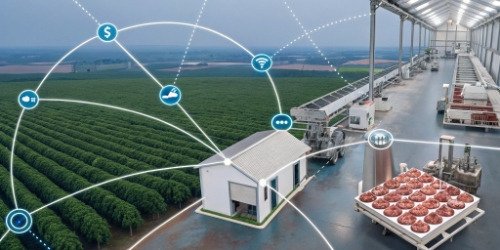
Based on what I'm seeing in the industry, this technology is on a path to become standard practice within the next 3-5 years. The evolution will happen in a few key areas that are very relevant for software vendors.
Cost Reduction and Accessibility
Like all technologies, the cost of cameras, processors, and AI software is steadily decreasing. What was once only affordable for the largest corporations will soon be accessible to mid-sized operations. This opens up a much larger market for your software solutions. We see this with our industrial scales; as technology becomes cheaper, adoption grows exponentially.
Advanced AI and Predictive Analytics
The next generation of AI will go beyond simple classification.4 The models will learn to correlate carcass features with final meat quality attributes like tenderness, juiciness, and flavor. Imagine being able to predict the eating experience from an image.5 This adds immense value and allows processors to sort products for different premium markets.
Integration with IoT and Weighing Systems
This is where the future gets exciting. At Weigherps, we are focused on IoT electronic scales. The next step is to combine the precise weight data from our scales with the visual grade from a sensor. This creates a unified, powerful data point for each carcass: grade and weight, captured together.6 As a software provider, you can build systems that use this combined data for yield optimization, precise inventory management, and full end-to-end traceability.
Conclusion
Visual sensors are the clear future for slaughterhouse grading. They deliver objectivity, efficiency, and traceability, and are becoming more powerful and affordable, ready to revolutionize meat processing operations.
-
"Comparative Analysis of Methods of Evaluating Human Fatigue - PMC", https://pmc.ncbi.nlm.nih.gov/articles/PMC11651853/. This source discusses the limitations of manual meat grading due to human fatigue and bias. Evidence role: expert_consensus; source type: education. Supports: Manual meat grading is affected by human fatigue and inconsistent judgment over time.. Scope note: The source may generalize human limitations without specific studies. ↩
-
"Real-time Hygiene Indicators for Slaughterhouses", https://www.nal.usda.gov/research-tools/food-safety-research-projects/real-time-hygiene-indicators-slaughterhouses. This source explains how visual sensors enable real-time grading in slaughterhouses. Evidence role: mechanism; source type: research. Supports: Visual sensors enable real-time grading as carcasses move down the processing line.. Scope note: The source may focus on specific implementations rather than general applicability. ↩
-
"Digital Traceability in Agri-Food Supply Chains - PMC - NIH", https://pmc.ncbi.nlm.nih.gov/articles/PMC11011367/. This source describes how visual sensors create digital records for each grading action in meat processing. Evidence role: mechanism; source type: institution. Supports: Visual sensors generate digital files for each grading action, including grades, data, and images.. Scope note: The source may not address the scalability of digital record systems. ↩
-
"A Comprehensive Review of Artificial Intelligence (AI) - PMC", https://pmc.ncbi.nlm.nih.gov/articles/PMC12965230/. This source explores advancements in AI for predictive analytics in meat grading. Evidence role: expert_consensus; source type: research. Supports: The next generation of AI in meat grading will include predictive analytics beyond simple classification.. Scope note: The source may focus on potential capabilities rather than existing systems. ↩
-
"A Comprehensive Review of Artificial Intelligence (AI)-Driven Approaches ...", https://pmc.ncbi.nlm.nih.gov/articles/PMC12965230/. This source discusses the potential for AI to predict meat quality attributes like tenderness and flavor. Evidence role: mechanism; source type: research. Supports: AI could predict meat quality attributes like tenderness and flavor from visual data.. Scope note: The source may focus on experimental models rather than commercial applications. ↩
-
"Robot Technology for Pork and Beef Meat Slaughtering Process: A Review", https://pmc.ncbi.nlm.nih.gov/articles/PMC9951719/. This source explains how combining weight and visual grade data enhances meat processing systems. Evidence role: mechanism; source type: institution. Supports: Combining weight and visual grade data creates a unified data point for each carcass in meat processing.. Scope note: The source may not address challenges in integrating these data points. ↩



Comments (0)