
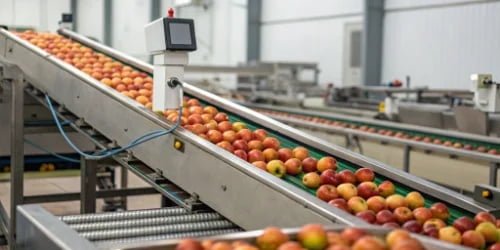
Your fruit sorting line is fast, but is the data from your scales keeping up? Mismatched data leads to wrong sorting, wasted fruit, and lost profits. Every millisecond counts.
A high-speed fruit sorting line needs more than just weight. It requires a continuous stream of accurate, real-time weight data, timestamps, and stability indicators for each item. This data must be transmitted instantly to the control system to ensure precise sorting and grading without slowing down the line.
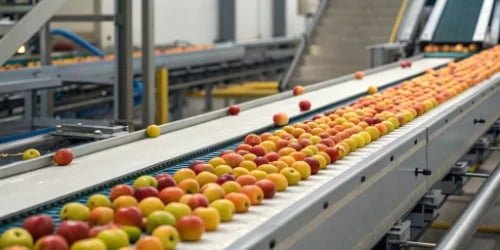
When I first started in this industry 19 years ago, speed was everything. But I quickly learned a hard lesson. I remember visiting a client's new facility in Europe. They had invested heavily in a lightning-fast conveyor system, but their sorting accuracy was terrible. The problem wasn't the mechanics; it was the data. Their scales couldn't provide clean, stable data quickly enough, creating a digital bottleneck that held the entire operation hostage. It was like putting a lawnmower engine in a sports car. This experience taught me that the quality of data is just as important as the physical speed of the line. Let's dig deeper into what specific data truly matters.
What Specific Data Do High-Speed Fruit Sorting Lines Require from Scales?
Just getting a weight number isn't enough for high-speed sorting. Inaccurate or incomplete data can derail your entire automated process, causing costly errors and production delays for your clients.
Specifically, sorting lines need precise weight values, item counts, data packets with unique identifiers, and stability flags. This data must be transmitted with an exact timestamp to synchronize perfectly with the sorting mechanism, preventing misdirects and ensuring operational integrity for the software system.

For any software vendor, the quality of the input determines the quality of the output. When your software is making split-second decisions on where to divert a piece of fruit, it needs a rich, reliable data stream. It’s not just about a single number; it's about a complete data profile for each item on the belt. At Weigherps, we engineer our scales to provide this comprehensive data package because we know it's the foundation of an intelligent sorting system. For example, a stability flag is critical. It tells your system "this weight is final and trustworthy," preventing a decision based on a fluctuating reading as the fruit settles. Unique IDs allow your software to track each piece of fruit from the moment it's weighed to its final destination, providing full traceability. This is essential for quality control1 and batch analysis.
Core Data vs. Advanced Data Requirements
| Data Type | Basic System Requirement | Advanced System (Your Software) Requirement |
|---|---|---|
| Weight | A single, final weight value. | High-resolution weight, updated in real-time. |
| Timestamp | Not always required. | Precise, synchronized timestamp2 for every reading. |
| Identifier | Simple item count. | Unique ID for each item for full traceability. |
| Status | Basic "ready" signal. | Stability flags, error codes3, and diagnostic data. |
| Protocol | Simple serial communication. | Fast TCP/IP4, Modbus, or custom API integration. |
This complete data packet empowers your software to do more than just sort; it allows it to manage, analyze, and optimize the entire process.
How Can Accurate Scale Data Improve Efficiency in Fruit Sorting Lines?
Your client's sorting line looks efficient, but are hidden data inaccuracies creating bottlenecks? This silent problem slowly eats away at their throughput and profit margins, making them less competitive.
Accurate scale data directly boosts efficiency by minimizing sort errors, which reduces manual re-sorting and waste. It enables faster conveyor speeds without sacrificing precision, leading to higher throughput. This data also provides insights for optimizing line performance.
Accuracy is the cornerstone of efficiency. Think about the downstream costs of a single missorted piece of fruit. A premium piece of fruit sorted into a lower grade means lost revenue. A lower-grade piece of fruit in a premium box damages brand reputation. These small errors add up to significant losses. I worked with a purchasing manager at a software firm whose client was experiencing a 5% error rate on their apple sorting line. The issue was data accuracy from their existing scales. After integrating our high-precision IoT scales, which provide clean data even with vibration, their error rate dropped to less than 0.1%. This single change eliminated the need for two manual inspectors and reduced their product waste by over 70%, proving that the initial investment in better data acquisition paid for itself in months.
The Financial Impact of Accuracy
Accuracy translates directly to financial gain. A small improvement in precision can have a massive impact on the bottom line.
| Accuracy Level | Items per Batch | Correctly Sorted | Incorrectly Sorted (Potential Loss) |
|---|---|---|---|
| 98% | 100,000 | 98,000 | 2,000 |
| 99.9% | 100,000 | 99,900 | 100 |
Maximizing Throughput and Reducing Rework
With accurate data, the sorting system can trust the information it receives. This confidence allows the conveyor to run at its maximum designed speed. There's no need to slow down to wait for a stable weight reading. Furthermore, getting it right the first time eliminates the costly and labor-intensive process of manual re-sorting5. This frees up personnel and floor space, further streamlining the operation.
What Role Does Scale Data Play in Optimizing High-Speed Fruit Sorting Operations?
Is your client's sorting operation running on guesswork? Without deep data insights from the scale, they are missing key opportunities to fine-tune performance, leaving money on the table every day.
Scale data is the foundation for optimization. It provides the raw information needed for yield analysis, batch tracking, and quality control. By analyzing this data, managers can adjust sorting parameters in real-time to meet demand and identify long-term trends for process improvement.

Data transforms a sorting line from a simple mechanical process into a strategic business tool. As a software provider, this is where your product can deliver immense value. When our scales feed your system a rich stream of data—weight, size distribution, throughput per hour—your software can turn it into actionable business intelligence. We had a client in North America who used our scale data, integrated with their management software, to analyze the yield from different farms. They discovered that one supplier consistently provided fruit in a more profitable size range. This insight allowed them to adjust their purchasing strategy and increase their overall margin by 12%. The scale didn't just weigh fruit; it provided the foundational data for a major business decision. This is the power you can unlock for your customers.
From Data Points to Business Decisions
The true value is unlocked when raw data is translated into strategic actions. This is the core function of an intelligent software system built upon reliable hardware.
| Data Point Provided by Scale | Operational Action Enabled by Software | Business Outcome |
|---|---|---|
| Real-time Weight Distribution | Adjust sorting weight categories on the fly. | Maximize yield for high-demand sizes. |
| Batch Totals & Item Counts | Automate inventory and packing reports. | Reduce manual data entry and errors. |
| Unique Item Traceability | Pinpoint the source of quality issues. | Improve supplier management and food safety. |
| Throughput Rate Over Time | Identify slowdowns and bottlenecks. | Schedule predictive maintenance, optimize line flow. |
How Does Scale Data Affect the Performance of Fruit Sorting Lines?
Your client's state-of-the-art sorting line isn't performing as expected. The problem might be invisible: the quality and speed of your scale's data feed is crippling the system's potential.
Scale data performance is a direct bottleneck or enabler for the entire line. Slow data transfer or inconsistent readings force lower conveyor speeds. High data integrity allows the system to run at its maximum designed speed, ensuring actuators fire at the right moment for flawless sorting.

The core challenge I've seen over my career is the intersection of speed and precision. Anyone can build a fast conveyor, and anyone can build an accurate scale. The challenge is getting an accurate weight from an object that is moving quickly. This is a physics and an engineering problem. The performance of the scale's data output—its speed, stability, and reliability—directly dictates the performance of the entire sorting line. If the data is slow, the whole line must slow down. We design our scales with advanced filtering algorithms that cancel out vibrations from the conveyor, allowing us to capture a stable, accurate weight in milliseconds. This is crucial. A delay of even 20 milliseconds in data transmission can cause a sorting gate to miss its target, sending a perfect apple to the juice pile.
The Technical Link Between Data and Performance
For a technical director, understanding these links is key to choosing the right hardware partner. Your software can't fix bad data.
- Dynamic Weighing and Filtering: The ability to get a true weight on a moving, vibrating surface is non-negotiable. Our scales use specialized load cells and software algorithms to isolate the item's weight from environmental noise, ensuring data integrity6.
- Data Latency: This is the time between the scale capturing the weight and your system receiving it. We minimize this through optimized electronics and efficient communication protocols like TCP/IP, ensuring your software has the maximum amount of time to make a decision.
- Integration and Compatibility: Performance means nothing if you can't access the data. We provide clear documentation, SDKs, and direct engineering support to make integration with your software seamless. This reduces your development time and gets your clients up and running faster.
Conclusion
In short, a high-speed sorting line needs more than a scale; it needs a reliable data partner. The right data ensures accuracy, boosts efficiency, and drives optimization for your operation.
-
Learn about effective quality control measures to enhance sorting accuracy. ↩
-
Find out how precise timestamps synchronize sorting mechanisms for optimal performance. ↩
-
Learn how error codes help diagnose issues and maintain operational integrity. ↩
-
Discover the benefits of using TCP/IP for fast and reliable data transfer in sorting operations. ↩
-
Learn about the financial implications of manual re-sorting and how to minimize it. ↩
-
Learn about the critical role of data integrity in ensuring accurate sorting and decision-making. ↩



Comments (0)