

Managing multiple workshops brings complex, often inaccurate, cost data. This can hide inefficiencies and hurt your bottom line. A system for clear, workshop-specific cost accounting changes everything.
The best way to manage costs across multiple workshops is to implement a system that independently tracks inputs and outputs for each one. This includes monitoring materials, labor, and depreciation against production volume, yield, and quality grades. This provides the precise, comparable data needed for true performance analysis.

Understanding the need for workshop-specific accounting is the first step. For many of my clients, especially in large-scale operations like slaughterhouses, this realization is a major turning point. But putting it into practice is where the real challenges pop up. You have to figure out how to divide up all the costs fairly and accurately. The details of allocation and management are critical. Let's explore how you can efficiently handle these costs and turn your data into a powerful tool for improvement and growth.
How to Efficiently Allocate Costs Across Multiple Workshops in a Manufacturing Facility?
Spreading costs like materials and labor across workshops often feels like guesswork. Inaccurate allocation can penalize efficient teams while hiding problems in others, making true performance impossible to see.
To allocate costs efficiently, you must use a system that tracks resources at the point of use for each workshop. For example, our WeigherPS system links material usage from weighing scales directly to a specific workshop, providing real-time, accurate cost data without manual entry or estimation.

Dive Deeper: From Guesswork to Precision
To truly allocate costs efficiently, you have to stop estimating and start measuring directly. I've seen countless companies struggle with this, and the solution always comes down to breaking down cost categories and tracking them at the source. It’s about creating a clear, undeniable link between a cost and the workshop that incurred it. This is where modern weighing technology becomes essential for your clients.
Here’s a practical breakdown:
| Cost Category | Traditional Method (Estimation) | Modern Method (Direct Tracking) |
|---|---|---|
| Raw Materials | Allocated based on total output | Smart scales at the workshop entrance record the exact weight of materials drawn, assigning the cost automatically. |
| Labor | Hours divided by total employees | Time-tracking systems or station-based logins link operator hours directly to a specific workshop’s production run. |
| Overheads | Split based on floor space or headcount | Allocated using dynamic drivers like machine hours or actual production volume, tracked by IoT sensors and your software. |
By integrating our IoT-enabled scales with your software, you provide clients with a system that removes the ambiguity.1 Costs are no longer a matter of debate but a record of fact.
What Are the Best Practices for Workshop-Based Cost Accounting in Multi-Workshop Management?
You might have tons of data, but it's not driving any change. When data just sits in spreadsheets, unused, it becomes noise. This is frustrating for everyone involved.
Best practices include setting clear Key Performance Indicators (KPIs) for each workshop, holding regular review meetings, and showing data on live dashboards. Our system helps build these dashboards, making it easy to compare yield rates, material loss, and labor efficiency across workshops.

Dive Deeper: Fostering a Data-Driven Culture
Data by itself is useless. The best practice is to build a culture around it. Over my 19 years in this industry, I've learned that technology is only half the solution; the other half is people. You have to make the data accessible, understandable, and actionable for the managers on the floor.
First, standardize your KPIs. For a slaughterhouse client, this might mean focusing on meat yield percentage, cost per kilogram, and giveaway rates. Every workshop manager needs to know exactly what they are being measured on.
Second, enable regular and transparent reviews. We encourage our clients to hold weekly meetings where workshop dashboards are the main topic. It’s not about pointing fingers. It’s about asking questions. "I see Workshop B's yield is 2% higher. What are they doing differently?" This sparks conversation and shared learning.
Finally, you must empower workshop managers. Give them a live dashboard for their own workshop. When a manager can see the immediate impact of their decisions—like how a small process adjustment improves their yield rate in real-time—they become proactive problem-solvers. This transforms their role from just overseeing production to actively managing profitability.
How Can Multi-Workshop Management Improve Cost Accounting Accuracy?
Your overall cost numbers look fine, but you have a nagging feeling they're hiding something. You worry that you're making big decisions based on averaged-out data that isn't telling the whole story.
Multi-workshop management improves accuracy by eliminating assumptions. Instead of averaging costs, it attributes them directly to their source. Our IoT-enabled scales, for example, record the exact weight of materials used in a specific workshop, which dramatically improves precision.

Dive Deeper: From Estimation to Direct Measurement
The biggest weakness in traditional cost accounting is its reliance on allocation. You take a big pool of costs and spread it out using formulas that are often just educated guesses. A multi-workshop approach, powered by accurate hardware, fixes this fundamental problem. It shifts the entire process from estimation to direct measurement.
I remember visiting a large meat processing plant. They were allocating raw material costs based on the finished product weight from each workshop. This seemed logical, but it completely ignored material loss and waste that happened during production. After we installed scales at the entrance of each workshop, they discovered one workshop had a 5% higher material loss rate due to an older machine. This problem was completely invisible when costs were pooled.
This is the power of accuracy. Instead of saying, "Workshop A used about 30% of the materials," your system can state, "Workshop A used exactly 3.2 tons of pork loins, tracked by Scale ID #001 at 8:15 AM." This level of granularity turns your accounting system from a backward-looking report into a live, operational tool for finding and fixing costly problems.
What Strategies Work Best for Managing Costs in Multi-Workshop Manufacturing Systems?
Identifying cost issues is one thing, but actually managing and reducing them is a whole different challenge. Without effective strategies, you get stuck analyzing problems without taking action, and costs just keep rising.
The best strategies create healthy competition and enable continuous improvement. By making workshop performance visible on leaderboards and giving managers tools to pinpoint waste, you empower them to optimize. Our systems provide the precise data needed to make these strategies work.
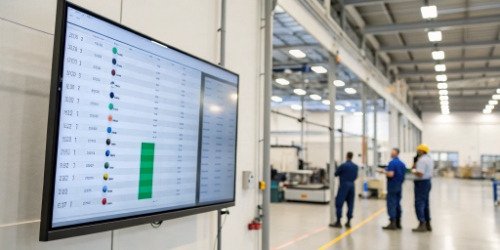
Dive Deeper: Turning Competition into Collaboration
Once you have accurate data for each workshop, you can use it to motivate your teams. The goal isn't to create toxic rivalries but to inspire everyone to reach the level of your top performers. In my experience, a little friendly competition can be a powerful driver for innovation. As a software provider, integrating our precise weighing hardware allows you to offer your clients the foundation for these powerful management strategies.
Here are some strategies that our most successful clients use:
| Strategy | Description | How It Works |
|---|---|---|
| Internal Benchmarking | Use your most efficient workshop as the gold standard. | The data from your best workshop sets a realistic and achievable target for others. It answers the question, "What is possible?" |
| Targeted Incentive Programs | Tie bonuses or recognition to specific, measurable KPIs. | Reward teams for improvements in areas like yield percentage or reduction in giveaway. This aligns their goals with the company's. |
| Cross-Functional Improvement Teams | Create teams with members from different workshops to solve problems. | When one workshop is struggling, team members from a high-performing workshop can share their methods, fostering collaboration and knowledge transfer. |
These strategies all depend on one thing: trustworthy data. When you can show a manager a dashboard with clear, objective numbers, the conversation shifts from opinions to facts. This is how you drive real, sustainable cost savings.
Conclusion
By implementing workshop-specific cost accounting with the right tools, you transform data into a competitive advantage. This drives efficiency, empowers your teams, and directly boosts your overall profitability.
-
"(PDF) Internet of things (IoT) in cost accounting for manufacturing ...", https://www.researchgate.net/publication/389064805_Internet_of_things_IoT_in_cost_accounting_for_manufacturing_industries. This source explains how IoT-enabled scales can improve cost tracking accuracy in manufacturing. Evidence role: mechanism; source type: research. Supports: IoT-enabled scales improve cost tracking accuracy in manufacturing by removing ambiguity.. Scope note: The source may focus on IoT applications broadly rather than specific implementations in manufacturing. ↩



Comments (0)