

Your slaughterhouse costs are a mess, making profit analysis unreliable. This uncertainty hurts your business decisions. Let's find the clarity you need for accurate cost allocation.
The best method depends on your goals. Quota-based allocation is fairer but more complex, assigning costs based on standard output. Average allocation is simpler but can distort individual product costs. The right choice balances accuracy with operational simplicity for your specific needs.

Choosing between these two methods is not just an accounting task. It directly impacts your bottom line and how you see your own business. To make the best decision for your operation, you need to understand the core differences and what they mean for your financial data. Let’s break it down further so you can pick the right path.
What Are the Advantages of Quota-Based Allocation Over Average Allocation in Expense Distribution?
Using average costing might feel easy, but it treats all your products the same. This can punish your efficient lines and hide the ones that are actually underperforming.
Quota-based allocation gives a more accurate view of true product costs. It fairly assigns expenses based on production volume or value. This stops low-volume, high-margin products from being unfairly burdened by overhead from high-volume products, giving you a truer profit picture.

Over my 19 years in this industry, I've seen firsthand how the wrong accounting can lead to bad decisions. An average allocation method might seem straightforward, but it often fails to capture the true cost of producing different items. This is where a quota-based system shows its real strength. It helps you see your business with much greater clarity.
Cost Accuracy
The primary advantage of quota allocation is fairness and accuracy. High-volume products usually consume more indirect resources. Think about the administrative oversight, sales efforts, and management time. An average allocation method spreads these costs evenly across all products, regardless of the actual resources they consume.
A quota system, however, links these costs to a specific driver, like standard output volume or value.
| Feature | Average Allocation | Quota-Based Allocation |
|---|---|---|
| Method | Spreads total overhead evenly | Assigns overhead based on a driver (e.g., units, value) |
| Accuracy | Low | High |
| Fairness | Can be unfair to low-volume products | Fairly reflects resource usage |
| Best For | Simple, uniform production | Diverse, multi-product operations |
Business Decision-Making
Accurate costs lead to better business decisions. I remember visiting a client's poultry plant years ago. Their simple average costing model made their high-value, organic chicken line look unprofitable on paper. It was carrying a large share of the overhead cost generated by the massive volume of their standard chicken production. After we helped them switch to a quota-based model using our WeigherPS system, the numbers told a new story. They discovered the organic line was actually their most profitable product per unit. This insight completely changed their marketing and production strategy.
Which Expense Allocation Method Is Better for Slaughterhouses: Quota Distribution or Equal Sharing?
You want the "best" method, but the answer is not always simple. Choosing incorrectly can hide product line inefficiencies or create a false sense of profitability. Let me help you understand which path is better for you.
The "better" method depends on your slaughterhouse's complexity and goals. For simple operations with very similar products, equal sharing is often enough. For complex facilities with diverse products and profit centers, quota distribution provides far better accuracy and control.

The choice between these two methods is a classic trade-off between simplicity and precision. In my experience, many managers avoid quota allocation because they believe it is too hard to calculate. However, with modern weighing and software systems, much of this complexity is handled automatically. The key is to understand when the extra precision is truly worth it for your business.
When to Use Equal Sharing (Average Allocation)
Simplicity is the biggest benefit of equal sharing. If your slaughterhouse produces a single product or a few very similar products with nearly identical cost structures, this method works well. The calculations are easy, and there is little risk of distorting costs because all products are essentially the same. It's a practical choice for smaller or highly specialized operations where administrative time is limited. You don't need a complex system if your process isn't complex.
When to Use Quota Distribution
Quota distribution becomes essential as your operational complexity grows.1 If you process different animals (e.g., beef, pork, poultry) or have a wide mix of high-value and standard products, quota allocation is superior. It gives you the granular data needed for smart management.
| Scenario | Recommended Method | Why? |
|---|---|---|
| Single product type | Equal Sharing | Simple, and no distortion occurs. |
| Multiple, very similar products | Equal Sharing | Easy to manage, any distortion is minimal. |
| Diverse products (e.g., beef, pork) | Quota Distribution | Accurately reflects different cost structures. |
| High-value & standard products | Quota Distribution | Prevents penalizing profitable niche products. |
Our WeigherPS system was designed with this challenge in mind. It can run both scenarios and present a side-by-side comparison. This removes the manual work and guesswork, allowing you to see which method gives you a more realistic view of your operations.
How Do Quota and Average Allocation Methods Impact Cost Sharing in Slaughterhouse Operations?
The allocation method you choose directly affects your product costs. This is not just an academic exercise. It can dramatically change your view of which products are making you money and which are losing it.
Average allocation can make high-volume, low-margin products appear more profitable while penalizing low-volume, high-margin ones. Quota allocation corrects this by linking costs to a driver like output, providing a truer cost and profitability picture for smarter decisions.
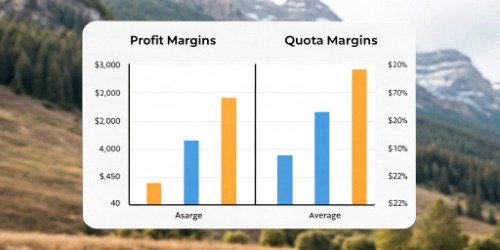
Let's look at a concrete example to see the real-world financial impact. Seeing the numbers is often the best way to understand the difference. It becomes very clear how one method can paint a very different picture from the other, which is why we build comparison tools into our systems.
The Impact on Pricing and Profitability
Imagine a slaughterhouse has $20,000 in monthly overhead costs. It produces two products:
- Product A (Standard Sausage): 9,000 units produced.
- Product B (Artisan Salami): 1,000 units produced.
With average allocation, the overhead per unit is $20,000 / 10,000 total units = $2.00 per unit. Both the sausage and the salami get a $2.00 overhead cost added.
With quota allocation based on production units, the result is the same. But what if the salami requires more sales and management focus? Let's use a standards-based quota. Let's say Product B requires 4 times the effort.
| Method | Product A (Sausage) Overhead | Product B (Salami) Overhead | Key Takeaway |
|---|---|---|---|
| Average Allocation | $2.00 per unit | $2.00 per unit | Simple, but possibly inaccurate. |
| Quota Allocation | $1.38 per unit | $7.69 per unit | Reflects higher effort for Product B. |
(Calculation for Quota: We assign a "weight." Product A = 1, Product B = 4. Total weighted units = (90001)+(10004) = 13,000. Product A gets (9000/13000) of cost, Product B gets (4000/13000)).
Under the quota system, you realize the salami costs much more to support. This affects your pricing, sales strategy, and decisions about which product lines to expand.2
The Role of Technology in Analysis
Trying to run these numbers manually across hundreds of products is a nightmare. Our goal at Weigherps is to make sophisticated analysis accessible to all our clients. We offer solutions because we strive to be your most reliable, trustworthy, and professional weighing expert. Our system lets you define the allocation rules and then automatically calculates and compares the outcomes. This empowers you to see the real impact of your choices without the headache and complex spreadsheets. It's about turning complex data into a clear path forward.
Conclusion
Choosing the right cost allocation method is key to understanding profitability. Our systems support both, giving you the flexibility and data to make the smartest business decisions for growth.
-
"G Individual Fishing Quota Case Studies", https://www.nap.edu/read/6335/page/306. Quota distribution is recommended for complex operations with diverse products, as it provides more precise cost allocation compared to simpler methods. Evidence role: expert_consensus; source type: education. Supports: Quota distribution is more suitable for complex operations due to its ability to allocate costs more precisely.. Scope note: The effectiveness of quota distribution depends on the proper identification of cost drivers. ↩
-
"Cost Allocation Methodology Best Practices", https://controller.ucsf.edu/reference/sponsored-research-post-award-administration/cost-allocation-methodology-best-practices. Cost allocation methods influence pricing, sales strategies, and product line decisions by providing insights into true costs and profitability. Evidence role: mechanism; source type: research. Supports: Cost allocation methods influence pricing, sales strategies, and product line decisions by clarifying true costs and profitability.. Scope note: The influence depends on the accuracy of the cost allocation method used. ↩



Comments (0)